It’s All About the Food and Tradition

One of our sons is visiting this week with his wife, and a friend from his school days has driven up the coast to join us for a few days.

If there were a theme to this week it would be “Food and Tradition” because when mothers entertain sons, isn’t that a major factor?

The mother begins with the questions a couple weeks out from the visit.

“What would you like me to cook?” she asks.

“Oh, you know, my favorites,” he responds.

The school days friend has no idea what he’s getting into. First the grocery list, the mountains of fruit and vegetables—all in season—because your body responds most efficiently to seasonal produce. Cherries as big as plums. Peaches that hold to a thumbprint test of ripeness. Then the seafood. Weathervane scallops from Alaska. We’ll have them seared in cast iron with a drizzle of olive oil and a smidge of butter. Toss them into the nearly smoking hot pan just as soon as the two fats meld.

We have them stuffed and baked. Double-size portions and they wish there were more.

An entire king salmon, stored according to the fishmonger’s instructions. We won’t insult the wildest fish in the sea by freezing even a single ounce of it.

“Put it in a box in the refrigerator on ice,” he said.

“Top or bottom?” “How many days?”

Marinated a half a day, then we bake and glaze it with pecans according to a recipe shared by my favorite captain—Capt. Brenda Thomas of the schooner Isaac H. Evans, out of Rockland, Maine.

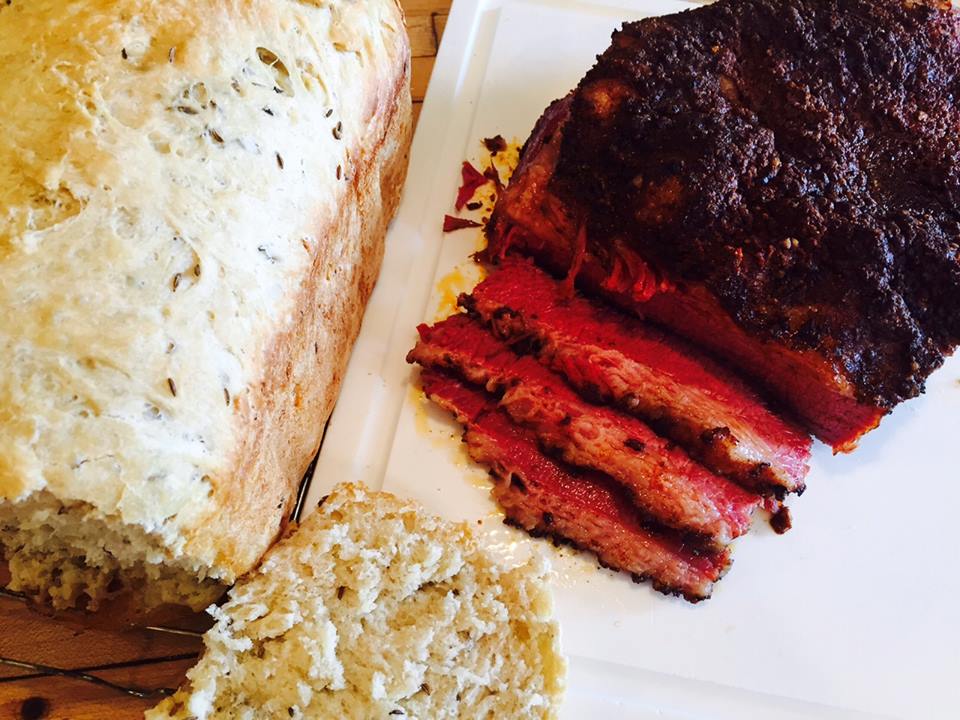
The air in the kitchen doesn’t have a chance to clear. If it isn’t yeasty caraway rye bread, it’s the pastrami ritual. The brisket, trimmed to a lean quarter-inch of fat, has been removed from the brine where it’s been curing, stirred and flipped lovingly four times a day, and now, after rubbing with smoked paprika, fresh ground pepper, and ground coriander, it’s ready to bake, sealed on a rack over a water bath. Do you know how long it takes to grind two tablespoons of Tellicherry pepper with only the peppermill from the kitchen table? It’s worth it.

With the vat of brine removed from the refrigerator, there’s room for the boxes of organic strawberries and a couple more bottles of wine. Layer the strawberries between paper towels in a sealed box and they’ll hold for ten days—instead of one. But we don’t need ten days. Strawberry rhubarb pies are on the menu.

Going kayaking today? Here’s lunch for the dry box. Muenster cheese en croute. Shredded and baked with minced parsley, lots of garlic, and sealed in pastry covered with toasty sesame seeds. Remember to pack the local craft brew, an IPA.

A hike down Shinglemill Creek? Pastrami sandwiches and trekking poles.

On the return, crispy fried oysters with homemade coleslaw, the cherished recipe from the cafeteria lady where I taught in 1973.

“Do you always eat this way?” asks the school days friend.

“When family visits, yes, absolutely yes.

food and tradition


Food and Tradition.

It’s part of every memoir. Follow me on Facebook.

food and tradition

Your Truth Can Inspire Others

Your truth can inspire!

Linda Joy Myers, Author and Founder of the National Assn of Memoir Writers,

shared a post today about vulnerability and truth in memoir. I don’t want to quote her suggestions in their entirety but you can read the entire post here.

There was one point that stood out for me.

When you’re dealing with the truth that you’re exposing, she suggests (her point #4) that you should

make a list of the ways you feel your story will help others—think of ten messages you will deliver in your book.”

I think this suggestion is one of the strongest reasons to press onward with your truth.
It’s more than a rationalization.
When the truth in your memoir presents strong examples of surviving the events that you detail, others who are experiencing the same will find strength and good in your conclusions.

Furthermore, if your memoir style is strong, you’re avoiding the “woe is me” syndrome.  Your memoir will stand out for other reasons and your words will be taken seriously.

Keep at it!

your truth


your truth

Do a writer a favor. Like my Facebook page. 🙂


Writer Conference Recharge

When the going gets tough, it’s tempting to close and laptop and back away. Writing is a struggle for all of us, and yet, if we back away, we’re just pushing The End further down the line.

This morning I awakened at 4:45 in a terrifying nightmare sweat. It was the first time my memoir crossed the line, jumped from my manuscript to my dreams. I was glad to see the light of dawn fade the darkness.

I’m that close to The End.


It’s been a long slog that I wish I had shared somewhere, somehow. Living these past twenty months in a new location, I haven’t yet joined a regular writer community and it shows in my insecurities.

Reading aloud, especially, is a great way to pinpoint the strengths and weaknesses of your work. Reading aloud to yourself is OK, but not as effective as reading to an audience.

I (very recently) asked if I could read a couple chapters of my work to two very new friends for feedback—one male, one female, two diverse individuals—two different chapters, two different occasions. It reminded me that there’s no substitute for the value of community for honest feedback and support.

It also reminded me that I should look for the someone who needs my support. We all need help finding our way through the darkness.


I’m participating in two writer conferences in the coming months. These are an opportunity to learn and share that I look forward to every year.

I know many writers wonder how much they’ll get out of a conference for the time and money spent. If you’re wondering that, know that it’ll be worth it. I’ve never yet left a writer event that didn’t lift my spirits and send me home inspired and recharged.


writer conferenceSome West Coast events coming up:

The Pacific Northwest Writers Conference is coming up July 28-31, 2016 in Seattle. Note that if you can’t attend the conference, you can still take Masters Classes.  www.pnwa.org/

The Magic of Memoir conference is October 15 and 16, 2016 in Oakland CA.  A specialized event for memoir writers. I’m attending it for the first time and it looks promising.  http://magicofmemoir.com/

The Northwest Writers Weekend takes place Nov. 4-6, 2016 at an old-fashioned camp in the woods about a half-hour’s drive from the Southworth Ferry WA (take from Fauntleroy/Seattle). This weekend is unique in that it includes workshops on songwriting. Bring your instruments! Great sense of community here. http://www.nwwritersweekend.org/

writer conferenceFollow me on Facebook.

The Creative Process

I love mornings. I wake up early and press the start button on the coffee, then slide back into bed to see who has visited me overnight and I respond right then because I’m all about “in the moment”. I go to pour some coffee, slide back into bed yet again and open Scrivener.

It opens to the chapter that I was working on the night before, and if I’m lucky—like this morning—I re-read it and think: Heck. This isn’t bad. In fact, it’s damned good.

The chapter that plagued me as I sat on the deck at dusk with a quilt and a laptop—and a cat—Don’t forget the cat—is actually good.

How did I not see that last night? When I closed my laptop and picked up a book from my stack and flicked on my headlamp, I had sighed with disgust.

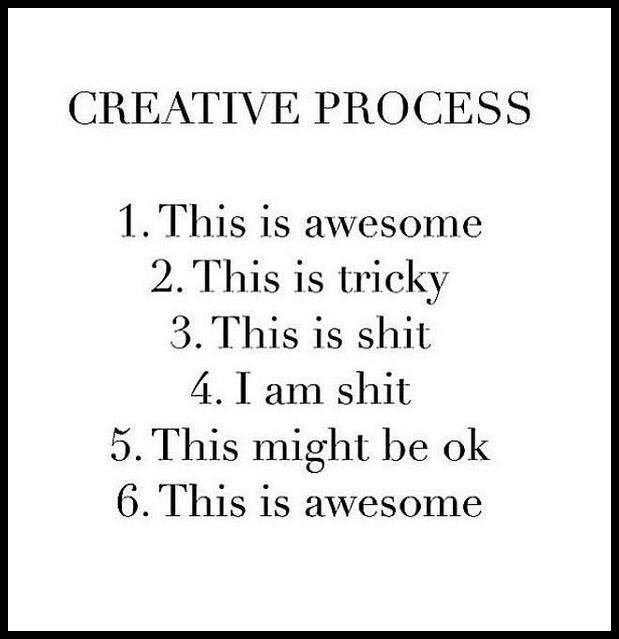
It’s the writer’s dilemma. The cycle of the creative process.

You like it. You hate it. You hate yourself. You say the heck with this (or worse). Then it’s OK. It’s good. No, it’s great.

“Cracker Pie” was last night’s chapter.  I went back to the farm to talk to Babci while I wrote it. Heard the rooster crowing when I rolled out from under the covers. I walked around the farmhouse in my mind. I smelled the smells in the kitchen. Smelled the sweat that wet her underarms as she dumped an armload of split oak into the woodbox. Felt the heat from the Glenwood warming my backside.

Here’s a sample.

“Meanwhile, after tending to her flocks and garden in the morning, Babci usually moved indoors for a little rest. She could count on me to pop into her kitchen unannounced about once a day—especially if I smelled cinnamon floating up the back stairs.

If I didn’t find her in the kitchen, she was probably feeding logs into the yawning mouth of her behemoth furnace in the dirt-floored cellar below.

I waited patiently in a pressed back chair at the kitchen table under the watchful eye of Jesus and the Apostles. (All good Catholics had a print of daVinci’s The Last Supper in their kitchen or dining room.)

Eventually Babci returned and eased her bottom into the chair beside me with a sigh.  She wiped a folded pad of handkerchief across her sweaty forehead.

The table was a massive, round, and oak with claw feet clutching the linoleum. Every Easter our entire family of aunts and uncles gathered around it for ham and kielbasa. Like most kids, we cousins sat off to the side at card tables, the boys in white shirts and the girls in pastel nylon party dresses. Me in a pastel party dress? Yeah. I’ve seen Uncle Joe’s slide collection. Proof positive that Mummy got me into one on special occasions.

Babci always had something good cooking or baking in her kitchen. The Polish standards, I wasn’t so fond of. I wasn’t into fleshy pierogis or pale goat cheese, but I sure did like the baking.

When I was lucky enough to be offered a slice of her homemade apple pie on a Blue Willow plate alongside a cup of Salada tea, or maybe a slice of raisin-studded babka, between bites I stared up at the men behind the table, wondering which one was Judas, that double-crossing jerk.

Judas would be all I knew about kisses for a very long time.”

Later today, I’m probably going to think this is crap. And now my coffee’s gone cold. Damn.

the creative processFollow me on Facebook.

Read more about morning, feelings, connection. And pie.

the creative process


The Setting in Your Manuscript

When I was in fifth grade I read a book with a vivid salt-sprayed setting on the coast of Maine, a mysterious place a few hours drive from where we lived in inland Massachusetts.

The author’s words described it in great detail and I entered her world vicariously.

The marsh grass swept the tips of my fingers as I crossed from the field to the edge of the beach. I could smell the dampness of the spray. The grains of sand were warm on the bottom of my feet as I walked the shore, and I shivered when the icy water reached my toes.

In this story, the child protagonist lived in an idyllic summer setting near the sea. The house had weather-beaten shingles, the windows were always open and the sheer white curtains fluttered in the ocean breezes.

When the child looked down from her bedroom window, she saw her mother weeding a flower bed of zinnias and petunias.

You’re wondering how I would remember such a simple scene in a book so long ago.

Here’s the thing. I had never seen the ocean. I wanted to see that ocean. I wanted to walk on that beach, and I definitely wanted to grow a flower garden.

For most readers, “zinnias and petunias” would be enough. I, however, had no idea what those flowers looked like.

I sorely wanted to see these flowers in my mind’s eye, so I asked my mother.

“Mummy, what are ‘zinnias’? What are ‘petunias’?”

My mother said, “I don’t know.”

My mother always said “I don’t know.” It was always too much trouble for her to devote a minute to explaining something to me.

You might find this sad or disconcerting. Don’t.

Yes, the coldness, that was inherent in that negativity, did hurt me. It caused me to turn within myself. Why wasn’t I worth an answer? Why couldn’t I get a response to that which puzzled or bothered me? Why was I always left hanging in uncertainty?

On the up side of this was the fact that her attitude fostered creativity and resourcefulness in me. I had to find my own answers. I had to find my own way to do things. I had to keep plugging away.

Look what just happened. You just witnessed a flashback.

A description of Setting sidetracked into a scene from my memoir—the reason being that I’m deep in the editing process right now and I never know what is going to trigger a momentary shift in time.

I began this post with the intention of describing the importance of detailed settings, and lapsed into recalling a frustrating childhood moment.

Books should totally do that too.

The book set in Maine did a perfect job with the setting for most people, so I doubt that anyone—except me—would object to not having enough description to visualize zinnias and petunias. However, my puzzlement over the zinnias and petunias is the kind of opportunity for description that we writers need to identify in our pages.

The zinnias had layers of tiny petals, that began at the center of each bloom and expanded outward like the explosion of a fireworks display.

The petunias, trumpet shaped, and ruffled like the collar of my favorite blouse, were white with throats of purple and lavender.

Look for your petunias and zinnias. Paint them vividly with words and feelings.

publishing newsFollow me on Facebook.

setting

The Playlist of My Memoir

My memoir has a musical current running through it that begins with the energetic rhythms of the Charleston and ends with a sentimental Van Morrison tune.

Blog posts on this page frequently have their beginnings in my musical memories, and many of them are gathered during my aerobic dance class.

I’m used to writing with a playlist at home. Often I’m optimistic for the future, sometimes moody for the present—and contemplative of the past. I get up periodically to move across the floor, yoga dance style, so it’s only natural that I should find myself developing writing themes during grapevines and curls.

memoir

Today was one of those days. Our newest routine involved a combination of  The Charleston and The Jitterbug—the dance steps of my grandmother Mémère and my mother.

I had never actually tried either of these moves but as soon as my feet fell into the snazzy jazzy steps of the Charleston with my arms swinging back and forth, I was drawn back in time to a few days before Memorial Day in 1929. It was Thursday, May 23, five months before the Stock Market crash. Could life have been any more optimistic? The two who would become my grandparents were whooping it up in the rumble seat of their best friends’ Buick after a night out on the town.

Mémère personified the quintessential Roaring Twenties gal with her auburn boop-boop-bee-doo curls cut in a stylish bob. Her fashion was glitzy and glamorous, her Prohibition beverage of choice was brandy and she loved to dance and sing at every opportunity.

Mémère was also six months pregnant with my mother that night.

Her water broke with the impact of a pothole off Main. Her shrieks cut the cool night air as the warm amniotic fluid seeped onto the seat and soaked the hem of her dress.

“Gerrrrald! The baby! The baby’s coming!!”
My grandmother always tended to shriek when she was excited.

That night, the amniotic fluid and the brandy combined in a potent mix.

Mémère and Pépère hastened back to the triple-decker in the Buick. Pépère helped her down onto the running board and then carefully up the three flights of stairs to their walk-up apartment. He could hear my grandmother moaning on the bed as he shut the door and flew down the stairs to fetch the doctor two streets away.

Pépère and the doctor arrived barely in time to deliver my mother. The young doctor shook his head nervously. Mummy weighed a mere two pounds.

There weren’t a lot of options back then for a premature home birth. He washed and dried his instruments at the kitchen sink, placed them in the black leather bag and snapped it shut. As he unrolled his shirt sleeves and buttoned his cuffs, the doctor gave careful thought to the situation.

He returned to the bedroom, where Mummy lay at Mémère’s breast and Pépère sat nervously on a straight back chair. He asked Pépère to find a shoebox.

Dr. Favreau proceeded to swaddle Mummy with a diaper folded over multiple times, and then he nestled her in the shoebox like a robin chick found beneath an apple tree in April. His instructions were simple. “Keep her in the oven with the door open.”

It was a gas oven.

The doctor tapped his bowler onto his head while Pépère accompanied him to the door. “Best of luck to you,” said the doctor as they shook hands. He retraced his steps down the stairs to the street level, slower this time. The milkman looked up from the bottles he was setting in the delivery box on the porch.

Mummy thrived in the warmth of the gas oven on Moon Street. She’s never been sick a day in her life, with the exception of that gallstone operation back in ’74. She’ll be 87 when the lilacs bloom.

The story that blossomed on the notes of the Charleston had been in development for a while, but it took experiencing the dance itself, eighty-seven years after the event, to bring it to life.

I continued to stretch and move and dance, finally coming back to reality with Stevie Nicks’ Stop Draggin’ My Heart Around.

And Tom Petty…”I’m learning to fly, but I ain’t got wings
Coming down is the hardest thing

Well, the good ol’ days may not return
And the rocks might melt and the sea may burn.”

By the time we were positioned on our mats in plank, Van Morrison was echoing off the rafters.

Hamstring stretch, seated twist.

I pulled back to child’s pose for a few minutes, then rolled onto my side with my eyes shut.

I made believe the drops sliding down my cheek were sweat.


memoirFollow me on Facebook.

Sign up at left to receive these Blog posts via email.


The Metaphor of Me

Today I listened to an interview in which it was suggested that we look inward for the metaphor of who we are and what we do in the worldwhat’s going on in our life.

My metaphor popped up instantly.

metaphor of meI am a conch shell.

A conch shell may be empty

but it once was a full, living, breathing creature.

It has been deep in the sea and

it has drifted in the shallows.

Its inner surface has become smooth and shiny and beautiful

from its body reaching out

over and over again

in order to move through the sea.

It has churned in the surf,

Become faded,

Scratched and cracked,

but it still has value, and now, a new role.

Although its core has been removed

(the food, the conch)

it has begun a new life.

Even when it’s damaged,

with its tip broken off,

it can be sounded like a horn.

Now it’s the voice of a musical instrument,

or a reminder to look up and listen for the message.

As an empty shell,

it can be held to someone’s ear

where the sound gets reflected back.

It still has something to contribute.

The shell will never be completely empty

as long as it can reflect back

someone else’s beauty,

or

a reminder

of where it once was,

and what it took to get here.


What’s your metaphor?


Show, Don’t Tell

“Show, Don’t Tell” is the closest thing I know to a writer’s mantra.

For every sentence that I write, I’m constantly berating myself—Did I “show”? Or did I “tell”?

Did I remain “in scene”?

Remaining “in scene” is my nemesis write now.

Yes, write now. You read that write. Writing is all I care about, but righting is what’s driving me bonkers.

It seems that the more I struggle with the editing of my memoir—the more advice I get from various sources—the more confused I get. I should insert “LOL” here, but it’s clearly not amusing.
The one thing that I’ve noticed in this week’s reading (not writing—this week’s reading) is that everywhere I look, writers are all stating that there is a really rough patch where you want to throw out the whole thing and go back to bagging groceries at the A&P or whatever you’re destined to do. And no offense to bagging groceries at the A&P. I don’t know what job I could tuck in here without offending someone.

That’s where I’m at right now.

I think I’ve got the “Show, Don’t Tell” part, but remaining “in scene” is driving me berserk. It’s depressing. I keep telling myself that this is just part of the process.

I have a half dozen books scattered around me. I keep opening them for style comparisons. Like lots of dialogue in the showing vs. just a little dialogue in the showing.

I’m weeding out anything that’s the voice of the present day survivor commenting on the events of the child. At least, that’s what I’ve been told to do, and it seems to make sense. Stay in scene!

I’ve been looking through The Glass Castle (Jeannette Walls) to see if she comments on her childhood from the adult point of view as she’s Showing, Not Telling. The Glass Castle, of course, because it’s a whacko childhood memoir. wink wink.

I downloaded a volume of Alice Munro’s stories onto my Nook yesterday and read her introduction as I waited in the ferry line. The introduction has Excellent Writer Advice. Munro describes how her stories are born—from bits and pieces of events in real life combined with her imagination. Writer advice and how she does it.

Everyone’s technique is different, of course…and combined with your voice, your writer style should make your story unique.

I just found Mary Karr’s The Art of Memoir lost in the bed covers between my quilt and sheets. I’ve been falling asleep with these writers every night.

The Liar’s Club (Mary Karr) is on the floor next to my bed. Another wacko childhood memoir. Her momma and daddy could give Jeannette Walls’ momma and daddy a run for their money in the OMG category.

In The Liar’s Club, Karr frequently makes present day statements, then expounds upon them. Isn’t that going “out of scene”? Apparently, not.

I need another cup of coffee.

show, don't tell

show, don't tell Follow me on Facebook.

Go ahead and Like my page while you’re at it.

The Scent of Writing

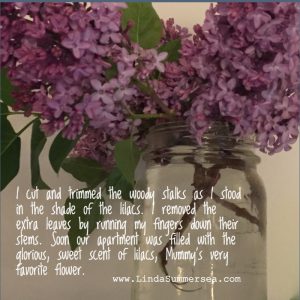
The scent of writing is all around me this morning in the form of a bouquet of lilacs. Yesterday, I placed the Mason jar bouquet on the shelf next to my bed, where I begin my morning reading and writing with my first cups of coffee.

The scent of lilacs. How that returns me to my childhood! All those times that I cut the stems for our apartment. All those times that I wished I could carry a bouquet of lilacs to school for my teachers—but was too painfully shy, year after year—to carry out my fantasy of standing before my teacher with the sweet blooms.

A smell from the past is often what one needs to jump start a memory.

The science behind this is that the olfactory bulb accesses the amygdala, which processes emotion, and the hippocampus, which is responsible for associative learning.

When we first smell a new scent, we link it to an event, a person, a thing or a moment in time. Our brain creates a link between the smell and a memory so that when we encounter the smell again, the link is already there, ready to elicit a memory or a mood—positive or negative.

I don’t know if it’s my imagination or not, but it seems that since I placed that bouquet on the shelf yesterday, I’ve been better able to fine-tune the outdoor chapters of Spring in my memoir. More details have come into focus.

Tomorrow, cinnamon.

scent of writing


Follow me on Facebook.

scent of writing

Humor in Memoir

On March 8th, I posted on Facebook that I was going to add Humor to my memoir. Humor. What was I thinking?

Those who know the story of my challenging childhood were probably taken aback because only one person “liked” it (That was you, Nancy Harris.) and no one commented.

With Facebook “likes” being the modern measure of approval, I’ll admit that my insecure self began to unravel a bit on the edges, wondering if I had made the right decision.

My essay writing in high school had always tended to be self-deprecating.

I remember that even as my peers sat sullenly watching the clock as it ticked towards lunch, my teacher usually shuddered with laughter as she read my work aloud. Mrs. Davis’ reading glasses shook down the length of her nose until she stopped and readjusted them several times. Fortunately, she had those chain thingies tied to the ends of the frames.

It was that memory of humor successfully covering my sadness that led me to decide. I can laugh about this.

I began a halfhearted attempt at yet another revision, this time injecting it with what I hoped might be laughable. I looked for the humor behind the angry glances, harsh words and tough times. Mummy’s meanness, Daddy’s sullenness. The 720 high school days when I ate my lunch alone. (Yes: 180 x 4)

Et cetera. 

I wasn’t sharing the results with anyone. I tried to judge for myself. Not always easy. Would this fly? Maybe.

This weekend, a month after my decision, I had a turning point. (Right. Yet another turning point. This is getting old.)

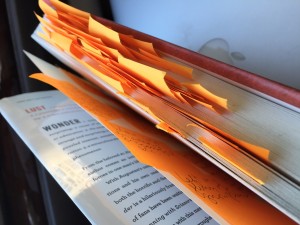
I spent a couple of weeks holed up with my manuscript in a timeshare in the Berkshires, and after seeing Augusten Burroughs’ Lust & Wonder quoted in GoodReads, I knew I had to run out and buy it immediately. I tucked it in my tote bag for the flights home.

Augusten Burroughs is the man who was Running With Scissors in Amherst while I was running away to UMASS. We were living within the same coordinates during the 70s— and I didn’t even know it until this past weekend! (Neither did he—but it’s probably not that big a deal to him.)

I opened to page one as soon as my first flight left the tarmac. Soon I was laughing out loud and hoping I wasn’t disturbing anyone.

Burroughs’ story is not a funny one. It’s about love, misunderstandings, disease, and broken hearts (multiple times), but Burroughs manages to inject hilarity into his memoir while still telling his true, sad story. It’s beautiful.

One of the craziest, most relevant, points he made— that really hit home with me—is that when your childhood is as insane as ours, of course you always think your life is going to go to hell when something good happens!

You can’t believe that life could really be that good without falling apart, and more than likely, in the very near future.

I always thought that I had simply inherited the Worst Case Scenario gene.

But no, that wasn’t it at all.  I had been programmed from a very young age to fear all good things falling apart and I managed to not notice this until now.

Wham.

Suddenly I was back in Mrs. Davis’ class. Tragedy can be funny. Very funny, in fact.

I had decided to tag pages that clicked with me, never imagining that when I was finished, the book would be thick with sticky notes and scribbles.

After crossing four time zones, I was landing at Sea-Tac just as I completed his Acknowledgements. (Seriously, I read it from one tarmac to another. East coast to West.)

The next morning, I had a Memoir class in Issaquah. Memoirist Bill Kenower, teaching. Jet-lag be damned, I made it onto an early morning ferry.

Each of us brought a few pages of work to share for critique. Bill read each student’s piece aloud as we followed along and later responded to his queries.

I have to say, my fellow students are damned good writers. (There are four of them.)

For my writing sample, I selected a chapter from my memoir that fit the criteria of “three pages long”. It didn’t matter about the humor part. They didn’t know my revised goals.

When Bill began to read my piece, I was surprised to hear—within two sentences of the beginning—chuckles. Then a few sentence along, more chuckles. They laughed periodically throughout the whole darn piece!

I shared that I honestly did not realize that this chapter was funny at all, but then Bill pointed out specifics of hilarity and understatement.

I got it. I get it.

It was funny. It is funny. What a funny day!

Now, if only someone can cure my phobia of looking in mirrors.

Humor in Memoir

humor in memoir

editing memoir


Follow me on Facebook.