The Creative Process

I love mornings. I wake up early and press the start button on the coffee, then slide back into bed to see who has visited me overnight and I respond right then because I’m all about “in the moment”. I go to pour some coffee, slide back into bed yet again and open Scrivener.

It opens to the chapter that I was working on the night before, and if I’m lucky—like this morning—I re-read it and think: Heck. This isn’t bad. In fact, it’s damned good.

The chapter that plagued me as I sat on the deck at dusk with a quilt and a laptop—and a cat—Don’t forget the cat—is actually good.

How did I not see that last night? When I closed my laptop and picked up a book from my stack and flicked on my headlamp, I had sighed with disgust.

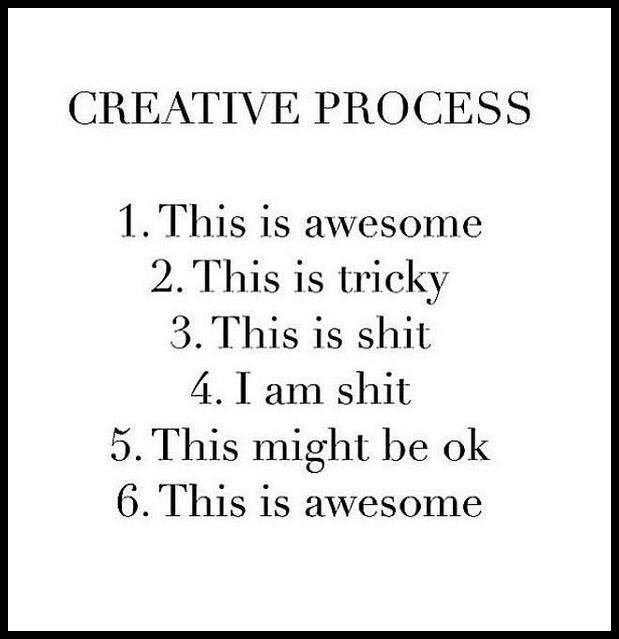
It’s the writer’s dilemma. The cycle of the creative process.

You like it. You hate it. You hate yourself. You say the heck with this (or worse). Then it’s OK. It’s good. No, it’s great.

“Cracker Pie” was last night’s chapter.  I went back to the farm to talk to Babci while I wrote it. Heard the rooster crowing when I rolled out from under the covers. I walked around the farmhouse in my mind. I smelled the smells in the kitchen. Smelled the sweat that wet her underarms as she dumped an armload of split oak into the woodbox. Felt the heat from the Glenwood warming my backside.

Here’s a sample.

“Meanwhile, after tending to her flocks and garden in the morning, Babci usually moved indoors for a little rest. She could count on me to pop into her kitchen unannounced about once a day—especially if I smelled cinnamon floating up the back stairs.

If I didn’t find her in the kitchen, she was probably feeding logs into the yawning mouth of her behemoth furnace in the dirt-floored cellar below.

I waited patiently in a pressed back chair at the kitchen table under the watchful eye of Jesus and the Apostles. (All good Catholics had a print of daVinci’s The Last Supper in their kitchen or dining room.)

Eventually Babci returned and eased her bottom into the chair beside me with a sigh.  She wiped a folded pad of handkerchief across her sweaty forehead.

The table was a massive, round, and oak with claw feet clutching the linoleum. Every Easter our entire family of aunts and uncles gathered around it for ham and kielbasa. Like most kids, we cousins sat off to the side at card tables, the boys in white shirts and the girls in pastel nylon party dresses. Me in a pastel party dress? Yeah. I’ve seen Uncle Joe’s slide collection. Proof positive that Mummy got me into one on special occasions.

Babci always had something good cooking or baking in her kitchen. The Polish standards, I wasn’t so fond of. I wasn’t into fleshy pierogis or pale goat cheese, but I sure did like the baking.

When I was lucky enough to be offered a slice of her homemade apple pie on a Blue Willow plate alongside a cup of Salada tea, or maybe a slice of raisin-studded babka, between bites I stared up at the men behind the table, wondering which one was Judas, that double-crossing jerk.

Judas would be all I knew about kisses for a very long time.”

Later today, I’m probably going to think this is crap. And now my coffee’s gone cold. Damn.

the creative processFollow me on Facebook.

Read more about morning, feelings, connection. And pie.
the creative process


The Writer’s Voice

While I was being chased by pugilistic geese and frightened by hoof-pounding Percherons back on our farm in 1955, I was almost totally unaware of the world that existed at the end of the road beyond our mailbox.

Sure, there were those Sunday afternoon drives to my grandmother’s cottage for our weekly shampoo in the lake after the well went dry—because the well always went dry around the 4th, necessitating an alternative to our sacred Saturday after supper bathtub ritual.

Along the way, I saw the signs (literally) that began to awaken the sense of inquiry that would forever motivate my life. “Clean Fill Wanted”. “Happy Hour”.

Likewise, those Friday mornings locked in the back seat of our Plymouth while my mother did her grocery shopping. “Weekend Special. Coca-Cola.” I wondered what Coca-Cola tasted like.

Sitting in the middle of my siblings’ fist jabs, I watched the other mothers entering and leaving with their kids until, at last, my mother returned. Pulling a box of Cheerios from the bag at my feet, I read “…or a reasonable facsimile”.

When I asked about the meaning of these, my mother said “I don’t know”.

She always said “I don’t know”, so before long I stopped asking, and it wasn’t until a few years later that I met the person who would answer my questions.

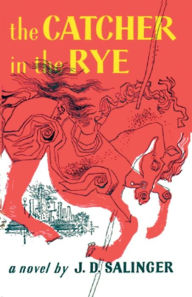
His name was Holden Caulfield.

He blew my freakin’ mind. Finally a voice I could identify with—although how a boy in California talking about a Pennsylvania prep school existence could have spoken so vividly to me, the barefoot kid in the hayloft, I’ll never know.

He had me on page one at the first mention of “cold as a witch’s teat”. Shocked my little Catholic body to its toes. I had certainly never met anyone like Holden. Until then, I had had to be my own bad influence.

He was no Nancy Drew in a roadster.

“Mummy, what’s a ‘roadster’?” I asked, holding my place in The Secret of the Old Clock with my finger and thumb.

“I don’t know,” said Mummy.

Holden’s voice was clear—shocking, irreverent—yet comforting at the same time. He shared his innermost thoughts with me and I suddenly realized that I was no longer alone.

Today I know that it was the voice of Holden Caulfield that made the difference. A writer’s voice is his most powerful tool.

J. D. Salinger’s Holden Caulfield came into my room that day and threw his stupid deerstalker cap down on my bed. He looked me in the eye, and said “Goddammit, there’s more to life than being curled up in the fetal position every day after school. Get up and get out there!”

His voice spoke with such clarity that there was no doubt he was a real, walking, talking, true to life being.

Holden Caulfield saved my freakin’ life.

He really did.

“. . . I’m standing on the edge of some crazy cliff. What I have to do, I have to catch everybody if they start to go over the cliff—I mean if they’re running and they don’t look where they’re going I have to come out from somewhere and catch them. That’s all I’d do all day. I’d just be the catcher in the rye and all.”

I was so close to the edge of that damn cliff, I wanted to run right into his arms and never open my eyes again.

That’s what a writer’s voice is all about. If I can speak to someone—anyone—with a voice as clear as Holden Caulfield’s, I’ll finally be there, catching those who are running in the rye.

That’s all I’ve ever wanted to do, and if I ever finish editing this damn memoir, I’m going to drive right down to the Vashon Bookshop and buy a copy of The Catcher in the Rye to re-read in the glow of completion.

the writer's voiceliteracy Follow me on Facebook. Like me.

Hear the writer’s voice.