I Said I Wouldn’t Spam You

I meant it. But this year’s posts have few and far between.

Priorities I’ve stuck to? Querying agents for my coming-of-age memoir. Taking writing classes via Zoom. Attending monthly writing group meetings. Exploring other writing formats—namely, Flash Non-Fiction. Oh yeah, and writing in my journal at least every other day.

The hard work?

Relocating from rental house to 2-generation house with my oldest son and his wife.

My health work?

Walking daily when possible. Live music. Traveling to a far off place to stimulate the culture needs of my spirit.

Haven’t visited my siblings and their children since pre-Covid. Catching up with them this season, followed by a self-proclaimed, post-Thanksgiving writing retreat. Extended stay AirBnB reservation.

It’s somewhat early but Happy Thanksgiving to you. I sincerely hope you share the holiday weekend with family and friends in the most meaningful manner. And safe travels, too. Be careful out there.

The Peace Train

Yesterday, in honor of International Peace Day, Yosef/Cat Stevens and Playing for Change, assembled a cast of musicians and singers from around the world.

If you haven’t watched it yet, prepare to be moved with Love and Hope.

  International Peace Day – Peace Train 2021

Well, here we are…

…having crossed into the second month of 2021.

What do you think? Are we better off? Do we see positivity on the horizon? Are we feeling better? Healthier? Mentally more stable? Are you at work on any resolutions?

I’m just glad that I’m not toggling between CNN Live and MSNBC 24/7. Although I did appreciate and enjoy the content between 9 PM and midnight—that I had little previous exposure to.

I got my first COVID-19 vaccine innoculation this week. Whew.

I’ve been listening to more music. Mostly 60s and 70s material. Thinking about those times, and missing live music. Very much. No sense looking for 2021 Bands On Tour.

However, I’ve been taste-testing podcasts. Some that I had forgotten about.

Flowers are blooming here in the rain. Time to think about the garden. I decided to dig a 12″ deep trench, 2′ wide, 8′ long. Maybe tomorrow. I want to drop my compost bins into the ditch so the worms can get in through the slots.

Dieting. Semi-successfully. I’ve taken off my “Covid Nine” but am having a difficult time getting past it. Weighing my food and abstaining from alcohol. Boo.

Can’t resist flipping through details of wild places to visit in 2022.

Oh yeah… Definitely writing more and taking Restorative Yoga classes.

Hiking in the woods, alone with my thoughts. Lost. Not Lost. Beating back depression with a trekking pole.

Baby steps. Thumbs up! 🙂

Swimming in the Dead Sea in Summer

Yesterday was my 70th birthday. Rather a big one, I think, and worthy of a big celebration. I don’t mean a big party or big money spent. I prefer to celebrate a significant transition with some kind of adventure, big or small or in-between.

I had hoped, if all went well, to be swimming in the Dead Sea this month as part of an expedition to Jordan to visit the ruins at Petra. It would be exhilarating to hike for a couple days in and around the ruins, then camp under the stars in the desert near Wadi Rum.

The same company that handled my return to Morocco to walk with Berber Nomads in 2017 and last summer’s 22-day Uncharted Expedition to Kazakhstan, Siberia, and Mongolia offers a “Women’s Expedition” to Jordan.

At first I ignored it because I thought in terms of the specialized women’s activities that one sees here and there. I surely didn’t want a frou-frou trip with shopping, make-up demos, and wine tasting. Definitely NOT my thing!

It turns out that their Woman’s Expedition involves hiking around Petra and Wadi Rum for a couple of days, camping under the stars (Love!) and, as they say in their materials “the best opportunity possible for developing a deeper understanding of Middle Eastern women – with full respect for their traditional cultural values.”

That’s what I want. Meeting Jordanian women in their homes for Middle Eastern cooking lessons, tea, the kohl experience, talking and socializing.

Of course, COVID put an end to all that. I’ve spent my days hiking familiar trails, gardening, harvesting vegetables, berry-picking, baking, installing 300+ feet of drip irrigation, bird watching, and—boring—repairing my dishwasher.

As the individual days of COVID blurred together, I decided to, at least, try one new-to-me adventure: stand-up paddleboarding.

This is what I emailed to my sons:

“It was great fun and a super workout. 100% positive experience. I loved it. I fell off three times. Lost my center of gravity, and the board shot forward out from under me. Then, Bang! Hit the water feet first and WHOOSH, rocket down Deep Deep Deep, followed by Glub Glub Glub, returning to the surface. LOL 
Getting back on the board isn’t too difficult, but I wouldn’t want to be 50 lb heavier.
Quartermaster Air temp was 61 F and water temp 65 F  (10 degrees warmer than Puget Sound). I wore my long-sleeve performance shirt under my sunblock shirt, with quick-dry river pants. Was perfectly comfortable even when wet. Actually quite refreshing.
Basic skills: Knees slightly bent.  Don’t grab the board with your toes or you’ll get cramps. Most important: Keep your core tight to control board wobble.
I knew I’d certainly be falling in. Brought a change of clothes.”

I perhaps should have been writing about my COVID experience these months. That’s what “everyone” says we should be doing—for the sake of documenting these days. But I haven’t.

I’m just trying to keep my head above water. I’ll continue to listen to the trees rustle in the breeze with the occasional scream of a gull in the distance.

Read more

The Prodigal Writer Returns

I know. I know. The date on my previous post is embarrassing. I had a rough spring. Uncertainty and doubt. Then I ran away to Mongolia in June.

Well, not exactly “ran away”.

In June 2018, I received an email from Australia’s Intrepid Travel—an email that had been sent out to those Intrepid travelers who had previous experience with Expedition-style travel. I clicked a link to a video that featured deserts, dust, mountains, and the note: “No fussy eaters!” with a reference to the Mongolian national drink: fermented mare’s milk. Yes, from horses.

The trip would be their first “Uncharted Expedition”. 22 days with no itinerary. Those accepted would agree to meet at 6 PM at a hotel in Astana, Kazakhstan on June 30, 2019. The only other detail revealed was that we should plan our departure from Ulaanbataar, Mongolia after July 22.

At the time, I was healing from two major breast cancer surgeries. Naturally, I signed up immediately. Within minutes.

I got a call the next day and learned that they were taking ten travelers and I was #11. I was assured that, more than likely, at least one person would back out, and someone did. I was in.

Now all I had to do was wait for June 30, 2019. A year forward. And plan my gear.

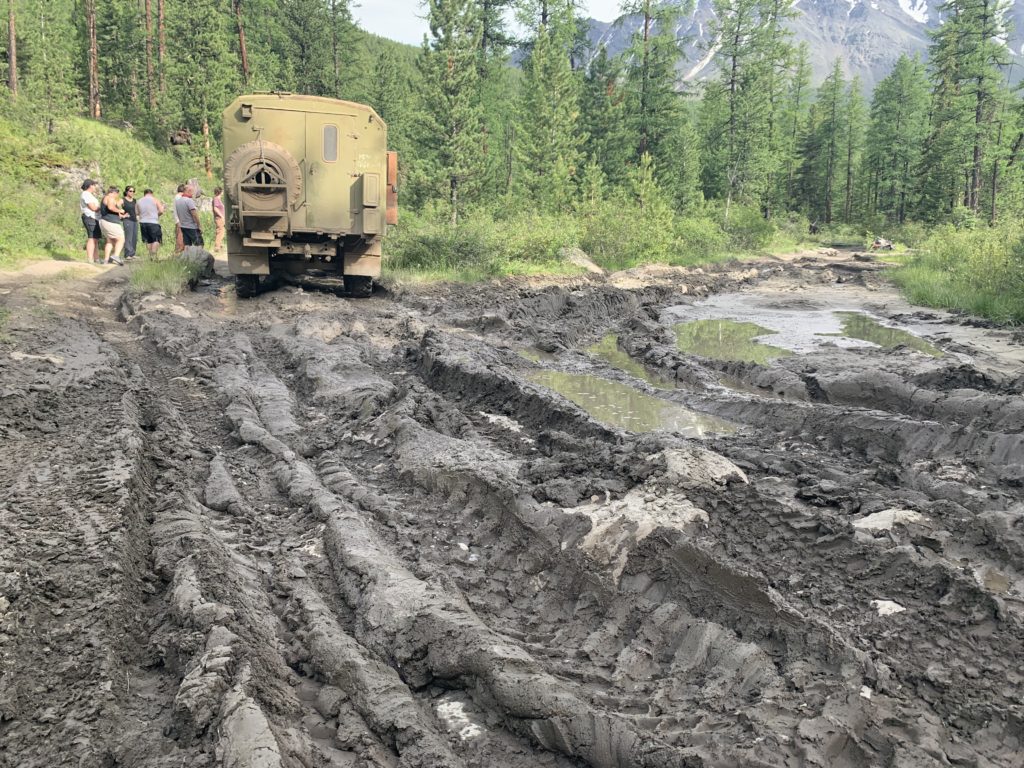
I’m not going to go into much detail here tonight. I kept a journal while on the expedition, but it’s not easy to write when you’re hiking or bouncing along in a Russian army truck making its way up a mountain.

I took hundreds of photos and dozens of video clips. I just this weekend finished a PowerPoint presentation that I’ll be sharing at the Vashon Senior Center (Vashon, WA, USA) on Friday, September 27, 2019 at 1 PM.

Creating the presentation has taken longer than the actual expedition. I’m admittedly some kind of perfectionist.

If you’re in the area, come see my captivating images and hear my stories. I promise you won’t feel like a literally captive audience.

That’s me—The Eagle Huntress—LOL—handling a full-grown female golden eagle. Each of her claws is just about the size of my hand. Yowza!
Altai Tavan Bogd National Park, Mongolia. July 2019

A Comedy of Errors

Back story: I’ve been coming to Belize from time to time for 30 years. In 1989, there was no electric power cable under the sea from the mainland to this island. Electricity was supplied by a humongous generator in town that hummed like a sleeping giant. It shook itself awake periodically, knocking out the power, bringing darkness and an ominous quiet. Eventually the purr of the ceiling fan’s return to slow revolutions followed the hum returning to the background. We slept in a thatched hut at the water’s edge. No window glass. Louvered hardwood window slats.

An elusive boa constrictor resided in the bar at the center of the semi-circle of huts, and my young sons hoped to see him in the rafters as they took turns getting drinking water for the hut.

The streets (Front, Middle, Back Sts.) were still unpaved—silky, hard-packed sand. My 9-year-old son Chris wore a machete in a leather sheath as he climbed the Mayan ruins at Altun Ha. We danced energetic Soca on Friday nights on the patio of the Sun Breeze Hotel.

One Sunday morning, we walked by a man lying in the middle of the street. Flies buzzed around his closed eyes.

“Is that man dead, Daddy?” my 7-year-old asked.

“No, Zack, he’s just sleeping,” my husband said as we walked around the body.

Those were good times. The tiny resort was called Paradise and it was torn down when a concrete resort—The Phoenix—rose up in its place. True.

____________________________________________________________________

January 2019. Day 1. An island off the coast of Belize.

After a successful morning of writing, I took a brief walk around the resort to see what was new. Not many people around for high season.

I decided to walk south under the clouds for two miles on the beach and then inland to The Truck Stop, and a rare place that sells ice cream cones. Sea Salt Caramel. Set out north again, on the road this time, through brief showers that fell between the patches of tropical sun. Being Sunday, it turned out to be very busy with local families ripping by on golf carts overflowing with babies and children, mamas at the wheel. (There are few cars here.) I returned to the beach via the path to El Pescador after stopping at a groceria for orange juice, pita bread, a couple of Belikin Lites—and some frozen bacon to keep the beer cold on the return trip.

Remember Jeff Goldblum traveling with his dehydrated food to Ecuador in Vibes? That’s me, filling up my suitcase to 49 lb (50 lb allowed) with granola, coffee, canned clams, flour, Himalayan pink salt, spices, probiotics, vitamins and more. It’s always worth it. As a woman traveling alone, I prefer to cook in my unit most of the time with fresh seafood and bring what I can from home to supplement. It’s a continuation of the frugality that was so necessary in my childhood.

After unpacking my grocery bag and cracking open a beer, I had a successful session of writing and editing, and granted myself the guilty pleasure of reading a culinary mystery after dinner. Fell asleep around 8 or 9 PM. Re-awakened at 1 or 2 AM, wrote for an hour or two, then tried to get back to sleep with no luck.

I have a lot on my mind. Even meditation methods didn’t work. I kept tearing off my sleep mask to take notes on the thoughts that kept popping up. I know from experience that middle-of-the-night messages will be forgotten if I don’t write them down.

Took an antihistamine and when that also failed to send me to sleep, I decided to catch up with news online. Nevermind Trump. I’m leaving him to Nancy Pelosi. I just wanted to know if Green Book won at Golden Globes. It did! And Mershahala Ali won best Supporting Actor. Yay.

At 5 AM, I put out the “Do Not Disturb” sign and went back to sleep pretty much instantly.

At 9:30 AM, I was awakened from a deep sleep (…and a nightmare: Christopher Walken approaching my home, leading a Pitchfork Brigade, all carrying flaming torches.). There was a persistent banging on my door. I tried to ignore it. No luck. It was the housekeeper saying that my door sign had blown off during the night. Which way had I hung the sign? Did I want “Do Not Disturb” or “Please Make Up Room”?

“Do Not Disturb”, I said.

On my way…

on my way“I’m on my way…” said the Travelocity gnome.

And so am I. After a crazy (read: hectic), stressful (read: brutal), downbeat (read: depressing) series of hours, days, weeks, months, I think I’ve finally come out the other side.

I’m on my way to a wedding in Hamburg, Germany. Traveling solo—but isn’t that what I’m used to?

Dancing shoes packed. Check! Dresses for each of the events. Check! Manicure, pedicure, color and cut. Smile in place. Check!

A German wedding begins with the Polterabendor as the happy couple has announced it:

Kein richtiger Polterabend— “not a proper stag party”.

It’s the breaking of the porcelain. Bring your own plate! Bring good luck to the marriage!

Last night I was remembering a wedding I attended at the age of 12. Cioci, my godmother, had invited me to come along with her family. I guess she always knew there was a storm cloud that followed me from place to place. It hovered over me, casting a dark shadow and spewing drops of rain that fell in the form of tears.

At this wedding—a traditional Polish wedding—there were all the traditional Polish foods—gołabki, pierogis, kielbasa, kapusta! Men wore their Sunday suits with white shirts and tion my wayes. Black pants, always. They peeled off their suit jackets as soon as they entered the reception at the Polish-American hall. It was a hot, steamy day in Connecticut.

The women wore floral dresses with lacy petticoats. (Mini-skirts were a couple years away.) I had a dress just like this one—the same kind of chintz that became popular for draperies in the Laura Ashley days. It was a hand-me-down that didn’t fit me quite right. I was self-conscious of that and my weak posture reflected as much.

What I remember most was the band, the music, and the dancers. As  soon as the accordion sounds of the first polka filled the air, dancers poured onto the slippery hardwood floor. I sat quietly at the linen-covered table, sipping my glass of water as the dancers circled the room, smiling, bouncing, petticoats revealed, and soon, sweat dripping from their foreheads in the New England summer heat. No air conditioning. Just lots of beer.

Contrary to the infectious joy that weddings and polkas generate, I felt overwhelmed with an unexplained sadness. Before the first song had ended, I had fled to the ladies’ room where I sat in a stall and let the tears flow.

Before long, word reached Cioci and I heard the door swing open, bringing with it the sound of the polka music beyond and then, the tap, tap, tap of kitten heel pumps crossing to the tile.

“Linda, is that you? Come out, please.”

I unlocked the stall and did as she asked. If you knew me then, you’d have seen a shy, young girl standing with eyes cast downward, clutching and unclutching her fists in a self-soothing action that didn’t quite work.

“What’s the matter, Linda? Why are you crying? she asked.

I was speechless. I had no explanation. It was just a part of me that blurted out unexpectedly, but especially when I was surrounded by happiness.

I craved that happiness. I wanted so much to feel that laugh-out-loud bliss that I saw in others.

“Do your parents beat you?” she asked.

“No. No!” I said.

We left the ladies’ room and I returned to the table and my glass of water for the rest of the afternoon.

In those days,  feelings of depression were unexplained, unlabeled, and never to be discussed for fear of being branded “crazy”. One simply made the best of it, which was usually the worst of it, and left a child like me with a stomach ache and a tear-soaked pillow at the end of the day.

This wedding celebration will be different. There will be dancing and beer and smiles all around. I can’t wait.

I’m on my way…

on my way


Follow me on Facebook. Like my page. Make me happy. 😉

A Return to Morocco after 42 Years

In 1975 I was twenty-three years old and had never traveled beyond the borders of North America. Yet one day, I got it into my head that I wanted to tour Morocco. Long story short, a few months later my new husband and I were singing “Marrakesh Express” at the top of our lungs in a shiny blue Renault. We were traversing the mountains and deserts of Morocco on a journey that would take us through Casablanca, Rabat, Meknes, and Fes along the undulating ribbon of freshly paved highway that connected them all to the oasis of Marrakesh.

Fast forward. 2017. Intrepid Travel’s Walking With Berber Nomads trip appeared in my Facebook feed. Whoosh! Suddenly I could hear the muezzin’s call to prayer, smell the spices in the medina, and feel the breeze lifting my hair off the back of my neck on the Barbary Coast. I signed up the very next day.

Why Morocco? Why now?

Well, you never forget your first time, right? I had thought of Morocco periodically over the years, and now I wanted to see if Morocco in the digital age had managed to remain the kind, eager-to-please country I remembered so vividly.
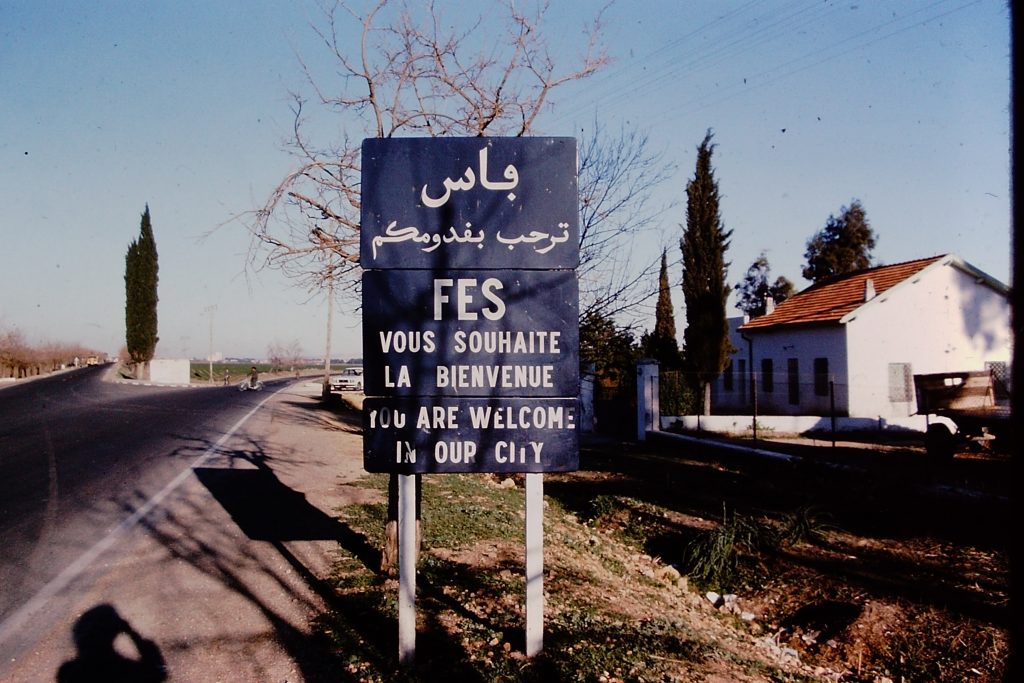
“You are Welcome in Our City”

This sign of hospitality on the outskirts of Fes remains my most enduring memory of 1975 Morocco.

See the young man on the motor scooter in the distance? He offered—undoubtedly in the employ of the hotel—to lead us to a reasonably priced guesthouse, petite dejuener included. We followed, and it was lovely. Tiled floors and a balcony overlooking the city, upstairs from a French bakery. Merci beaucoup. At the time, Arabic and French were the prevalent languages.

In those days before Trip Advisor, we traveled unencumbered by reviews. It may have been naive, but times were different.

We never met another traveler on that trip, and once we were outside the cities, we never saw another car. No wonder Jimi Hendrix was hiding out there! We did chat with some Peace Corps volunteers in Rabat whom we recognized as Americans by the Clarks Wallabies on their feet.

Early each day, with an Orangina in one hand and an open box of fresh croissants between us on the seat, I spread the road map on my lap as a napkin and off we went.

In contrast to the few lodgings in 1975, today there are now over a thousand hotels of all sizes—mostly in the cities—in a country the size of California. Frankly, other than these small differences, the countryside we experienced during our Walking With Berber Nomads trip remains very much the same beautiful, undeveloped landscape that I recall.

Morocco

Between Ouarzazate and the mountains

The twelve of us arrived from the US, Canada, UK, Germany and Australia to join Abdellah, our nomad guide, in Marrakesh. Most of the group were millennials, along with three 40ish, one 50ish, and me, the baby boomer senior citizen at 67.

Abdellah briefed us on our trip details before dinner. We were the very first participants—the guinea pigs as it were—so flexibility was going to be our motto. The next morning we set out on the same switchback roads I recalled. During the 7-hour drive from Marrakesh, we chatted, laughed, enjoyed the scenery, and bonded rather quickly with our shared love of traveling, hiking, and worldwide cultural experiences.

Soon we crossed the mineral-rich mountains of the Low Atlas and rolled off-road to the desolate location where we would join our Berber nomad family. It was springtime in Morocco. The nomads were ready to move their winter camp from the lowland desert to higher elevations for summer, and we would be hiking alongside, 9 to 15 km (6 to 10 miles) a day, an average of 4 to 5 hours a day on foot.

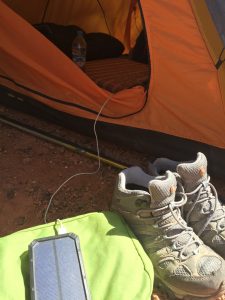
For three weeks prior, I had laid out my duffle contents on a coffee table back at home, adding and subtracting the vital and frivolous contents. Most valuable items: broken-in hiking boots with wool socks, wet wipes, hand sanitizer, trekking poles, solar charger, journal. We each were allowed a duffle bag (40 lb/ 18 kg max) and had purchased drinking water along the way. There would be no water available for bathing or showers.
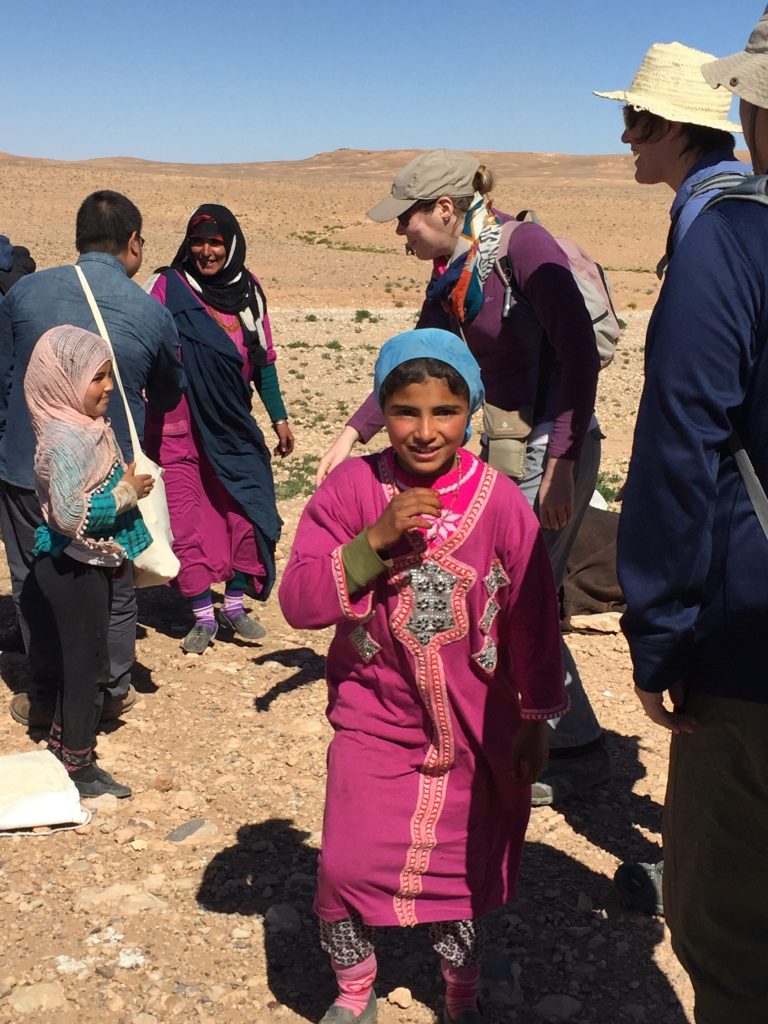
Morocco

Meeting our Berber family

As we approached the Berber camp, our van drove ahead to drop off our gear, and we walked the final couple of miles to stretch our legs.

Our Berber nomad family was waiting for us across the plain at a location with smoke darkened caves that had been hand-carved into the banks by nomads hundreds of years ago.

A cook, as well as a contracted team of three men to transport our tents and gear on mules, rounded out our group.


MOrocco

Tucking in the Baby Goats

The animals consisted of 3 adult camels (1 of them very pregnant, and no—darn it—she didn’t give birth that week), 3 mules, 4 donkeys, 53 goats, 8 baby goats, 120 sheep, and 2 chickens. The baby goats tolerated being tucked into blanket pockets on the back of a donkey every morning with the two chickens decorating the top of the blanket pile like the bride and groom on a wedding cake.

Day temperatures averaged low 80s F./ 26 C., and dropped to 40s F./4.5 C. at night. Not too hot, not too cold. “Just right,” said the baby bear.

After dinner in the cave, we retired to our tents and fell asleep listening to the murmur of animals around us. I slept deeply in my silky long underwear with a change of clothes stuffed in the pillow shell of my sleeping bag.

Morocco

Sunrise Slowly Coming over the HIlls

At dawn, we were awakened by a symphony of cellphones with a back-up chorus of goats and sheep. I hustled into my clothes, laced up my boots and sprang from my tent to greet the day. Watching the low rays of the sun swim over each hill until we were all bathed in its rosy warmth never got old.

Morocco

Tents Pitched on the hill over the Caves

Breakfast: Mint tea, English breakfast tea, sweet Moroccan oranges, cheese, flatbread and jam.

While we ate breakfast, the crew took down the cook tent, packed up, and set out ahead of us. As Karen Blixen’s houseman Farah had longed to do in Out of Africa, the mule team went ahead of us and prepared for our arrival.

Each day had a similar routine, except for the days when they didn’t. Yes, pleasant surprises were frequent, but the common denominator was the same relaxed pattern.

Privy

  1. Rise and shine. Use privy, a hole dug in the ground with a canvas privacy stall around it.
  2. Pack up, take down tent, refill our water bottles.
  3. Eat breakfast.
  4. Hike for a couple of hours, enjoy a 15-minute break with a snack of tangerines, nuts and some bite-size cookies/biscuits like American animal crackers. Maybe some chocolate.

    Morocco

    Break for Tea in a Dry Riverbed

  5. Continue hiking to the night’s campsite.
  6. Enjoy the lunch that awaited us in a cave lined with rugs and our sleeping mats.
  7. Rest for the afternoon in our

    Solar Charging my iPhone

    tents or communally in a cave, write in our journals, or explore.

  8. Meet for dinner in a cave around an oil lantern. Share stories and comradery.
  9. Before or after dinner join the nomads in their singing, dancing and drumming.
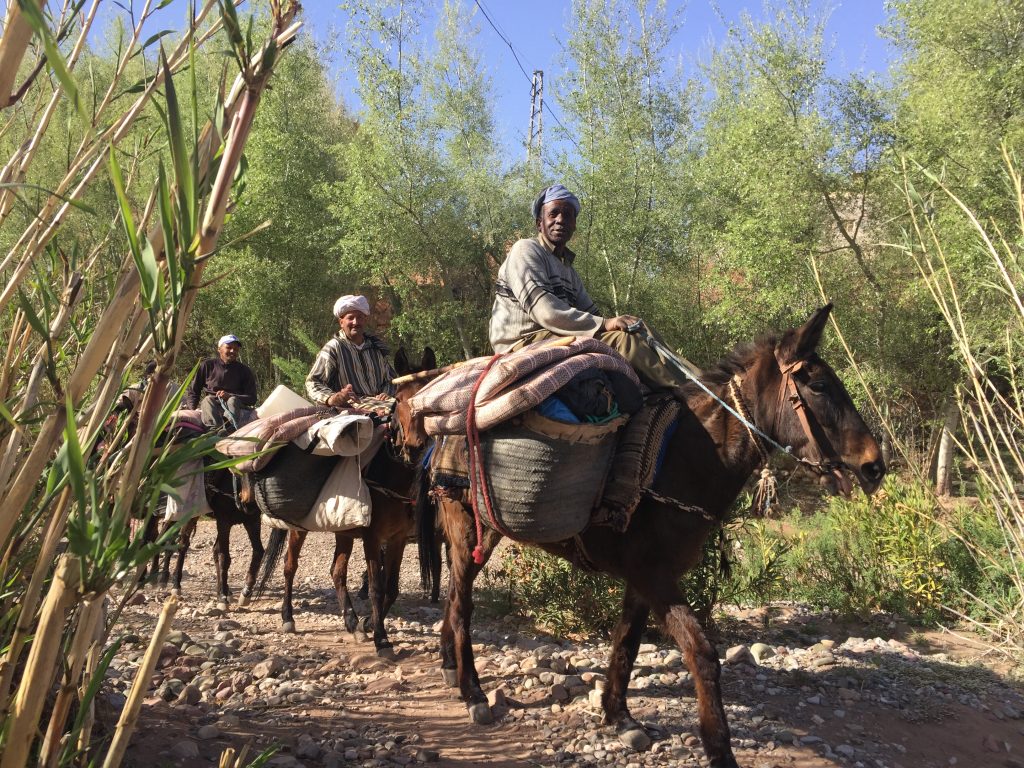
 

Mule Team Transporting our Gear
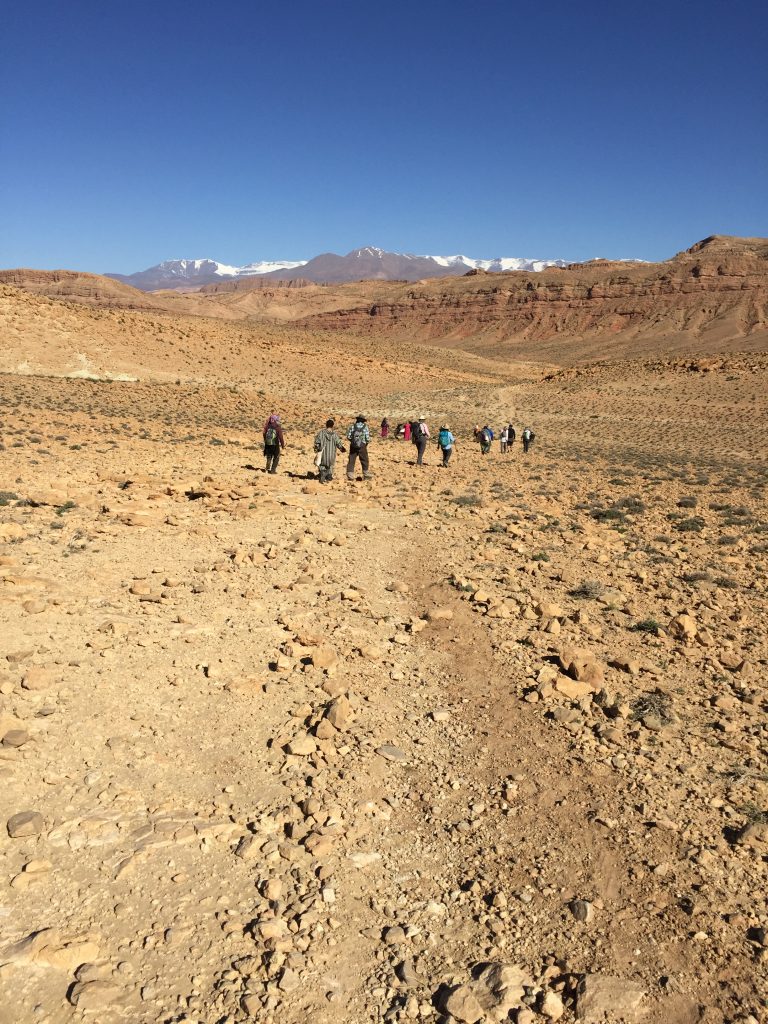
 

Day Two. The High Atlas before us. Seven hours. Crossing two valleys, countless ridges and a dry riverbed.
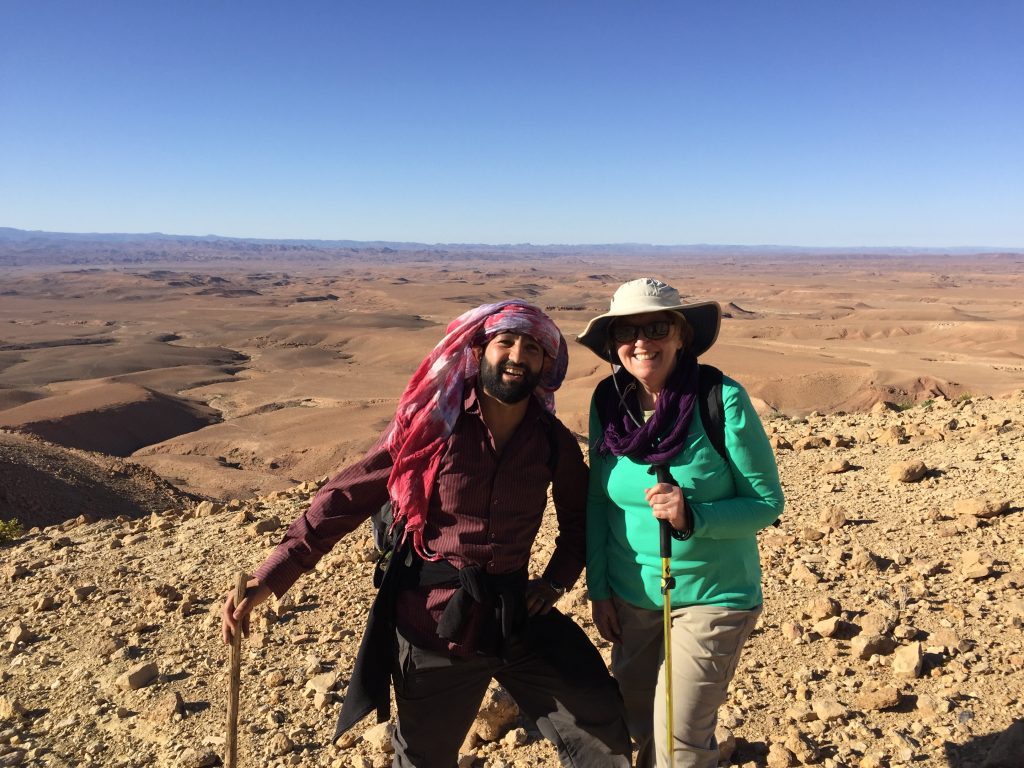
Abdellah and Linda Summersea pause at the first 1000′ climb in elevation. Low Atlas behind us, High Atlas ahead of us.

Our guide Abdellah with a member of the nomad team.

What did We Talk About on the Trail?

Everything except politics. Exclamation Point.

When you’re traveling with strangers, you don’t have the same reservations about being judged, so you tend be more frank. In the group, we rarely, I think, spoke about ourselves. This was about cultural immersion and we wanted to learn as much as we could about the nomadic lifestyle. For myself, I found that the conversations I had were about comparing travel destinations, discussing religious philosophy, and asking Abdellah questions about everything under the Moroccan sun: halal vs. non-halal, education, solar energy in Morocco, and more. Abdellah frequently addressed us on topics related to our passage: farming, crops, exports, irrigation, the structure of village politics, cemeteries and burial customs—anything we saw that caught our interest. Other times, we walked along alone with our thoughts, the rhythm of our footsteps the only sound.

After many miles, a village.

The nomads follow the old caravan routes, so our trek eventually brought us to some of the original 1000-year-old kasbahs (walled towns) in the mountains. The family herded the animals around their perimeter, while we passed through two villages. We saw the architecture and gardens up close, and stopped for tea at a B&B.

Approaching the Village
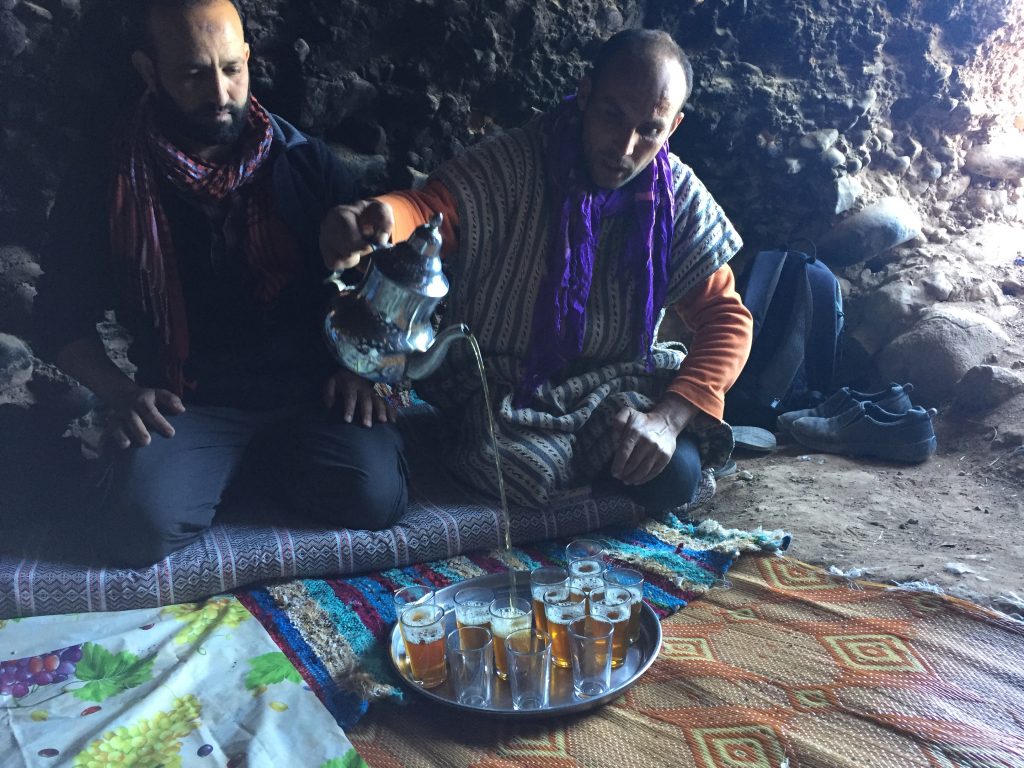
As in Moroccan households, in camp, fresh mint tea was a ritual at every meal. The silver teapot is held high while pouring into the traditional glasses with lots of Moroccan lump sugar.

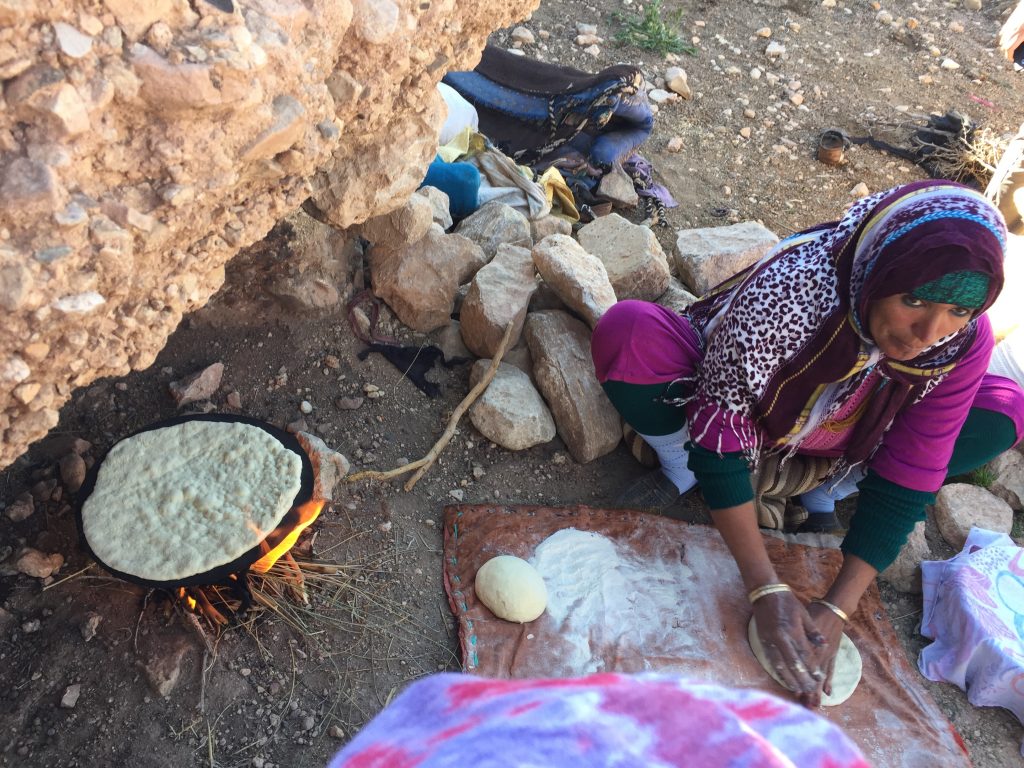
Fatima shared her daily tasks, teaching us a variety of skills from flatbread baking over the fire to goat milking at dawn. She even applied kohl to the eyes of our women and organized a mock wedding with the “bride” selected from our group and the cook serving as “groom”. The wedding took place on our final night in camp, a celebration that coincided with reaching the nomads’ summer location. There was a bridal procession with singing and dancing, and even “parents” of the bride and groom to demonstrate the details of a typical Berber nomad wedding.
Morocco

Fatima with Flatbread

Morocco

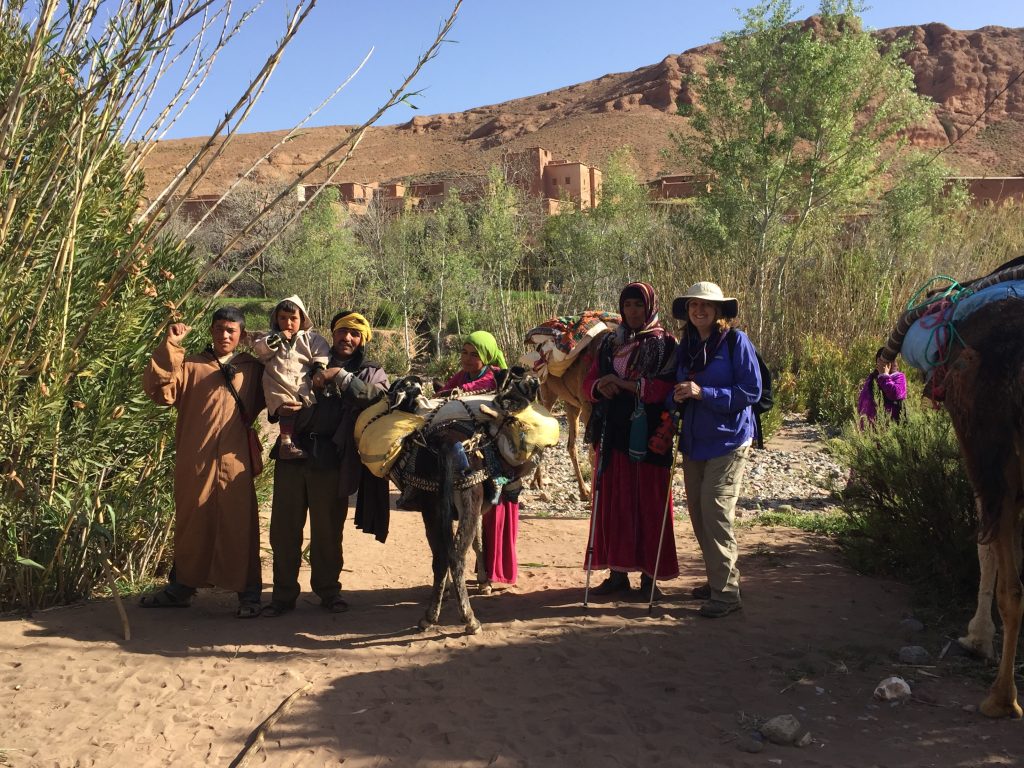
Linda Summersea with our Berber Nomad Family

That night was our final night in camp. The following morning we expressed our heartfelt thanks to the family for being such kind hosts and so generous in sharing their culture with us.

We passed along items from our gear that we thought they might be able to use. I contributed my trusty roll of duct tape.

After many hugs and shukran’s (thank you’s), we reluctantly lifted our backpacks for our last hike as a group.

Just before rounding a bend in the trail, I turned back for one last look at the scene of camp activity in the distance. Generations of nomads have repeated this tradition annually in the deserts and mountains of Morocco, but for how much longer, I wondered.

Ahead of us, our van was waiting, ready to return us to the bustling streets of Marrakesh—and our first showers in a week.

After we split up at the hotel, I spent a couple extra days unwinding in the city, eating ice cream, getting a hammam (traditional scrub-down, bath and massage), and exploring the Djemma el Fna Square to see how the cobra charmers were doing.

But that’s a story for another day.

#RockTheCasbah


MoroccoFollow my adventures on Facebook.

American Writers Museum

american writers museumToday is opening day at The American Writers Museum in Chicago IL.

Actually I didn’t even know that it was being assembled until page A13 in this morning’s Wall Street Journal.

According to the review by Edward Rothstein (Critic At Large), the AWM has been created at a “sensible” cost of under $10 million: its 11,000 sq. ft. are housed on the second floor of an office building at 180 N. Michigan Avenue, Chicago, IL 60601.

Since I haven’t visited, I can’t very well make this a review within a review, but I do think the concept of a writers museum sounds pretty admirable. Of course, as a writer myself, I found myself questioning the punctuation of its name. Should it be American Writers’ (possessive apostrophe) Museum?

No, I guess not. It’s not owned by writers, they don’t possess it, so it can hardly be possessive. It’s not even for writers, as one doesn’t go there to learn writing. It’s best described as a museum for readers (Rothstein says that “an earlier era’s powerful American writers’ museums were called libraries.”)

Mr. Rothstein, for the record, says “I wanted to like the result much more than I actually do.” The fact that his review is entitled “A Cliffs Notes Approach to Literature” hints at his opinion so I dug in. The accompanying WSJ image shows The American Voices exhibit of 100 (dead) writers. Rothstein finds a lot to critique/criticize.

Again, I’ll not quote his lukewarm response to the finished result. It seems to me that his review hints at his personal dilemma. He weighs the better and lesser points of the museum. I could picture him walking around saying “…hmm.” On the plus side, Rothstein does say that the AWM was “put together with care and designed with panache by Andrew Anway”. And FYI, The American Writer Museum is “the brainchild of Malcolm O’Hagan, a retired engineer who, after seeing the Dublin Writers Museum, was determined to build one like it here.”

I could say something about Americans not revering their writers quite as much as the Irish. However, that might be debatable.

After reading the Rothstein review, I sought out the AWM website. They have a lot to share at the museum, and a lot of it is interactive.  There are a many events lined up, including writer readings and signings. Ha! I guess we all know what the newest writer coup will be.

My favorite page is their Affiliates list: The Museums/Writer Homes officially affiliated with them. A long list is it. A bucket list, to be sure.

My second favorite is the home page because my favorite deceased author, Herman Melville, is featured dead center—I mean, “front and center”.

Checking out some other reviews online:

Amy Diegelman for BookRiot calls it “Chicago’s New Literary Paradise”.

The Chicago Tribune’s reporter Steve Johnson calls it “far-reaching, dramatic”.

The Washington Independent Review of Books tells the story of the museum’s inception in this 2012 article.

It’ll be a while before I get to Chicago. In the meantime, if you visit The American Writers Museum, we’d love to have you share your impression here.


american writer museumI’d love it if you’ll follow me on Facebook.

C’mon, you know you want to. 😉

New Yorker Envy

I refer to New Yorker subscription envy. Not New Yorker resident envy.

Sure, it would be fun to live in NYC—maybe for a month or a semester. (It’s been decades, but maybe once again I’ll find myself with a syllabus.)

I see myself hitting up the museums I’ve not gotten around to. The Cloisters, for example.

The museums I’ve not gotten to the finish of. The top of the Guggenheim ramp, e.g.

And I would take the bus to museums that were closed on the day that I visited. The Whitney.

When I needed a break, I would sit on the stairs at the Metropolitan and eat a hot dog with sauerkraut while watching the tourists pass by on the Double Decker Bus. This is the only place where I eat hot dogs with sauerkraut. I’ll enjoy the hot dog as much as the martinis and the view of Central Park from the Met’s Roof Garden Cafe. Martinis make me tipsy. Very. Is that why I usually stick to wine? I think I’m now old enough to let my guard down.

Every night I would take a cab to Broadway and see a show, since I have never seen a Broadway show. Broadway cast shows on tour, yes. Actual Broadway cast, no. Yes, I have Broadway envy, too.

And when I missed rolling around in the grass, I would head to Central Park  with a blanket and a thorough spraying with DEET for a total immersion in their microcosm of nature, placed as it is like an open terrarium in the midst of Lego block skyscrapers.

I digress.

I love The New Yorker. I envy a friend’s subscription. The issues are stacked on her coffee table when I visit. I put down my glass of wine and turn to the cartoon. Why can’t I be so witty as that?

I read a paragraph or two, but then my friend has returned to her place across from me on one of her delightfully unique and artistic chairs. Her taste is impeccable.

She eyes The New Yorker in my hand and admits that she has fallen behind.

I, who have just read a wonderful fantasy of reading the stack of New Yorkers in a tropical location, pick up my iPhone and send her the link.

“Estás sola?” I’d been asked, at the airport, and on the bus, and when I ordered my dinner later at the open-air restaurant. Are you alone? I liked the way the word sounded when put to me in Spanish, like a woman’s name fashioned from the English word ‘soul.’”

I get that a lot, too. Enjoy.

A BIKINI, A TOOTHBRUSH, AND 44 ISSUES OF THE NEW YORKER

new yorker envy

writingFollow me on Facebook.