Writer Conference Recharge

When the going gets tough, it’s tempting to close and laptop and back away. Writing is a struggle for all of us, and yet, if we back away, we’re just pushing The End further down the line.

This morning I awakened at 4:45 in a terrifying nightmare sweat. It was the first time my memoir crossed the line, jumped from my manuscript to my dreams. I was glad to see the light of dawn fade the darkness.

I’m that close to The End.


It’s been a long slog that I wish I had shared somewhere, somehow. Living these past twenty months in a new location, I haven’t yet joined a regular writer community and it shows in my insecurities.

Reading aloud, especially, is a great way to pinpoint the strengths and weaknesses of your work. Reading aloud to yourself is OK, but not as effective as reading to an audience.

I (very recently) asked if I could read a couple chapters of my work to two very new friends for feedback—one male, one female, two diverse individuals—two different chapters, two different occasions. It reminded me that there’s no substitute for the value of community for honest feedback and support.

It also reminded me that I should look for the someone who needs my support. We all need help finding our way through the darkness.


I’m participating in two writer conferences in the coming months. These are an opportunity to learn and share that I look forward to every year.

I know many writers wonder how much they’ll get out of a conference for the time and money spent. If you’re wondering that, know that it’ll be worth it. I’ve never yet left a writer event that didn’t lift my spirits and send me home inspired and recharged.


writer conferenceSome West Coast events coming up:

The Pacific Northwest Writers Conference is coming up July 28-31, 2016 in Seattle. Note that if you can’t attend the conference, you can still take Masters Classes.  www.pnwa.org/

The Magic of Memoir conference is October 15 and 16, 2016 in Oakland CA.  A specialized event for memoir writers. I’m attending it for the first time and it looks promising.  http://magicofmemoir.com/

The Northwest Writers Weekend takes place Nov. 4-6, 2016 at an old-fashioned camp in the woods about a half-hour’s drive from the Southworth Ferry WA (take from Fauntleroy/Seattle). This weekend is unique in that it includes workshops on songwriting. Bring your instruments! Great sense of community here. http://www.nwwritersweekend.org/

writer conferenceFollow me on Facebook.

Snowstorm

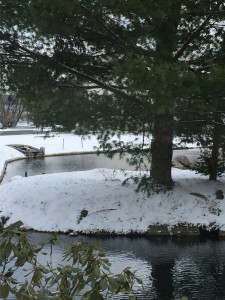
A spring snowstorm arrived overnight in the Berkshires, triggering more childhood memories.

Haven’t lived where snow is a regular event for more than twenty-five years.

There was plenty of warning. We all knew the snow was coming. I went to the Stop & Shop yesterday afternoon. Stocked up on groceries for a couple days’ worth of meals.

When the wind awakened me in the middle of the night, I got up and peeked through the blinds, still a little surprised to see the forecast snow accumulating. Turned the heat up a couple degrees and went back to bed, burrowing under the covers as I did when I was a child.

When I reawakened at seven, the snow was still blowing.

Suddenly it was as if I were listening to the behemoth wood-paneled Zenith radio that stood next to the kerosene stove in our kitchen in 1955.

I remembered the radio announcer and the “no school” bulletins. Heard the wind echoing in the chimney. Felt the cold linoleum floor beneath my feet on the way to the bathroom.

Smelled the coffee percolating on the counter. Sniffed the burnt toast that my mother grilled directly on the cast iron stove top. Given any feasable alternative, my mother always avoided dirtying a pan.

Smelled the wet wool from Mummy’s gloves drying in the open jaw of the warming oven. She helped Daddy broom off his car before he left for work.
This morning, after my own coffee, I returned to the memoir chapter that I was working on at bedtime.

“Winter.”

Synchronicity.

snowstorm


snowstormFollow me on Facebook.

Actun Tunichil Muknal

Belize’s Actun Tunichil Muknal has been named the #1 Sacred Cave in the World by National Geographic. That distinction alone is enough to attract serious archaeology fans and spelunkers from all over the world. Add the fact that accessing the cave requires a one hour hike through the jungle, while crossing the meandering Roaring River three times- just to get to the mouth of the cave- and you have an adventure that narrows it down to those who are fit enough for this Indiana Jones experience.

My first visit to Mayan ruins was Belize’s Altun Ha in 1990.  Between 2005 and 2015, I visited Lamanai and Xunantunich in Belize, and Chichen-Itza in Mexico.

I didn’t learn about Actun Tunichil Muknal- the cave of the “Crystal Maiden”- until 2010. I was intrigued that even though this site offers a unique opportunity to view skeletal remains in the place where the victims were sacrificed, there’s very little information available- especially about what a visit to this cave entails.

I began to ask around. In 2010, Actun Tunichil Muknal wasn’t on the list of standard Belizean tours, and the Belize Institute of Archaeology’s website still has no information about Actun Tunichil Muknal in 2016- even though it’s one of their own archaeological sites. Not sure why.

The only detail that I knew for sure was that Actun Tunichil Muknal is not for wimps. It’s a veritable obstacle course of jungle, river, caving and climbing.

I had to seek out word of mouth accounts in an attempt to judge my own ability, and it took me a couple of years to get mentally and physically fit for the adventure.

This year I was confident that I could do it. When I arrived in Belize, I acclimated myself to the heat by spending the ten days prior to the trip with a daily 2-hour fitness combination of either 1-hour hike + 1-hour bike ride or 1-hour hike + 1-hour kayaking.

The morning of the trip, I paced back and forth on the dock watching the sunrise, while waiting for the boat to take me to town where I would board a flight to Belize City on Maya Island Air. I still had doubts. I was really nervous.

On the dock, I met my travel companions, a couple from Fairbanks, Alaska who were in their 50s, and had the same travel, hiking, caving and climbing experience as I. That was a huge plus because we were going to need to become a support team for each other. I began to feel better.

In retrospect, now that it’s over, I’m in awe. If you asked me to go back tomorrow, this is one trip that I’d repeat without hesitation for the sheer opportunity to absorb the experience again and to try to retain as much as possible.

One is limited to carrying in only the clothes on one’s back, so there’s no photography, no audio recording, and no note taking. Bring a change of dry clothes. They’ll be locked in your guide’s vehicle. (I’ve included a few photos from the time prior to the change in regulations, and have included credits.) The reason for the regulations is that visitors to the cave have damaged skulls by dropping items onto them, most notably, a man dropped a heavy SLR camera onto a skull breaking it. Another person’s carelessness broke a tooth on a skull.

It’s difficult to judge the time and distance during the hike and in the cave, but I’m going to do my best to be accurate in all details.

From the boat to the airport in San Pedro, we were accompanied by Guide #1, Vince. Our flight to Belize City was delayed for an hour (?) or more due to fog on the mainland. Visual flight rules.

When we finally arrived in Belize City, we met Guide #2, Freddy, who was going to drive us out to the cave’s access road. We share his enthusiasm for his native Belize. We talked all the way out of the city and on the Western Highway from Belize District and into Cayo. Belize politics, economics, business, agriculture, history, flora & fauna, gossip & misinformation- and more. The time flew by as the terrain changed from tropical to sub-tropical. Meanwhile, Freddy received two or three phone calls from our official cave guide, wanting to know where we were. Freddy was driving the speed limit. He was doing his best.

We passed the Belize Zoo (a very small, very nice, animal preserve) and the Sleeping Giant Mountains. After a little over an hour’s drive, we arrived at a place somewhere beyond the turnoff for Belmopan, the capital city.

We left Freddy at the beginning of an eight-mile dirt road (At least, I’ve been told it’s eight miles.) and we transferred to another vehicle with Driver #3, in order to meet  our official Actun Tunichil Muknal guide #4. It was beginning to feel like we were trying to shake a tail in a film noir.

On the dirt road, we passed mahogany plantations, beautifully pruned to reach the sky with straight stock. Our vehicle drove through the Roaring River, about ten inches deep at this place, just like the creeks I was used to crossing back in the US when we lived in northwest Arkansas. The young women, who had joined us at the beginning of the dirt road, squealed.

There are only 24 guides for Actun Tunichil Muknal. It requires study of a two-inch-thick textbook and extensive classes in San Ignacio. A big commitment, followed by testing. Once licensed, the guides can take only groups of eight into the cave, usually one group per day. This is not a Disney-esque concession.

At this point, I have to say that I have good news and bad news. The good news is that Actun Tunichil Muknal Cave was definitely the best adventure I’ve ever come across in a foreign country.

The bad news? Our guide was really nasty and unprofessional. He was annoyed about the flight delays and took it out on us- even though there was no problem with the cave schedule and nothing else was affected by our delay. His frustration caused him to put us in danger as he forged ahead without looking back- both on the trail, and inside the cave.

The writing was on the wall as soon as I got out of the car. The absolute only thing that we’d been told was that we would be swimming in our clothes and shoes, and that we should bring a pair of dry socks to wear once we got to the part of the cave that holds the sacred skeletal remains and artifacts.

I got out of the car and asked:
“What should we do with our socks?”

Well, that was a mistake. I got blasted.

“Never mind thee socks! Go to the bah-throom! Get back here and get your helmet and head lamp!”

Uh. OK. I did as directed. I’m not going to reveal his real name here, even though the danger that he subjected us to surely calls for some kind of disciplinary action. Let’s just call him “Bozo”.

The three of us were joined by five others, a 50ish couple from Vancouver, Canada and three young women from New York. Looking around the parking lot, it was obvious that 95% of the others were under 30 years old. Under 30? Piece a cake. Did I mention that I’m 65? I asked another guide how old his oldest participant has been. He said 90-something.

Me: “Former Triathalete type?”

Guide: “Yes.”

As soon as we eight were assembled with our gear, Bozo led us into the jungle down a well-cleared clay path. Just slippery enough to get your attention.

After a while, we came to a clearing where we were directed to leave our water bottles. Since it was overcast, I removed my sunblock shirt and left it on the side of the trail. I was glad I did. A Speedo tank suit and lightweight river pants turned out to be just right for the swimming and climbing. Don’t wear clothes that will get hung up on the rocks. If I were to do it again, I’d wear capri-length yoga pants, the clingy kind. I was glad my knees were covered for the areas where we had to crawl in the sand and climb over the boulders, but my wet river pants were sometimes not stretchy enough.

For shoes, be sure that you have excellent traction. In many places, we had to climb very smooth limestone boulders with no cracks or other rough spots to stop our feet from sliding.

Along the trail, we crossed the Roaring River three times. The first crossing was about waist deep for me (I’m 5’4″.) The other two were about 10 to 18 inches deep. The river is filled with smooth stones that constantly knock you off balance. There’s a rope tethered across the river from tree to tree to use as a handhold. The current made my two companions and me fantasize about kayaking here.

This hike to the mouth of the cave was probably 45 to 60 minutes. Once we set out, Bozo didn’t look back more than once. We were watching. He didn’t check to see how anyone was doing. If anyone had any difficulty, he’d have never known. This is so unlike the usual guide experience. I guarantee that you won’t have this kind of treatment. The other guides were friendly, concerned and helpful of their groups.
Actun Tunichil Muknal

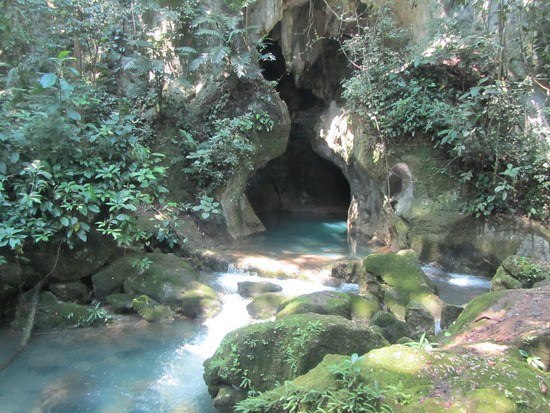
Actun Tunichil Muknal cave entrance, Picture from AlternateAdventures.com

At the mouth of the cave, the scene was magical: tall cliffs, thick vines hanging down fifty feet or more, dense green foliage everywhere.

We stepped down some nicely paved stairs to the waters edge. I asked Bozo: “What’s the air temperature in the cave?” A normal question, right? In North America, our caves are usually about 55 degrees F. I sincerely wanted to know. I was on this trip to be educated.

Bozo snarled: “I don’t know.”

Me: “Hmm. I guess you missed that one on the test.” (Yeah, I was surprised that I made such a quick retort.)

Bozo: 65 degrees!

We returned to the river and swam into the cave. The depth, we were told, is 14 feet. Ice cold. After the initial shock, it felt refreshing.

The National Geographic article that I read said that it’s 1 mile of swimming and wading until you get to the sacred area. Bozo said that it was 800 meters total: 500 meters in and out of the water to the sacred area and another 300 meters walking the sand in our socks. 500 meters equals 1/3 mile. We were told that our total time in the cave was more than two hours. My companions both wore FitBits and clocked eight total miles round trip from the parking lot. I think they said 19,000+ steps. My female companion and I were comparable size. FitBit said we burned 1910 calories.

Actun Tunichil Muknal

Actun Tunichil Muknal, Picture from GreenDragonBelize.com

During that 1/3 mile, we completely lost track of time. We were swimming and wading against the current in an underground river that rose 400′ in elevation inside of the mountain. As we swam, the river depth varied from neck deep to knee deep. There were lots of irregular rocks and boulders, some areas that required scrambling over rocks with no predictable conformity and swirling rapids that churned, disguising deep holes and sharp edges.

In some places we had to pull ourselves up nearly three foot rises to get up onto the next ledge. Bad knees- don’t even think about it. Upper body strength and leg strength an absolute must. Bad back? Don’t do it.

Actun Tunichil Muknal

Actun Tunichil Muknal, Photo from GreenDragonBelize.com

There was one tricky crevice where we had to slide our body sideways through the crack while lifting and twisting our head and neck into position to get our head through a small space over a very sharp rock. Fortunately this spot is close to the beginning. We saw one young woman turn back here due to claustrophobia.

Our guide didn’t bother to hang around to assist anyone who might need assistance. It’s been our experience that when you’re traveling with a guide in challenging terrain, the guide positions him or herself at the tricky spots to make sure that everyone gets through OK.

We helped each other, including one non-swimmer in our group.

There were many twists and turns in our trek, rising higher and higher through the cave.

Our guide’s instructions:

“Keep going! Take your time- but hurry up!” He repeated this periodically, laughing to himself and getting no responses from us.

One time he said “I don’t care if someone in another group dies, you keep going! We are a team!”

I heard one of the young women say “He’s affecting his tip…”  They had heard him make sexist remarks- which my companions also heard.

We climbed treacherous areas that I’m amazed have not resulted in more severe injuries. Example: a 60-degree climb up a wall with no ropes, no back-up. Just “follow me” straight up a wall in the pitch black with our dim headlamps and finding our own hand and footholds in the limestone cave wall. No climbing instruction! Fortunately the three of us all had our own caving and climbing experience in our favor.

I often had to select my footholds and handholds two or three times before finding the one that was going to be successful for my height and weight. In many, many places, we stretched up (or down) areas wider than a normal stride while placing our feet on small knobs of limestone.

Someone told us that a man fell off the wall here and it took eight hours to get him out of the cave, as it required waiting for help to bring a pallet to secure him in place on the way to the hospital in Belize City.

As we continued deeper into the mountain, the chambers became larger, the stalagmites and stalagtites became more impressive.

Our guide said “Keep going! Never mind the stones. They are just stones!”

“Don’t look at the ceiling! Look at your feet!” he shouted.

As we got closer to the area where the artifacts were to be found, we saw an 18′ ladder in one place- nearly straight up, and lashed onto something with duct tape.

It was somewhere before here that we all removed our shoes. Our guide passed out our socks, which he’d been carrying in a dry sack. The socks were to prevent the oils in our skin from affecting the sand and surfaces.

Remember how Lord Carnavon asked Howard Carter what he saw through the wall when they reached the tomb of Tuktankhamen?
“Beautiful things,” was the response.

We didn’t see classically “beautiful” things. We saw priceless artifacts– Mayan skeletons that were the result of human sacrifices, plus pottery and the incredible geology of the cave interior.

Most remarkably, the remains, the pottery shards and near whole pottery items were right there at our feet, where they had been left by the Mayans hundreds of years ago. I’m not going to quote specific historic periods of Mayan history because I simply don’t have that information. The guide did rattle through lots of accurate Mayan facts and dates, but it was difficult to remember.

At this stage, we were allowed to stop and look at the massive chambers, shelves, stalagmites, stalagtites, calcified remains. There was more than one skeleton fused to the cave floor by crystallization- but don’t quote me on the science of it.
Actun Tunichil Muknal

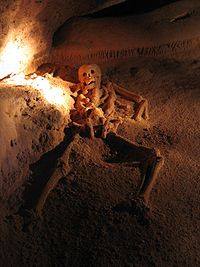
Crystal Maiden, Actun Tunichil Muknal, Picture from Wikimedia.com

Finally, 300 meters in from where we removed our shoes, we arrived at the skeleton of the Crystal Maiden, the most famous of the remains in the cave. Probably the most famous remains in Belize- or Central America. Our guide told us, while pointing out the physical characteristics of the skeleton, that archaeologists now believe it’s possible that the skeleton is male. Not definite, but possible. He pointed out the area where the weapon was found, and speculated that the dying victim may have crawled the eight feet or so to the location where he or she collapsed and died.

Why did the human sacrifices take place? The Mayan civilization was experiencing a long drought which threatened their crop production to the point of possible starvation. The Mayans- as I understood the guide- began by offering up plants and food stuffs. When that didn’t work to bring rain, they sacrificed animals. Finally, they began to sacrifice humans.

He pointed out that each skull had a small round hole where a weapon had been used to place the death blow. Babies were sacrificed. Young virgins were sacrificed.

As you stand in the cave of Actun Tunichil Muknal, the overwhelming feeling that surpasses other emotions is that you’re standing in the same rooms where Mayans once stood, climbing the boulders and shelves that they also climbed, and swimming in their waters.

At the location of the Crystal Maiden, the Institute of Archaeology has placed a fence to prevent passage beyond that point. We turned around and began our return trip. Replaced our shoes, and slid back into the water, this time traveling with the rapids instead of against them.
Every one of our footsteps was made by shining our lamplight through the water. Our guide would direct “Stand right. Rocks left.” That was somewhat helpful.

Towards the end, Bozo could tell that we were all silent and unenthusiastic about his actions. At the 60-degree climb, he stood and for the first time, helped each female down, but insisted that we sit down and skoot over the edge- the exact wrong way to negotiate down a steep vertical drop. When the man in my companion group of three got to this place, Bozo turned and left him completely without assistance. He’s a big guy and has a slightly wonky ankle- football injury- so he was looking for some help. Due to the steep terrain, and dearth of footholds and handholds, it wasn’t possible for any of us to go back up and help.

Soon we were back at the deep water. I lay back and floated for a bit, letting the cold water rise up inside my helmet to soak my hair for the return hike. Once outside the cave, we all stopped and looked back, wishing we could photograph what our eyes were seeing.

Our return hike was fueled by the excitement of what we had just experienced.

I regret that our bad experience with our guide had to mar this adventure, and that I had to include it in this telling. It wouldn’t be right for me to neglect that fact.

As we made our way through the jungle and crossed the river three times again, our guide was long gone. He didn’t wait for us, and we decided that we were not going to run along the path. We had to follow at his dangerous pace inside the cave, but here in the jungle, we decided to take time to enjoy our surroundings and listen to the birds calling in the distance.

At the parking lot, we changed into dry clothes, and were served a simple lunch of chicken, rice and vegetables with Coca-Cola or water. We got back in the car, while our guide hovered around expectantly.

This is the very first time I have ever stiffed a guide. There was no doubt that I was not going to reward this man for his rudeness and lack of safety.

As we drove away to meet Freddy, one question did cross my mind.

I wonder when they will have female tour guides in Belize?

Subscribe to my blog here.

Actun Tunichil MuknalFollow me on Facebook.

Babci and Me. Courage.

My babci (grandmother), Róża, was only seventeen when she boarded the train to Antwerp—alone— near Kolno, in northeast Poland. It was December 1911, three years shy of the turmoil of  World War I.

Stars sparkled in the moonlight on the coarse crust of the deep frozen snow and young Róża drew her cheap coat closer against the bitter cold. She stamped her feet to warm them.

When the train left the station that night, its whistle merged with the whistling wind and the howling of wolves in the forest, lifting with it the spirits of passengers bound for the Christmas holidays in Western Europe. Others on board, like Róża, may have shed a few tears for Mama and Ojciec left behind.

Odwaga

nounon możliwość zrobić coś, co przeraża jedno.

I was eighteen, sitting silently in the back seat of my father’s Ford, when I began my own journey from our rural farm to Amherst, Massachusetts, bound for freshman orientation at the University of Massachusetts. I had never been to UMASS. The trip to Amherst— 49.7 miles—might as well have been across the ocean. Amherst would be my Antwerp.

Courage

noun– the ability to do something that frightens one.

I didn’t know a soul there, except for my orientation roommate. A classmate from my high school, she was, frankly, very sexy for a high school student and her voluptuous breasts made me feel even more like the boyish freak that I thought I was.

When we went to the Student Union Bookstore to buy t-shirts to show off our college student status to our peers back home, we held up the shirts to our bodies, trying to judge the sizes.

I knew right away that I was a t-shirt size Small.

Rifling through the stack of athletic grey shirts, my roommate asked, “What size do you think I should buy?”

Without hesitation, I said, “Extra-Large.”
“University of Massachusetts” would surely be distorted by the peaks and valleys of those breasts if she chose a smaller size.
We left the Student Union with our purchases and changed into our new t-shirts back at the dorm.

Mine fit perfectly, not too tight, not too loose, its hem reaching just a few inches below my waist.
Hers, unfortunately, fit like a nightgown.
I was shocked. At that moment I realized that our bodies were not all that dissimilar. Sure, she was sexier and she still had bigger breasts, but I suddenly grasped that my self-image was significantly distorted.
It was a testament to her good nature that she didn’t berate me for my poor judgment, but I’ll never forget my embarrassment.

We enjoyed the introduction to college life during that week. Not good enough to want to be freshman roommates, but good enough.

When it came time to leave home for the school year two weeks later, I once again sat silently in the back of my father’s Ford, this time with my mother in the front passenger seat and my youngest brother, a kindergartner, sitting in the back with me and my record turntable.

It didn’t take too long to unpack the car when we got to Amherst. One red Samsonite suitcase, one red Samsonite train case, my stereo and my milk crate of records. My family drove away without much comment. Certainly there were no hugs and kisses.

I lay back on my bed and listened to the quiet.

SS_Finland_underway_in_harbor_before_1917

SS Finland

At Antwerp, Róża boarded the gangplank of the passenger ship Finland with all of the other young people in steerage class. Was she also fleeing a less than happy home life?

She watched her trunk being stacked on the baggage wagon and hauled on board. Everything she owned was in that trunk. Her clothing, her Sunday church shoes, her rosary, a knitted shawl and a basket woven of native willow. Being peasant Polish, she couldn’t afford a stylish feathered hat like those she had seen en route. More likely, she wore a babushka, like the ones she wore almost every day for the rest of her life.

Steerage class on the Finland proved to be its own education, and Róża also was the victim of distorted information.

One day over cups of tea in her kitchen on the farm, Babci told me that she first saw people with black skin during that trans-Atlantic crossing. Someone told her they were devils. She laughed self-consciously when she said this. It was the slightly embarrassed character of that laugh that communicated to me—a ten-year-old who had only seen black people on television—that she might have actually believed it. She didn’t know better. Not any better than the 18-year-old college student who truly thought that her orientation roommate had a figure of outlandish proportions.

Oftentimes, I opened Babci’s trunk in the attic on the farm when I was sent up to fetch onions from the braids that hung from the rafters. The trunk stood near a window under the peak of the roof. It was empty inside, and its pale paper lining had flaked away in parts. I often opened and shut its lid multiple times, clasping and unclasping the draw-bolts, and running my fingers along its wooden slats while daydreaming of Róża, curled up in a bunk, trying to stay warm with her mediocre steerage-issued blanket, as the Finland rose and fell on the high seas.

The devils sometimes infiltrated the dreams that she had of a new life in America as she slept in her bunk in the Finland.

A couple years later, the devil in her world became the man whom she would meet in a small town in Connecticut and marry, beginning a life within the farmhouse where the trunk sits in the attic, empty of her dreams.

My red Samsonite cases traveled with me for quite a few years, and they too eventually crossed the Atlantic. When their linings began to smell slightly of mildew and they had served their purpose, I donated them to the Salvation Army.

Babci’s willow basket sits in my kitchen today where it contains my last memories of my grandmother and the times we spent together. I think that she’d be surprised to learn that not long after college, I became quite a proficient basket weaver.

At eighteen, I was navigating my own troubled waters. Having grown up in a cold and hostile household where animosity always seemed to be simmering beneath the surface, I had not yet learned how to communicate properly with others. I’d always been a loner.

At sea on the Finland, Róża was alone too, preferring to keep to herself as Christmas came and went.

Three days later, when Róża processed through the Great Hall on Ellis Island on December 28, I suspect that she received the greatest Christmas gift of her life. For her, Ellis Island was the “island of hope.” The Ellis Island Immigration Museum describes how others, who were not permitted entry, found Ellis Island to be an “island of tears” as they were put on ships and returned to their countries of origin.

What if Babci had never arrived in the America? What if her spirit had not harbored the desire to surpass her humble beginnings? What if she had placidly continued to live the peasant life somewhere in Eastern Europe, killing and plucking chickens on a tree stump in her barnyard?

What if, supposing that I still had been born—but with different genealogy—I had never arrived at UMASS? What if I had stayed at home and, as my father had proposed, had gotten that job operating a keypunch machine at the factory? Or, barring that, apprenticed to become a bank teller, in spite of my absolute incompetence with numbers?

Belize Day 4 – Morning Has Broken

“Morning has broken like the first morning
Blackbird has spoken like the first bird.” Cat Stevens

At 5:10 AM, I peel back my comforter and step out onto my porch. Yikes, the burrito man, with his bicycle and a cooler full of breakfast, is standing there in front of me with a broad smile on his round brown face. No problem. I know him. He saw my light and selected me as his first customer.

“Burrrritos! Beef! Chee-ken! Pork!”
“Vegetable?”
“Sur-ry, no ve-je-ta-bull. Is the meestair inside?”
“No, sorry. He’s not. I’m sorry. I’m not eating meat… but have a great day!”

“Si!”

I go back to bed and get distracted with some reading and writing online. The sun comes up and the sky turns blue. Damn. I’d better get out there.

Day 1 was breezy. Days 2 and 3 were cloudy. I barely broke a sweat during my early morning walks those days. I didn’t even wear a hat. I had insane amounts of energy.

Today is blazing sunny and I know I’m gonna fry if I wait much longer.

Shorts, tank top, quarter cup of sunblock, wide-brimmed hat, sunglasses.

After one mile, something weird is going on. It is HOT, but I’m not sweating. Wiped a few drops of sweat off my upper lip. No, I’m not dehydrated and bordering on hallucination. I’m just not sweating.

A couple guys my age jog by with shiny shoulders and ear buds. Millennial women running fast.

After two miles, normally, I’d be a ball of sweat and looking for the Palapa Bar over the horizon, thinking that it can’t be that much farther. It marks my half-way mark, where I turn around and head north.

This year, I don’t even notice when I get to the Palapa Bar. The time flies and I have tons of energy. I wipe another line of sweat off my upper lip.

In earlier years, I’d be so sweaty on a day like this that I’d sometimes peel off my sweaty clothes and go for a swim in my underwear off the back porch at the (closed until 11 AM) bar. It’s over water at the end of the dock. (Don’t tell my husband.) Then I’d dry myself off with my wadded up cotton shorts, get dressed and make my return.

After mile 3, I wipe the sweat off my upper lip again. Mile 4, I’m home. My hatband isn’t even wet!

It’s the sugar. This is Day 24 of No Sugar. The cravings are gone. My metabolism is changing. I’ve lost a chunk of weight. Down 7.5 pounds when I left home. Don’t know where I’m at now but my buttoned shorts are sliding off my hips. There’s a dimple on my right cheek that I haven’t seen since 1989. Looking in the mirror, I see a vertical line appearing from my belly button to my breasts. Can it be? The space between my ribs is showing up.

Belize Day 3 – Synchronicity, continued

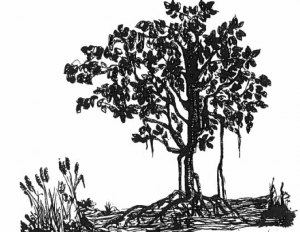
In 1970, I was an undergraduate student at UMASS Amherst trying to come up with a suitable subject for a lithography printmaking assignment. I wasn’t terribly inspired in those days. I had a Merriam-Webster’s Dictionary that had been a graduation gift from my local hometown newspaper, where I was a high school journalist. I flipped the dictionary open at random that day and saw a tree/shrub called “mangrove.”

mangrovesI had never heard of this species but I’d always had an interest in plants. An illustration of the mangrove with its small leaves and tangled roots accompanied the definition. I sketched it on drawing paper and the following day, I copied my sketch onto the limestone and printed it. It’s the only print that I still have from those days. The black and white litho-crayon sketch hangs in the stairwell of our home in coastal Washington.
macalriverBelize

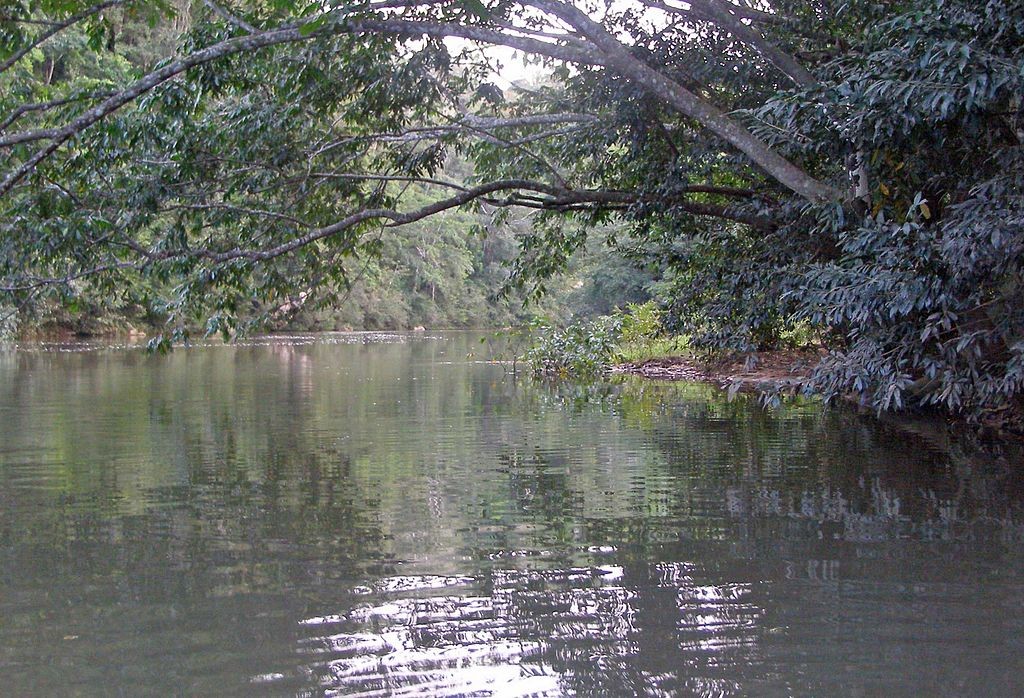
Mangrove swamps along the Macal RIver. Image source: “Schaamacal2” by Original uploader was Anlace at en.wikipedia – Transferred from en.wikipedia; transferred to Commons by User:Leoboudv using CommonsHelper.. Licensed under CC BY-SA 2.5 via Commons – Wikipedia source attribution: https://commons.wikimedia.org/wiki/File:Schaamacal2.jpg#/media/File:Schaamacal2.jpg


In 1990, our family was in a open motorboat at low tide, navigating  the shallows off the Belizean coast enroute to the entrance of the Macal River, then traveling upriver to meet our guide to the Mayan ruins at Altun Ha. At one point, we grounded on the shoals. Our boat pilot hopped out to lessen the weight in the boat and braced himself in the soft sand to push off and free us. We continued to the Macal and entered the mangrove swamps, stopping once to view a Fer-de-Lance snoozing in camouflage.

How does a timid college student in a cold North American climate select a subject matter that will turn up twenty years later and become a recurring botanical theme in the travels of a middle-aged woman? Synchronicity.

mangroves

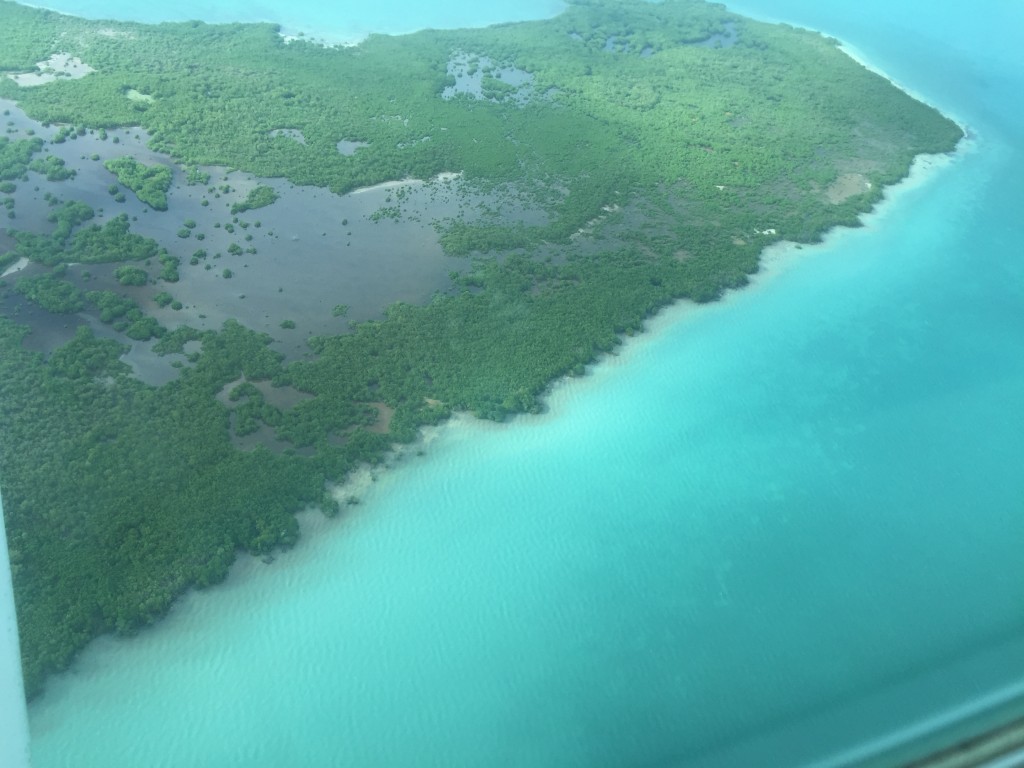
Mangrove swamps, coastal Belize, 2016. Linda Summersea.

In 2016, as Maya Island Flight 2181 made the fifteen minutes crossing from Belize City to San Pedro, I took a few photos from my seat behind the pilot. This image shows the dense forests of mangroves that line the Belizean coast and many of its islands. The salt-tolerant trees with leggy, exposed roots are useful in preventing erosion and offer a certain amount of protection from storm surge during hurricanes.

The mangroves are more important than that to me. They’re a touchstone. Synchronicity.


After a day filled with bicycling, cooking, writing and even a swim off the dock, I carried my Eno DoubleNest Hammock to the seawall. Found two cooperative palm trees. That is, two palm trees aligned so that I would receive the delicious breeze off the water, yet block the unforgiving rays of the Central American sun, and spaced just right for the hammock length and its sturdy carabinered straps.

Took me just 5 or 6 minutes to set-up. Tucked in with my Nook, thinking that this is crazy tight for two persons. It would have to be two very intimate persons. Or two very skinny persons. Or two persons who wouldn’t mind spooning all night long with no way to change position. I suppose you could lie with heads are opposite ends, but the images online all show happy couples cuddling in its cocoon shape.

Lounging in the Eno DoubleNest alone, the hammock completely encapsulated me. I wiggled around to Suggested Position 2, which is to lie crosswise. Then I lay back and prepared to read, but I became totally distracted as I lifted my eyes to the sky.

A row of perfectly painted clouds was stretched out before me hugging the eastern horizon, just above the fringe of waves crashing on the coral reef. The clouds were reflecting the color of the water, which at this time of day was the precise color of tender blue bruises. The tops of the clouds were shaded pink. Romantic pinks.  Thomas Cole landscape pinks. Hudson River Valley pinks.

As the sun inched downward to kiss the tops of the palm trees in the west, the clouds became more and more blue, less and less pink. The scene was so beautiful, it almost hurt.

Actually, it did hurt. All this beauty and no one to share it with. It hurt.

I saw a man photographing the scene from the end of a dock. Two pelicans sat on two wooden pilings, totally ignoring the incredible scene, which was destined to be viewed on a hundred Instagram accounts that night.

Two persons came by in a kayak, enjoying the calmer water at this time of day, their paddling totally synchronized like two lovers who have been enmeshed in each others’ moves for the better part of a lifetime.

Finally the clouds were totally blue. The palm trees in the west transitioned to a black silhouette as a water taxi zipped by with its running lights on.

I returned to my Nook and the 2013 Best American Essays that I had downloaded from the library.

I haven’t read any of the annual Best American Essay collections, but when Cheryl Strayed showed me her home library, after pointing out the books that had belonged to her mother, she was most proud of her collection of Best American Essays.

This was several months before Wild hit the film screens at the Toronto International Film Festival. And several months before Strayed began the resulting rock star ride of her life. She was well-know to readers, of course, but the film brought her work to the masses.

Cheryl, being Cheryl, didn’t tell me that she had essays in those volumes, and she didn’t share that she had been invited to edit the latest (at that time) volume of the Best American Essays. Always modest and low-key, always concerned more about you, Cheryl Strayed is a woman who personifies the highest order of best intentions- not to be confused with the road to hell that’s paved with good intentions.

Finally comfortable in my hammock, I clicked to the Introduction from the Editor:

“When I teach writing I tell my students that the invisible, unwritten last line of every essay should be and nothing was ever the same again. By which I mean the reader should feel the ground shift, if only for a little bit, when he or she comes to the end of the essay. Also, there should be something at stake in the writing of it. Or, better yet, everything.”

As I read this, something suddenly clicked. I read it again.

I’ve never had a course in essay-writing. It seems that the general interest in writing instruction prevails upon Fiction and Non, mostly in book length. Short form is usually relegated to Poetry.

I read on. Everything the editor had written was so on target with what I needed to hear. By the end of the introduction, I was pretty much convinced that essays are meant to play a significant role in my writing.

Then I saw the signature line of the editor. Cheryl Strayed.

Synchronicity.

Subscribe to my blog here.

perfectionFollow me on Facebook.

Belize Day 2

It’s been less than 12 hours since arrival in Belize and, already, I’m back in the groove. Any thoughts I had of maybe going elsewhere next winter are slowly getting squashed by the synchronicity that I always experience here.

syn·chro·nic·i·ty1
/ˌsiNGkrəˈnisitē/

noun

  1. the simultaneous occurrence of events that appear significantly related but have no discernible causal connection.

I’m thinking that I need to assemble some writing based on the experiences that I’ve had here during 10 trips spaced over the past 26 years (8 of them in the past 8 years.). I’ve been visiting here since before electricity was brought to this island. In the early days of my visits, huge generators supplied the island with its power. There was an ever-present hummm in the background. Except when they went down and the lights went out.

It never occurred to me that my Belizean experiences might have some memoir aspects to them, but after this morning’s events, I see that they have.


Here’s an example of synchronicity from last winter.

One morning in February 2015, I stepped down into a water taxi with a half dozen school children of assorted ages, all of them dressed in the public school uniform of white shirts and navy blue pants. As we pulled away from the dock, I looked at my companions and began to reflect on the various school children that I have met here over the years.

A high school boy sat quietly on the bench beside me. I turned to him and said:

“I’ve been wondering… Years ago, maybe 10 years, there was a little boy, maybe 7 or 8 years old, who used to sell jewelry outside the Capricorn restaurant up the beach. His uncle works at Capt. Morgan’s. Would you happen to know who that boy is?”

The young man turned to me and smiled.

“Mum, I am that boy.”

I still get goosebumps when I remember that conversation.

We talked all the way into town re: his little sister, his brother, his parents. I asked him what he is studying. What he likes best. Updated all. Synchronicity.


Now. January 3, 2016.

Today as I bicycled into town, I met the usual assortment of golf carts and bicycles, tourists and locals. I noticed that the newly-arrived tourists, the ones without tans, were not terribly comfortably looking. Maybe it’s their first visit to a third world country. They’re ignoring the people around them.

The locals peddle along minding their own business, realizing that 99% of the tourists have zero interest in them. Here’s where I say that I am among the 1% that do have an interest in them. As fellow human beings.

I want to be perfectly clear that we are all 100% equals. I don’t engage with the locals in some kind of condescending phony-friendly, chit-chat.

I simply smile and call out “Good Morning” to everyone I meet as I pedal along. The smile and another “Good Morning” gets reflected back at me warmly. …and this day, I add “Happy New Year”.

It’s a simple premise. It’s always best to appreciate those around you. As a woman traveling alone, I naturally don’t do anything stupid. I’m aware of my surroundings at all times. I don’t travel alone after dark. At the same time, I don’t let my solo situation block me from having rich experiences. I explore. I ask questions. I don’t take anything for granted. But I’m not fear-faced.

Belize day 2

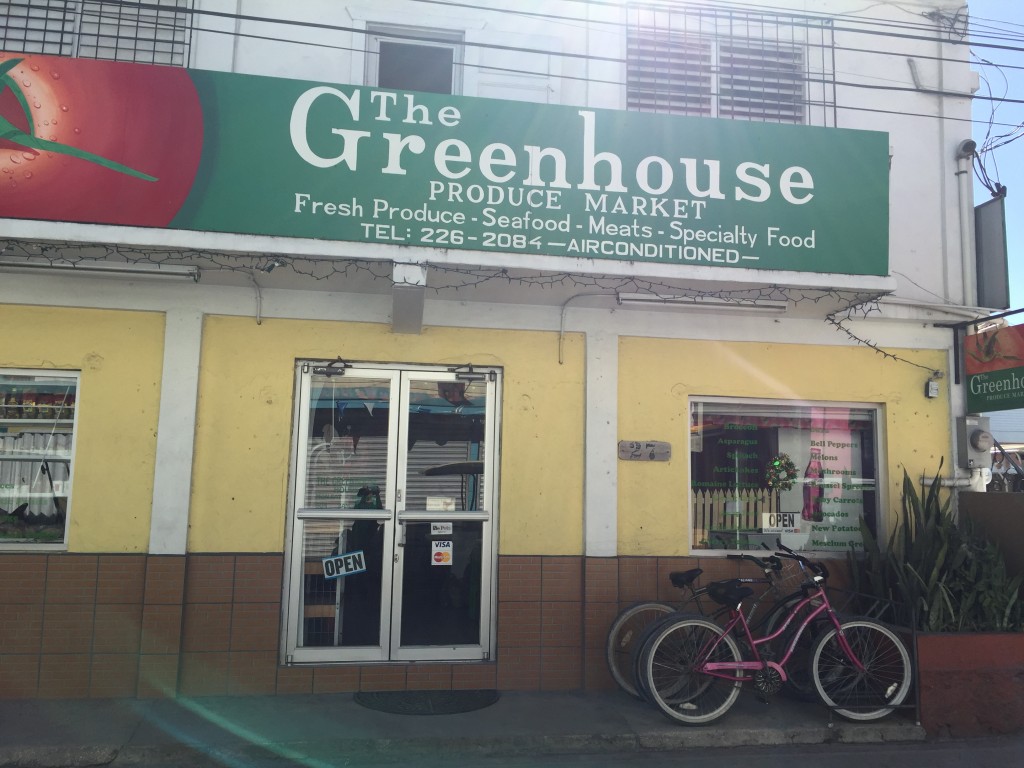
Arriving at the market:

That’s my bike out front. I was pleased to see that I was able to get everything I need to make the vegetable soup that is my daily Ayurvedic lunch, as well as the local fish that is my dinner. Sea bass, lobster. Everything  except the kale and broccoli. I’ll substitute seaweed (nori) in the meantime. The fact that you can even get kale is a very big deal. I’m glad to see that there’s a demand for it from the expats living here. The Mennonite community of about 10,000 members inland grows the vegetables supplied to the island and raises pasture-fed beef.

Since it’s my first day in the heat and I have a heavy load to balance on my handlebars, I didn’t stop to take any photos, but my eyes took in the changes and additions to town. I’ll take pictures on Thursday when the kale comes in. Normally I don’t go into town at all, but kale- that’s a good reason.

As I crossed over the one bridge on the island and left town pedaling north, I passed a boy, maybe 11 or 12 years old, on a bicycle. I smiled “Good morning” and “Happy New Year”. He responded the same, and then a little later, I heard his bicycle coming up behind me so I called out to him with a smile over my shoulder-
“Wanna race?”

Chuckle.

Well, that was all he needed to hear. We didn’t race, of course, but he pulled up alongside of me and the two of us, the boy and the lady, bicycled side by side for a couple of miles, talking about the day to day like two old friends.

His name is Jessum. He lives not far from where I’m staying. His mother owns a local hotel there. “The pink one.”

Was I here for the fireworks?

“No, I just arrived yesterday.”

The fireworks are fairly new. Now there are enough prosperous businesses to donate the cost.

I can tell that he’s a bright young man who will do well. He has the natural curiosity that one needs to thrive and succeed.

A couple miles later, he pulled off the road, saying “Maybe I’ll see you… on the road.”

“Yes, maybe!”


After that, I was so engrossed in thoughts about Belize and how it has become part of my life, that I totally missed the turn for the place where I’m staying! That’s pretty incredible- considering the fact that I was toting a heavy load and it is Hot outside and my First Day in the heat. Normally I would be keen to get back.

Once I realized what I had done, I stopped, came about, and back-tracked the half-mile that I had overshot my destination. I’m staying at Captain Morgan’s Retreat, a Belizean-style resort with 1000′ feet of sandy shoreline.

Belize Day 2

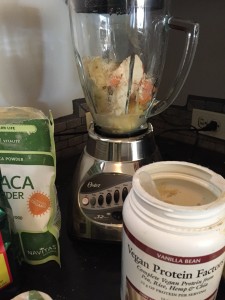
I unpacked and made my breakfast: banana pineapple carrot protein smoothie with cinnamon and maca powder. I didn’t have IMG_5785Belize Day 1any ice (yet) so I put it in the freezer in two glasses. By the time I got to the second one, I discovered that I had inadvertently created an awesome banana pineapple carrot popsicle!

Tonight I’m cooking sea bass. Have never cooked (nor eaten!) sea bass, but I think almonds and cashews are going to play a role. Stay tuned.

Here it is: Sauteed Sea Bass Summersea with Snow Peas and Fresh Pineapple. Delicious!

seabass


Subscribe to my blog here.

perfectionFollow me on Facebook.


The Dream, Climbing Back to Creativity

The Dream, Climbing Back To Creativity

Yesterday I arrived at my destination just as dark fell upon a tiny beach village on the U.S. side of the Canadian border at British Columbia. I had driven north on a grey day (or a gray day or a grey dey- I was already contemplating poetry and prose- and listening to writer podcasts).

It didn’t begin to rain until I was almost there. I clasped the stirring wheel tighter and shut off the podcast, staring intently ahead. I couldn’t be foolish enough to let my guard down and turn this writer retreat into a disaster before it had even begun.

Slush began to form on the bridges, and sure enough, at the exit where I turned off, an ambulance was departing the scene of an accident (“wrecks”, they called them in the South, where they’re not so polite about the possible accidental cause of such an event). A police car’s blue light was lighting up the dusk, a white station wagon pointed face first into a gulley, its side peeled open by a little red something or other that lay wounded up ahead. See? You have to be careful when the weather turns.

I remembered that I had forgotten to bring coffee and blueberries so the light of a market lured me off track. The smartphone lady told me to return to the route. Recalculating. Suddenly I was surrounded by frosted donuts and sprinkled cookies and six-thousand calorie muffins and Talenti gelato (sea salt caramel). I waded onward to fruits and vegetables. Blueberries. Coffee. Fresh-ground Columbian breakfast blend. Tunnel vision to the checkout.

Checkout lady: Making smoothies?

Me: Um. Yes. As a matter of fact, yes.

Checkout lady: I thought those were too many blueberries for muffins.

Me: Mm. Right.

4:20 PM. I pulled up to the premises and parked. Poor lighting. Can’t see the office. No sign of life. Dug my arrival info out of my bag.

“Check-in time: 4 PM. In order that your unit be properly prepared for your arrival, we regret that early check-ins are not available.”

Called the phone number on the sheet.

“Thank you for calling Holidayland. If you are reaching this message, we are closed for the weekend. Our hours are 9 to 4, Monday through Friday. If it is an emergency- and ONLY IF IT IS AN EMERGENCY- call 000-0000. If it is not an emergency, leave a message.”

I put up my hood and got out of the vehicle. Pouring rain and wind blowing horizontal. Behind the fence I saw white pages taped to the inside glass of a door.

“If you have arrived after 4 PM and have not made arrangements for late arrival, call 000-0000.”

Rosemary answered the phone, and yes, she had been expecting my call. Key in a dropbox at unit 208. Everything’s ready. Warmth, fireplace, 3 bedrooms if you need them. (I don’t.)

I carried my groceries inside the spotless, cozy, home away from home. Freshly scented, vacuum cleaner tracks on the carpet. Put suitcase on a bed in Bedroom 2. Unpacked the basics and got sorted away, as I always do.

This time was different.

I was blocked. I was making an attempt to get back on the writer track, on my Nth edit of the manuscript, trying to find the key that was going to turn my memoir into something meaningful. If not, I told A.C., I would mark it fiction, add erotica, and upload to Amazon. Well I told him that with a wink but I wasn’t very convinced. He agreed. “Yes!”

So there I lay (lied? laid? Verb tense, my weakness), on a colonial sofa with some very cozy pillows behind me, checking my email and twitter notifications. I was a little bit frightened that it wasn’t going to work this time. (It had always worked before. Isolation, quiet and aloneness- as opposed to loneliness- always work for me.)

By eight o’clock, I was drifting off. Put on my playful puppy-printed flannel pajamas. (Why are flannel pajamas always playful prints? Why are there no sexy flannel pajamas? People in Canada get horny too, you know.) Went to bed. Of course I brushed my teeth and flossed and all that hygiene stuff that I wouldn’t want you to think I skipped over.

The next time I awakened, it was 12:30 and I was sweating. I peeled off the puppy pajamas and tossed them on the floor where they belonged.

Deep breath. Asleep again. The next time I awakened I realized that I had been dreaming the most amazing Technicolor dream. I didn’t dare open my eyes or I would lose the dream forever because that’s how I always lose my dreams.

I am normally a vivid and regular dreamer of dreams. Every night, great adventures. However, the past few months have been dream-free— maybe from too many awakenings or tossing and turning, but I missed my dreams. I felt uninspired.

This dream might be significant.

I kept my eyes closed and began to carefully recount the details, retracing my steps in the dream to recall as much as possible.

I had been attending some kind of weekend self-improvement course for women. The content is nebulous, but “Paris” was a factor, so it could have been about Survival or Art or even Beauty. No, not Beauty. There were four or five other women in my group and suddenly it was time to leave. I had four bags, all cross-body types. I lifted my laptop strap first, then, layered the next onto the opposite shoulder. It was made of brown velour. In the dream I fondled the fabric, remembering that I once had a brown velour dress in college, the one that I wore to the Janis Joplin concert for homecoming. Then I added the two other bags. Their weight was an encumbrance. I had the impression that they were filled with art supplies. I looked like Pancho Villa with all the straps across my front.

At the exit of the event, I was asked to reach into a box and draw a name. A winner was going to receive a trip to Paris. I did so and called out the name of a young woman who popped up smiling, long dirty-blond hair, not dirty-blue jeans. (Who decided that “dirty-blond” was a color for hair? Do people even say that anymore? Rude.)

My group of four or five found each other and set out for home on foot. It was a bright blue and green day and we wandered far and wide, oblivious to the miles, like pilgrims. Or the characters in The Handmaid’s Tale. Onward, finding our way.

Soon we came upon a roadblock on a hillside. Tall piles of dirt filled the road. I climbed up and looked around to the other side. A house was being demolished. Its contents sat piled up precariously on the side of the road. Asian antiques. Ducks, brass, ivory, calligraphy, cranes and more. All quivering on this delicate pile. I stopped and rebalanced a duck sculpture that looked like it might knock the whole pyramid down. We admired the antiques as we passed. Blue china. Plates and cups in porcelain. Vases. More tentative stacks, all assembled on the hillside. Fragile Beauty.

Workmen continued to add to the stacks, walking back and forth from the scene of the house demolition as we passed. When we got to the top of the hill, we looked back and saw that they had finished.

Suddenly, music vibrated against the hillside and its echo caused all of the Asian antiques to fall down into a broken mess. The workmen were cursing one of their midst who had found an old Donovan tape and couldn’t resist playing it. I don’t remember the song but Donovan brings to mind art and colors. “Colours,” “Mellow Yellow,” “Wear Your Hair Like Heaven,” “Try and Catch the Wind,” “Season of the Witch”. These were songs that meant something to me years ago. I hadn’t thought of Donovan in as long.

We turned around and now the scene changed to one of Art being created all around us.

An outdoor passage, the width of the Sistine Chapel, was filled with young men and old men—all men— creating Art in brilliant media. There were no canvases or brushes. The earth was the canvas and it was sparkling White and made of something magical and malleable.

I leaned back to look up and saw single colors being celebrated. No rich realistic Michelangelo mastery. Just wedges of pure color in abstraction. Royal blue was being spread into a graphic shape. Yellow pigment was being swirled into a sculptural scene marbleized with white as translucent as the Pieta. I was aware that there was much wet paint and I was admonished to step carefully. We were climbing and there were no stairs. The artwork composed the steps and risers, and each riser was taller than average. I had to strain to lift myself from one section to the next, as if I were suddenly Lilliputian.

I was marveling at how each artwork was more beautiful than the next. Crowds of others making their way and seeing my travel companions ebbing and flowing with the crowd. Nearer, farther. Together again.

The world was Art.

A fast moving rush of water suddenly appeared in the midst of all this art, pouring from a huge opening in the wall. It was like the rivers I’ve floated in the caves of Central America, sharing the same waterways that were once part of the sacred Mayan underworld. I suddenly had the impression that the water was healing but that I had to stay on the “right” side of this flowing water.

Then I was awake, amazed that I had dreamed of all this Creativity and Art.

I remembered that Royal Blue and Yellow—the primary colors in the Dream—are colors that I never use. Maybe I’m supposed to dare to go places in my writing that I haven’t dared to go before today.

The Beautiful Asian Antiques that were being saved from the demolished house and later collapsed? Maybe I’m supposed to save the best bits of my writing and be careful to use them properly and not be distracted by other influences.

Time to write.

creativity

Time to Write

creativityFollow me on Facebook.

From Hopeless to Hope – My Week at Kripalu Center for Yoga & Health

This is Mental Health Week.

Last week I enjoyed a glorious retreat of self-discovery and restoration at Kripalu, the world famous yoga and wellness center in Stockbridge MA. I didn’t check in under my writer name and I definitely didn’t plan on writing about my time there.

I also didn’t plan to be transformed by the experience.

First, let me assure you that this is not a woo-woo place. It’s a serious non-profit devoted to helping us become our best selves through a rich catalog of courses for growth.

We were 16 participants in a program entitled “Rejuvenate and Reclaim Life over 40.” On Sunday evening, we shed our flip-flops outside the door to our meeting space and claimed our places on the carpeted floor where a circle of cushioned yoga chairs awaited us. Our youngest participant was 42 and I was the oldest at 65. When Maria Sirois, our clinical psychologist leader, introduced herself, I’m sure that I was not the only one who was more than slightly envious of this sensuous 40-something young woman with a playful, positive style.

Maria told us that we were going to be given the tools that would help us to become more mindful, resilient human beings. We would increase our capacity to thrive and regain our sense of a life worth living. Really?

I began to cry. I was not the only one, of course. Maria passed me a tissue box while lightly, but sincerely, reminding us: “What happens in Kripalu stays in Vegas.” Our individual burdens were varied, and no one was required to share their story, but we found that in our pods of two to six caring peers, we were safe. We could do this.

We would be dreaming and talking about very concrete, practical goals—putting our lives into perspective.

Would we really find serenity and begin living our true, authentic life in just under a week? We would, and we did.

Each morning began with an opportunity to participate in Gentle Yoga, a lovely way to greet the day with a relaxed wake-up yoga practice—easy prone positions or hands and knees asanas. After savasana, we rolled off our mats and followed the fragrance of breakfast.

Breakfast at Kripalu is always silent, giving us the opportunity to practice mindfulness as we enjoyed the nourishing, organic choices. Vegetarian, non-vegetarian organic, Ayurvedic, Buddha bowls— too many to describe here and all beautiful. Have you wanted to try healthy organic foods that someone else has prepared superbly for you? Ayurvedic spices, world sourced organic teas, and an abundance of fresh fruit and whole grain breads. Meals for Living and Thriving.

One is not allowed to use electronics on the premises, except in the Café or in the privacy of your room. I hand-wrote my notes and transcribed them to my laptop each evening. It turned out to be a good opportunity to review what I had learned each day. Mindfulness. Happiness. Flow. Loving Kindness. Courage!

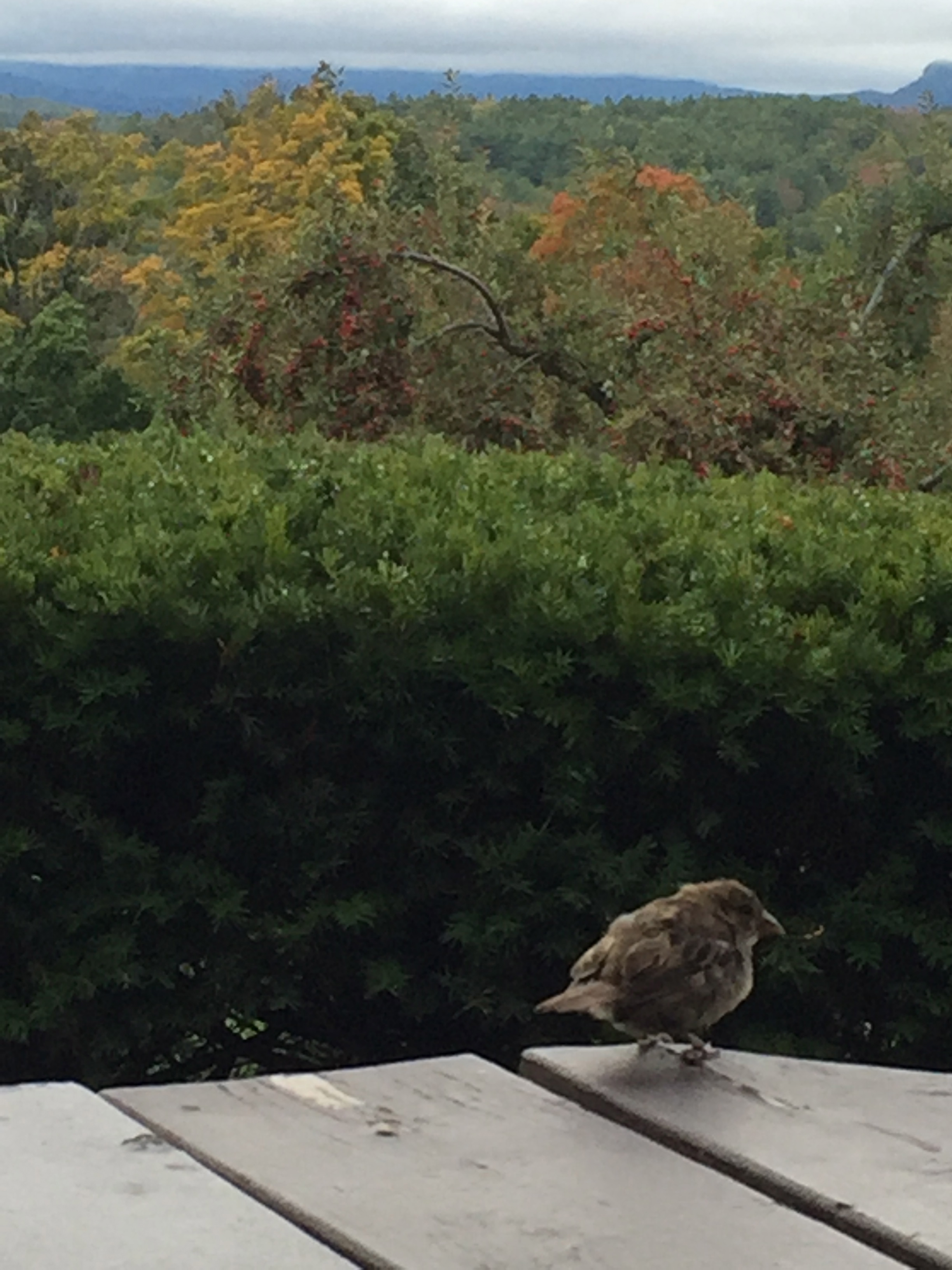
IMG_5148Outside there are expansive lawns, orchards, hiking trails, a lake, labyrinth and lots of places to contemplate quietly or share conversation. Sometimes I enjoyed taking my lunch tray outside to a picnic table under a canopy, even on a cool rainy day when a little wren, with her feathers puffed up against the breeze, was my only company. She hopped over to me and we contemplated each other with our heads tilted, eye-to-eye. I imagined that we were giving each other much needed encouragement.

By the third day, I had the energy to join the Yoga Dances during lunch—an hour of spontaneity during which we were introduced to yoga and Qigong moves that were translated to contemporary music, starting slow, gaining tempo. Fantastic sweaty joyous fun!

Our program also included Wellness taught by an M.D., a class in Qigong taught by- don’t laugh- a soft-spoken, near Harrison Ford look-alike. We also enjoyed a superb class in Nutrition with valuable content that dispelled any of our predisposed ideas that a class in Nutrition might possibly be boring.

The next day I cried some more and finally on Wednesday night I sobbed for four straight hours as the clock inched towards midnight. Filled a wastebasket with spent tissues. I didn’t know I had it in me. Letting go. Crying for the prospect of the new Life ahead of me.

Finally, at midnight, I threw a tunic over my nightgown and set out barefoot, to roam the halls where I made a walking meditation. Passed no one except a person talking to someone on the other side of the world, softly speaking in an Asian language that I couldn’t identify. Found my way to the dining room where I made myself a cup of chamomile tea and closed my eyes as the raw honey drizzled slowly into the cup, wishing I could drizzle the honey over my head— wishing I could feel the sweetness seeping into my soul.

The next morning, I felt cleansed. My fellow yogis ignored my swollen eyes. Maria’s topic of the day was Falling in Love with Life Again. Stillness, Focus, Self-Compassion. Using the tiny moments for relationship building.

I learned that it takes courage to be Authentic. There are epic gains to be made in living a true life of authenticity, but there will also be painful moments too- like crossroads decisions.

Late that night I took a sauna bath, lying back alone and naked in the dark as the heat drew the impurities away. I rested my hands on my belly, feeling my breath rise up with each intake, then drawing out and away with each release.

I came here on the edge of Hopeless. Now, six days later, I am on a path of Hope. Thank you, Maria. Thank you, Kripalu.

#hopeless and #hope

The Road to Marrakesh

After flights totaling 21 hours, we wearily checked into the El Mansour Hotel in the old Medina of Casablanca, Morocco. Roger left me in the dark shuttered room while he hailed a cab to pick up our rent-a-car. “I’ll be right back,” he said.

That was more than 40 years ago. February 1975. Our honeymoon.

Four hours later, my husband had not returned. I had taken two showers, paced back and forth endlessly, stripped off my clothes and burrowed deep into the downy bed, hoping to fall asleep and escape this nightmare.

I dressed and stepped out onto the balcony, shading my eyes from the brilliant sun that sparkled in the waves crashing on the Barbary Coast in the distance. Lorries and men in djellabas leading donkeys piled high with bundled goods vied for position in the street below. There was much crying and gnashing of teeth. Mine.

Finally, the brass doorknob turned. In strolled Roger, as though he’d just popped down to the lobby for a newspaper. An argument ensued. Roger claimed that some fellow had transported him all over the city because the car rental office was closed that day.

The next morning, he led me to a white Renault sedan and we headed north to Fez via Rabat. Roger was driving, although perhaps he might not have had the appropriate license. A young fellow, seeing our hippie clothing, had approached Roger earlier. Roger said the fellow would be our guide.

Distracted by this man in the backseat, Roger promptly zipped through an intersection, ignoring a traffic policeman’s directive to stop. Said policeman promptly signaled us to pull over. Our guide leaped from the back seat and ran away. I saw him growing smaller and smaller.

The policeman spoke no English. We certainly had no Arabic, and very limited French. The policeman commandeered a big-finned ’59 Chevy Impala and, as he climbed into the vehicle, he looked back, swiveling his wrist in a “follow me” gesture.

We traveled through narrow streets, finally emerging into a bustling square. An enormous pockmarked white stucco building stood at its edge. Unshaven men in dingy grey shirts stared out through barred openings.

The policeman, with starched uniform and stiff-brimmed cap, motioned out of the car. He brushed the street dust off his epaulettes, and adjusted the hem of his jacket. Throwing back his shoulders, he led us into the miserable building through a small cellar door.

There, across the vast, dirt-floored room, an enormous mahogany desk rose above us.

A ray of early morning sunlight shone through the single tiny window, and the polished surface of the desk reflected the somber faces standing in the long queue of derelicts beneath it.

A scowling magistrate peered down through wire-rimmed glasses. The policeman led us to the end of the line and as we inched forward, Roger formulated a plan.

“We’ll say that you’re ill from the heat. No—from your period! You have cramps! Hold your stomach. Moan!

When it was our turn, Roger pled “Ma femme est malade!”

A staccato conversation rose between the judge and the policeman. Suddenly the voice of the judge became louder– angry! What? The judge was reprimanding the policeman! Mon dieu! We just might get out of this.

The policeman led us back to the street, where he motioned that I was to drive. Roger hung his head, suitably shame-faced, and slid into the passenger seat. With an expression of disgust, the policeman waved me away from the curb. I shifted into first, then second, and pulled into a roundabout.

“Go!” he called, pointing north, “Go!”

Many kilometers later, we passed through Meknes and finally entered the capital city of Rabat. We were greeted by a traditionally garbed water-seller who poured cool water from his goatskin bag into shiny brass cups. We ate couscous in a café, then French pastries from a bakery. We were licking our fingers—rich strawberry tarts washed down with cold Oranginas.

Back in the car, we exited through the elaborately carved gates of the city, and soon were in the middle of nowhere, cruising along a smooth asphalt road that waved up and down, curving around orchards bright with oranges. The Atlas Mountains rose in the distance.

An argument ensued. Roger wanted to drive the car. “There’s no one here,” he contended. We quarreled for forty kilometers. Maybe more. I held my ground. He may have called me a “b*tch”. I may have said he was a “f*cking idiot.

Suddenly we heard a siren. It couldn’t be. It was. A motorcycle cop with a pen and ticket book in his hand. He spoke good English. He said that I had passed a donkey cart a while back in a “no passing” zone. Indeed, I had.

For a mere 200 dirhams (about US$50 at the time) we could put this little incident behind us. I peeled the bills from my wallet and smiled with appropriate humility.

At Fez, we hired a licensed guide who showed us his city with great pride and let me wear his fez for photos. We spent the night in a tiny hotel where the echoing Muslim call to prayer awakened us at dawn. We set out on the long road through the mountains to Marrakesh singing brightly. You know the song. “I’ve been saving all my money just to take you there, I smell the garden in your haairrr…”

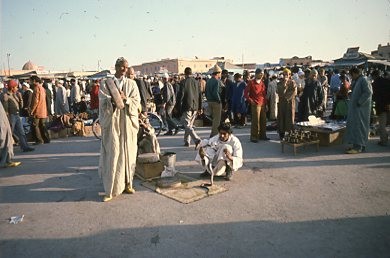
Cobra charmer, Djemaa El-Fna, Marrakesh; Linda Summersea photo

Cobra charmer, Djemaa El-Fna, Marrakesh; Linda Summersea photo

We found a room near Djemaa el Fna. A snake charmer removed his cobra from a coiled basket and led him in a hypnotic dance on a blanket. I practiced my negotiating skills, acquiring leather goods and djellabas from the vendors that surrounded the square.

It was time to head to Casablanca again, this time across the desert. Shimmering mirages appeared as a train steamed past us to the east. We rolled the windows down in the heat, singing “Marrakesh Express” at the top of our lungs.

Guess who was driving?

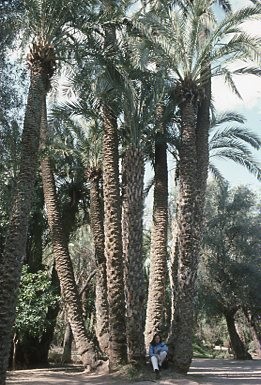
Linda Summersea, Marrakesh, 1975

Linda Summersea with Palms, Marrakesh, 1975