My Kindergarten Best Friend

My Kindergarten best friend was also my very first friend. We were so similarly timid that we didn’t mind that our conversations were brief bits that hinted  at our equally isolated upbringing.  Our zen-like circuit of a cobblestone walk was our practice place for future socializing.

Visit Substack to read about my first rewarding peer relationship with another fragile soul.

A Woman Who Desires More Writes a #Memoir

Hear me share a couple of childhood anecdotes from The Girl with the Black and Blue along with discussions of immigration and what values drive a woman to persevere on the road to pursuing her dreams.

Recently I had the pleasure of being interviewed by Fiona Citkin for her program, #TheBridgeforWomenWorldwide. (18-minute video)


“I have always loved wild places.

I grew up on a three-generation, hundred-acre family farm

where my siblings and I were put out to pasture at an early age.

We crawled on our bellies in our stick forts

and grazed on wild strawberries till the cows came home.”

Linda Summersea


Linda Summersea, a late bloomer in creative writing, authored a memoir THE GIRL WITH THE BLACK AND BLUE DOLL, and confessed:

“My writing is not my hobby. It’s my passion. I want to write and travel and live my life to the fullest for as long as I am able.”

Please VIEW on YouTube and LIKE. ❤️ THANKS!

#comingofage #amwriting #writercommunity #literarynonfiction #amquerying

Frank McCourt was my Inspiration

About once a year, I do a Google search for Noah Adams’ NPR interview with Frank McCourt so I can hear McCourt’s lovely Irish voice and once again, be inspired.

Why was is Frank McCourt my inspiration?

  1. Because it was after hearing NPR’s 2009 interview with Frank McCourt, that I knew I wanted to write my own memoir.
  2. Because when Frank McCourt published his first book, Angela’s Ashes, at the age of 66, I thought maybe I could still be considered an “emerging” writer at my age.
  3. Because I loved the way he managed to write the dreadful conditions of his childhood in a comic manner.  Wikipedia calls it a “tragicomic memoir of the misery and squalor of his childhood.”
  4. Because I had first-hand knowledge of a painful childhood.

No, I didn’t grow up in squalor. We lived on a 3-generation farm where we had plenty of food to eat, and a hundred acres to run around. Of course, the reason we had a hundred acres to run around was that my mother commonly locked us out of the house so she could watch “her stories” on television and smoke cigarettes. I was in charge of the younger kids and, for their entertainment, I led them over hill and dale, dodging cow patties, grazing on wild strawberries, and building stick forts until the cows came home.

When I heard the NPR interview, I was 59.  It took me more than a few years until I got started. I was naive enough to think that my memoir would be ready after two or three rounds of editing. Ha! It’s taken seven drafts to get it right.

But enough about me. My mother would always accuse me of “getting a big head” if I said anything positive about myself. 

I think I’ve managed to write some decent tragicomedy in my 371 pages of The Girl with the Black and Blue Doll. (McCourt’s has 369 pages. A coincidence.)

But I can’t match McCourt’s “we were so poor” story.

He told of how they were often without food.

One night he asked his uncle about food to eat and his uncle said there was none, so after the uncle went to bed, young Frank saw his uncle’s discarded fish and chip newspaper on the floor.  He retrieved it and began to lick the oil out of the newspaper pages.  Licking the obituaries and the sports pages and the headlines of World War II (and more!) until there was no more oil to lick.

I still think that fish and chip newspaper is the most tragicomic story I’ve ever read.  In my own memoir, the fish and chips were a bit more serious. Here’s the short version.

Like McCourt, we also were Catholics. One day when my mother had just put the Crisco on the stove to heat for the fish on Friday that she was going to cook, she got distracted. She heard the bread man toot his arrival in the driveway, and since Mummy was always very chatty, she and Norman always spoke at great length. The next thing she knew, Norman saw black smoke pouring out the screen door. A fire! The firetrucks, my baby brother being brought out to his carriage, my siblings and I running down the road from the school bus to discover the disaster. I saw my 10-year-old brother being flung horizontally from the front step by a fireman.

“Get outa here!” snarled the fireman.

“It’s my house!” screamed my brother.

That night as we sat around the kitchen table, my mother cried. Then, my father began to cry. I don’t know what we had for supper, but it wasn’t fish and chips.

And the next day? We went to school as usual. Dirty hair, smoky clothes. Sad.

I was in the girls’ room when I heard Sister Florentine’s voice, “Where’s Linda?”

That concerned me but I eventually came out of the stall and she ran to throw her arms around me. I remember her wooden cross pressing into my chest, her scratchy wool habit, and the feeling of being held like a baby.

It was my very first hug. I was in eighth grade.


Here’s a link to the NPR interview. Noah Adams reveals a great deal of the man in this 9-minute listen. Enjoy!

https://www.npr.org/1996/10/01/1045022/frank-mccourt-on-angelas-ashes

The First Memoir I Ever Read…

The first memoir I ever read was Frank McCourt’s Angela’s Ashes. It caught my ear as I was waiting in the car while my husband popped into an auto parts store. We were parked at the intersection of Route 412 and Butterfield Coach Road in Springdale, Arkansas and the auto parts surely had something to do with flat tires. I changed many a flat on our chert-laden Washboard Hill.

But given my love of wild places, it was a no-brainer that we were raising our children in a cottage located down four miles of dirt road and across two creeks (and no bridges) on a lake in Arkansas.

It was ten miles by road to the closest school bus stop. Or a mile by canoe to the closest bus stop as the crow flies. This option was down in Hogscald Hollow, as soon as they were old enough to paddle alone—at ten and twelve.

But back to Angela’s Ashes. It was a beautiful sunny day and on that day, October 6, 1996, NPR was interviewing Frank McCourt—another late-blooming memoir writer. I think what impressed me the most was the way he laughed and chuckled as he spoke about some of the most dreadful events of his childhood.

He couldn’t do anything about it. He was a kid in Ireland, living in The Lanes.

If ever there was a personification of perseverance, I suppose the late Mr. McCourt must surely be on the list. This was a man with grit and joy.

To hear it from the man himself and his lovely accent, listen to the 1996 NPR interview with Frank McCourt below.  He wrote Angela’s Ashes at 66.

R.I.P. Frank McCourt.

https://www.npr.org/templates/story/story.php?storyId=1045022

Happy Christmas to all, and to all a good night!

I haven’t posted in a while because here on the home front, beyond politics and Covid-19, I’ve been riding the roller coaster of Life. I’ve been hanging tight… It wouldn’t be Life if we didn’t have a few lessons to learn, right?

I wish all of you a wonderful holiday season and a happy new year 2021! And without further ado, here’s a happy memory from Christmas week, 1966.

“I was sixteen. I was driving myself to Denholm’s Department Store in a city twenty miles away on a school night. I must have told Mum and Dad what I was up to because I had to ask permission to borrow the car.

As proof of my emotional immaturity—and my hesitation to leave childhood behind—I was on my way to fulfill a childhood fantasy. I had always wanted to have my picture taken with Santa Claus.

On the second floor of the store, I saw Santa sitting on a golden throne in the Toy Department. His throne, hung with fragrant evergreen swags and a string of twinkling white lights, was the centerpiece of a green-carpeted platform placed three shallow steps above the rest of us. I joined the line of small children and their mothers, and they paid no attention to me. Well, maybe they did.

I was wearing an A-line, mint green, silk shantung dress. It was the prettiest dress I have ever owned in my life—bar none. I even felt pretty in that dress.

I was a little nervous and somewhat intimidated. I had my coat unbuttoned, ready to shed it quickly as I got closer to Santa.

When it was my turn, I handed my coat to an elf. I tiptoed up the steps to Santa and sat on the edge of his lap, just barely touching his red velvet thigh. I told him I didn’t want anything for Christmas except the photo, and I directed one of my rare smiles towards the elf with the camera. Santa didn’t say too much. Maybe he ho-ho-hoed. After the camera flash, I stepped down from the Santa throne and a few minutes later, my Polaroid was ready and Santa’s elf handed it to me in a Merry Christmas photo card.

I liked it. I did. There I was—carefully seated with Santa in my pretty green dress. My long brown hair looked just right. It was perfect. Even in my self-conscious state, I couldn’t find anything wrong with it. I stared at the photo as I rode down the escalator and floated out the door to where it was snowing lightly, just a scattering of fluffy flakes under the street lights to dust this fairy tale evening with Christmas magic.

I drove home on auto-pilot, parked the car in the driveway and before anyone had time to question me, I hung my coat in the hall closet and made my way upstairs to bed. I never shared that experience with anyone before now. Maybe I’ve always been a little embarrassed at being so lonely and emotionally withdrawn, but having my photograph taken with Santa Claus at age sixteen had given me Joy. I’m glad that I was brave enough to realize that it’s never too late to make something right.”

Summersea, Linda. The Girl with the Black and Blue Doll.

On the Steamship Finland

“Babci! Can I have a cup of tea?” I skipped into the kitchen and plopped into a chair at the kitchen window. From upstairs, I had watched Dziadzia heading across the lawn to the barn where he would milk the cows.
“Yah,” said Babci. She opened the upper cupboard for tea cups and tea bags, then pulled a teaspoon from the drawer below.


Babci’s kitchen continued to be a good place for a lonely girl to get away to. She and I spent many quiet afternoons in mostly companionable silence. We always drank tea. Lipton or Salada. No sugar or milk. If we were having tea alone with no bread or pie, we sat near the kitchen window with a low oak cabinet between us. The cabinet stood in front of the west window where a sill full of potted red geraniums bloomed plentifully all year ‘round. Their strong herbal fragrance lifted into the air when Babci pinched off a dried blossom or plucked a withered yellow leaf. Even today, years and years later, I always have geraniums in my planters, and I always remember Babci as I remove the spent blossoms.


It was during one of those tea-infused afternoons that I learned Babci had been only seventeen-years-old when she set out for Antwerp and across the ocean beyond on her way to America. I don’t remember how the subject came up, but soon Babci was blurting out the whole story of her travel on the steamship Finland.


She was standing alone on a train platform somewhere in western Russia in 1911, six years before the Russian Revolution. Her family lived in Kolno, in rural eastern Poland which was part of Russia at that time, and she managed to find a ride in a carriage that would pass by the station.
The moonlight sparkled on the crust of the deep frozen snow. Young Róża drew her cheap coat closer against the bitter cold and stamped her feet to warm them.
When the train arrived at the station, Róża boarded and handed her ticket to the conductor. It departed soon after with her trunk in the baggage car, and its shrill whistle merged with the howling of the wind and wolves in the forest. Some of the travelers, those bound for fancy destinations in Western Europe and the Christmas holidays, were elated to be on their way. Others, like Róża, may have shed a few tears for her Mama and Ojciec left behind.
She layered her hand knit shawl over her coat and pulled it tighter. Being peasant Polish, she couldn’t afford a stylish pheasant-feathered hat like those she had seen entering the First Class compartments. More likely, she wore a babushka tied beneath her chin, like the one she wore almost every day of the rest of her life.


Arriving at Antwerp the next day, Róża’s trunk was transferred to the waterfront. She carefully removed some money from a pocket hidden in her petticoat and bought a Steerage Class ticket to New York at the Red Star Lines’ ticket window.
The dock was a beehive of activity. The ships of the Red Star Line were always full occupancy with travel between eastern Europe and the United States. Many of them were Jews until the threat of the Nazis stopped their exodus.
Wagons were being unloaded left and right. Róza walked the gangplank onto the ship Finland with the other young people, first watching to be sure that her trunk was stacked on the baggage wagon and hauled on board. She knew to be careful. Everything she owned was in that trunk. Her clothing, her Sunday church shoes, her featherbed, and even—a basket woven of willow that sits on a shelf in my kitchen today—right beneath my cookbooks. Róża fingered the rosary in the pocket of her coat, one bead at a time, her lips moving silently with her prayers. She found her way below deck to the Steerage Class bunks. Soon the ship was underway.


Babci told me that the trip at sea was scary. Girls in the nearby bunks whimpered and moaned, crying and vomiting with seasickness. The food served below was “nie dobzre”—“no good”—she said, but she had to eat in order to be strong for the medical examination upon arrival in the United States. She stood in line with her tin plate to receive a grey meal consisting of a chunk of bread and a scoop of watery stew ladled from a big pot. The smells of seasickness and the boiling meat blended together, so, like the others, Babci mostly stayed in her bunk with her queasy stomach.
She shared that when she first made her way through the ship’s windowless hold to her assigned bunk, she saw people with dark black skin nearby. The lady in the next bunk told her they were devils.
“Devils.” Babci repeated the word. “Devils!”
She laughed self-consciously when she told me this. It was the slightly embarrassed character of Babci’s laugh that communicated to me—a ten-year-old who had only seen black people on television—that she might have actually believed it at the time.
We shook our heads at such a silly thought. Who would believe such a thing?


As the Finland steamed westward, Róża preferred to keep to herself. Christmas came and went. She told herself her Christmas gift would be stepping ashore at Ellis Island. And so it was, although it took some time. The steerage passengers were transported on unheated barges, and by the time they got to the Great Hall, her hands were cold and her nose, dripping. There were examinations and interrogations.
“Where are you going? Where are you from? What is your occupation? Who is meeting you? Do you have a job to go to? How old are you?” and more. Those were the questions that were asked as she stood before the official in Immigration. The answers were scribed in a ledger and Róża was officially permitted entry into the United States of America.


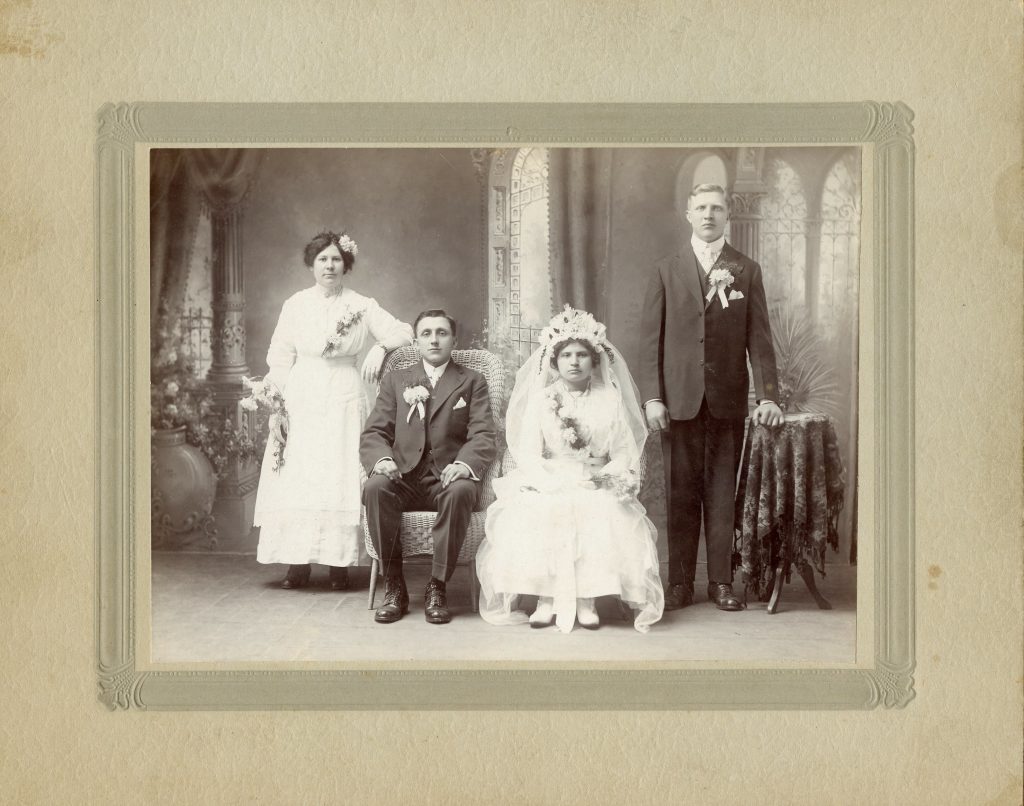
Babci and Dziadzia, Uncle Heromin and the unidentified Maid of Honor

Unexpected Triggers

Yesterday, Janet brought me a freshly-picked bouquet of August blooms accented with curly-topped white phlox. They were just like the phlox that were as tall as I in the days when I ran barefoot in dewy cool green grass. I was 3 or 4 years old in that memory and my grandmother’s phlox border must have been about thirty feet long. It stretched the length of our tractor garage from the tool shed to the outhouse.

Vivid blue-violet salvia, the spiky perennial kind, sturdy-stalked and long-lived, stood out boldly, almost dominating the three velvety stalks of gladiolus that completed the arrangement. I placed them in the middle of the coffee table and examined the gladiolus more closely.

They were a color that I’m still challenged to describe—somewhere near coral but pinker and not quite red. These sweet gladiolus were the trigger.

How could I have forgotten about my mother’s love of gladiolus?

Gladiolus were always prominent in the displays on the altar at St. Joseph’s when I was growing up. After Mass, my mother would coo over the gladiolus.

“Did you see the red and yellow gladiolus? Ohhh, they’re so beautiful…”

You may know that gladiolus are grown mostly for cutting.

My mother, however, never cut a single stem of hers.

The reason was that my father would not allow fresh flowers in our house (except for lilacs which he had grown up with). He despised the fragrance of fresh flowers and said that they made the house smell like a funeral parlor.

Maybe it was the metamorphosis of soft vulnerable petals to dry and withered remains that offended him. Acceptance of his mortality had never come easily.

My mother would not be discouraged. She planted her beloved gladiolus in a long, straight row, five inches apart like it said on the bulb package, next to the Tenderpod green beans. She would walk in the vegetable garden after supper in August, and given the alternative, she was content to admire her gladiolus next to the green beans.

In the house, she placed a bouquet of plastic flowers in a cheap cut-glass vase on top of the TV. They couldn’t come close to standing in for flowers sprung from the soil, rained on by spring showers, and coaxed open by summer sunshine. These plastic flowers would never die, even though they faded to pale ghostly shadows in the window’s bright light.

Eventually, silk flowers were invented, and my mother tossed the dusty plastic flowers, replacing them with silk roses, red as the ones lovers send on Valentine’s Day, flowers that my mother never received.

The years passed and soon my father was at the end of his days, under hospice care at home, a hospital bed installed in their living room. When my mother found him dead, she refused to unplug his oxygen until the first responders came to take on the task.

The next day, she awakened and went into the living room. She swears that one of the roses red as a lover’s valentine had popped up from the bouquet during the night. She says she found it sticking out five inches above the rest and is convinced to this day that my father was sending her a message from the other side.

And while I do believe in ghosts and I do believe in miracles, and in lovers bringing red roses, I’m not sure that I can believe in this particular ghostly miracle.


gladiolusFollow me on Facebook. I can always use a few more friends.

You CAN Go Home Again

It’s the time of year when most of us make the trek to the scene of our origins. It’s a return to where we grew up, or where the siblings that we’re still speaking to reside, or where our parents—if they’re alive— might still be hosting a neutral setting for others to come together.

When I was in my twenties, this holiday renewal took the form of careful baby steps.

My parents and I had had many confrontations during my high school and college years over politics and lifestyle, but once I had a “real” job (teaching), we all seemed to calm down a bit.

A detente of sorts.

My parents accepted that I had finally joined the mainstream of brassiere-wearing professional females, and I chose to ignore my parents’ many hair-raising inconsistencies.

My mother had always modified the truth to suit her view of circumstances.

Her Big One was lying to us about her high school graduation status. I always suspected she hadn’t graduated, and I was right. How did I know? Well, of course, I checked her graduation class stats in the yearbooks of the largest online database of high schools in the U.S. You know the one. They send you cryptic emails all the time, tempting you to see who remembered whom.

To Mummy’s way of thinking, if she had admitted that she dropped out of high school, she was convinced that we also would drop out of high school. Because of course, we would want to emulate our mother.

Not much chance of that—but that’s how she thought.

Big One #2. She lied about never having tried cigarette smoking. Not only did she exclaim boldly that she was “so glad” she had never tried cigarettes, but she said this in spite of the fact that we all knew—from the billowing clouds of nicotine that she left in the bathroom on winter mornings when she couldn’t open the window—that she was a bold-faced liar. The only person she was fooling was my father, himself a lifelong smoker with a permanent aura of cigarette vapors clinging to his clothes.


I had always yearned to have a wise mother figure with whom I could talk about boys or my period or the state of my ambiguous future. Someone like Barbara Billingsley or Donna Reed. Someone who might tell me where babies came from.

Instead, by the luck of the draw I got the antithesis of the nurturing stereotype. But things weren’t all bad. My siblings and I were allowed to run untethered from dawn till dusk from a young age. Yes, Mummy locked us out of the house—but we had more freedom than any of our schoolmates. We developed independence.

By the time I married and had children, I continued to visit periodically and kept my mouth shut about my early years. Let sleeping dogs lie, as it were. Mummy had her grandchildren to gift with polyester rompers and I could monitor her interactions, ignoring her parenting suggestions as I felt appropriate.

“Don’t pick up the baby when he cries. You’ll spoil him!” she said.

Year after year, my memories sifted to the surface with bits and pieces of long-forgotten trauma.
My father is gone. My siblings and I all get along fine, in spite of childhood years where we were pitted against each other. (My father’s special talent was his ability to make each of us feel that we were the least loved.)

My mother is now a remarkable 87 years old. I suppose it’s not surprising. She certainly acquired her share of immunity, and she passed it on to us.

“You’ll eat a pound of dirt before you die!” she always exclaimed when she picked up the slice of our cake that had fallen in the dirt and returned it to our grimy little hands. No forks and plates for us! No siree, Bob! No napkins either. We used our sleeves for wiping our mouths and our noses in no particular order.

At 87, I thought that she might be in a position to answer some of the questions I’ve long wondered about but never had the courage to ask. I tried for years, but always stopped short of confrontation. I had shed my tears long ago. No need to start them flowing again.

Last week, as Mummy sat at the kitchen table completing page after page of dementia-fueled word search puzzles—her obsession—I dared to ask where she had gone during those times when she dropped us off. At swimming lessons. At the movies and such.

She looked up confused. Did we go to swimming lessons? Yes, Mum, we did.

Was it indoors or out? It was outdoors, Mum. It was at the town pool where the other mothers sat in the bleachers sipping Coca-Cola through straws tipped with red lipstick while tapping their cigarette ashes against the cold metal benches and squinting into the sun at the swimmers flailing below.

I realized last week that I’m never going to get answers to the questions I have had for so long. And point would it serve?

We each have our own memories. How we choose to allow our memories to color our lives is up to us. We can use our past as a lesson, we can dwell upon it, or we can move on.

 

Follow me on Facebook.

 

Writing the Nightmares

This morning I awakened at four, as is not uncommon for me. I rolled over and thought happy thoughts, took a few deep belly breathes and fell back asleep, only to reawaken two hours later with a vivid nightmare shaking me by the shoulders.

Writing the Nightmares

When I attended The Magic of Memoir conference in Oakland CA two weeks ago, I was witness to a lot of amazing stories told by brave, wounded, survivor writers. It made me realize that writers with those kinds of memories are more likely to write about them—in memoir or as the basis for fiction—than the fortunate souls who leaned back and pumped their swings higher and higher into blue skies and fluffy white clouds.

Last night I was reading one such story and it combined with my personal memories to produce this morning’s nightmare in full living color. (I don’t often dream in color.)

The content is not so important. I wanted to forget it quickly—but I haven’t. I could tell you about the multiple layers of the dream—but I won’t.

Instead I’d rather tell you about where my mind wandered after that.

I clicked open the piece that I’m fine-tuning for The Lit(erature) Lounge storytelling event next Sunday at the Open Space for Arts and Community on Vashon Island, WA. It’s partly about my grandmother Mémère. My chain of thought this morning went something like this. Not the writing piece, just the musing. I’ve left out the punctuation. Ha. Too many apostrophes.

“Mémère. French.

Memoir. It sounds French, but it isn’t spelled French. We spell armoire with the e, so why not memoir with the e? If it were, we’d be spelling it memoire. Our memories. Another inconsistency of the English language.

Memoire of Mémère.

Mémoire. Like armoire. An armoire is a chest. And isn’t a memoir like a chest? A chest of memories?

Except that armoires were originally used to store weapons. Memoire then is not so far-fetched, since doesn’t a memoir-née-memoire also store weapons?”

Writing the Nightmares

As I read the memoir last night, I thought of the woman who wrote it, who lives here on this island. Another survivor walking around with a smile on her face in the midst of all these other survivors walking around with smiles on their faces.

Because we all survive something.

It might not be the stuff of memoirs, but it’s another layer that has made us who we are. If we’re lucky—and we can make our own luck—we get to put it behind us and let the good days, the now days, the tomorrow days, outshine the nightmares.

Once we have finished writing the nightmares, we’ll be on the other side, ready to pump our swings higher and higher into the blue skies and fluffy clouds.

writing the nightmares


writing the nightmaresFollow me on Facebook.

Subscribe to this Blog by click here or the Subscribe button at the top of the page. Go ahead. I’m never gonna Spam you. 🙂

Sit With Us App

The Sit With Us app was announced yesterday, creating a subtle but ground-breaking way for lonely teens to connect in lunch rooms without calling attention to themselves.

16-year-old Natalie Hampton designed the Sit With Us smartphone application in response to the feelings that she experienced when she spent her entire 7th grade year eating lunch alone. The app invites students to become ambassadors and indicate their lunches are open for other students to join.

A brilliant idea.

If you’ve ever experienced lunch room loneliness, the news of the app may have hit you right in the middle of your aching stomach. The same stomach that felt really sick every single day as you slid your cafeteria tray down the stainless steel counter, dreading the end of the line, knowing that after you gave your fifty cents or dollar to the lunch lady, you’d have to pick up that tray and join the crowd whose roaring voices were filling your head with fear.

I was one of those kids.

I attended a parochial school in a neighboring town for grades K-8, and then, because my own town had a public junior high that went up to grade 9, I was forced to make my transition to public school there. After that, I transferred to a public high school back in the neighboring town again for grade 10-12.

I ate lunch alone every single day for those three years.

I can tell you the colors of the matching Bobbie Brooks sweater and skirt sets that the girls at the popular tables wore as I inched my way to a place by the window.  I remember their hair styles, their loud laughter, their Weejuns, their monogrammed sterling silver necklaces, their purses that held their rat-tailed teasing combs and packs of cigarettes. I can even tell you the conversations I overheard.

I did actually have a handful of friends—not at the same time, of course. But those friends had boyfriends or a lunch schedule that wasn’t the same as mine.

Every day my schedule placed me in the cafeteria at its busiest. By the time I lifted my tray from the counter and turned to face my fate, there were just a few single seats here and there.

The oak tables and chairs were lined up so close together that I had to lift my tray to shoulder height as I squeezed through the tight aisles. The sturdy old chairs had fifty years worth of bruises on their legs with lots of rough spots. They had seen a lot of abuse.

My goal each day was to carefully pick my way through the crowd to an empty space without getting a run in my nylons. About once a week, I failed. My stocking snagged on a splintered chair leg and I felt the hole in my stocking grow as its climbed up my leg leaving an ugly track of broken nylon and pale skin.

If I was lucky, my mother might have a spare pair of nylons at home but usually I had to wear the same stockings with the runs in them until she remembered to pick up a replacement.

We lived in a rural area of farms—no stores. I rode the school bus home and depended on my mother for the sundries of high school life. Nylons, binder paper and ball point pens.

It wasn’t so bad. I survived.

But the Sit With Us app would have helped.

sit with us app


sit with us appFollow me on Facebook.


Maybe you know someone who could use the Sit With Us app. It’s available as a download in App stores.

Sit With Us App