The Setting in Your Manuscript

When I was in fifth grade I read a book with a vivid salt-sprayed setting on the coast of Maine, a mysterious place a few hours drive from where we lived in inland Massachusetts.

The author’s words described it in great detail and I entered her world vicariously.

The marsh grass swept the tips of my fingers as I crossed from the field to the edge of the beach. I could smell the dampness of the spray. The grains of sand were warm on the bottom of my feet as I walked the shore, and I shivered when the icy water reached my toes.

In this story, the child protagonist lived in an idyllic summer setting near the sea. The house had weather-beaten shingles, the windows were always open and the sheer white curtains fluttered in the ocean breezes.

When the child looked down from her bedroom window, she saw her mother weeding a flower bed of zinnias and petunias.

You’re wondering how I would remember such a simple scene in a book so long ago.

Here’s the thing. I had never seen the ocean. I wanted to see that ocean. I wanted to walk on that beach, and I definitely wanted to grow a flower garden.

For most readers, “zinnias and petunias” would be enough. I, however, had no idea what those flowers looked like.

I sorely wanted to see these flowers in my mind’s eye, so I asked my mother.

“Mummy, what are ‘zinnias’? What are ‘petunias’?”

My mother said, “I don’t know.”

My mother always said “I don’t know.” It was always too much trouble for her to devote a minute to explaining something to me.

You might find this sad or disconcerting. Don’t.

Yes, the coldness, that was inherent in that negativity, did hurt me. It caused me to turn within myself. Why wasn’t I worth an answer? Why couldn’t I get a response to that which puzzled or bothered me? Why was I always left hanging in uncertainty?

On the up side of this was the fact that her attitude fostered creativity and resourcefulness in me. I had to find my own answers. I had to find my own way to do things. I had to keep plugging away.

Look what just happened. You just witnessed a flashback.

A description of Setting sidetracked into a scene from my memoir—the reason being that I’m deep in the editing process right now and I never know what is going to trigger a momentary shift in time.

I began this post with the intention of describing the importance of detailed settings, and lapsed into recalling a frustrating childhood moment.

Books should totally do that too.

The book set in Maine did a perfect job with the setting for most people, so I doubt that anyone—except me—would object to not having enough description to visualize zinnias and petunias. However, my puzzlement over the zinnias and petunias is the kind of opportunity for description that we writers need to identify in our pages.

The zinnias had layers of tiny petals, that began at the center of each bloom and expanded outward like the explosion of a fireworks display.

The petunias, trumpet shaped, and ruffled like the collar of my favorite blouse, were white with throats of purple and lavender.

Look for your petunias and zinnias. Paint them vividly with words and feelings.

publishing newsFollow me on Facebook.

setting

National Teacher Day

May 3 is National Teacher Day.

In Kindergarten, we were asked what we wanted to be when we grew up. Girls were given the choice of mother, nun, nurse, or teacher—not necessarily in that order. We had to say our choice aloud. I knew that mother—from what I had witnessed thus far—was not a very good occupation. I knew too little of nuns, and I was definitely not nurse material. I didn’t have much empathy. That left “teacher”, which I spouted mechanically when it was my turn.

I was a lost soul, wandering whichever way I was pointed and I was pointed to teaching.

Teaching Art became my life’s career—especially with Youth at Risk and children in low income areas. Even though it was a role that came to me accidentally, I loved it, and I learned a lot from my students. I hope they learned half as much from me.

If you’re fortunate, teaching is not something you learned, but something you were born with.

One of my principals made that observation after her annual teacher assessment visit in my classroom. She told me that I was a “born” teacher— a comment that took me by surprise. It affected me tremendously and after that event, I made even more effort to be sure that every day, every hour, in the classroom was a worthy one.

Every year when I see the National Teacher Day advertising, I can’t help but think of my favorite teachers and how they earned my respect and admiration.

My first Great Teacher was Sister Florentine, my 8th grade teacher. She was the first person in my life to give me a hug. I can still feel the rough brown wool of her habit wrapped around my shoulders and the pressure of her wooden cross on my chest as she drew me close.

My second Great Teacher was Adele Davis, my 9th grade English teacher. She read my essays aloud to the class. If we had a two page assignment, I usually wrote four. I loved to write and I didn’t know when to stop. Our class was the period before lunch, so as she read my work, all eyes were on the minute hand of the clock as it inched forward to noon. I knew better than to think anyone might be listening. I didn’t have anyone to sit with at lunch so it wasn’t a big deal for me.

I sat at the back of the class, next to student X, a guy who made derogatory remarks about my body. Listening to Mrs. Davis distracted me from my self-consciousness and the daily pain of having to sit next to him.

Writing comedy was what I enjoyed most. I listened intently, noticing which lines she liked, which sentences made her shake with laughter. Her reading glasses quivered, making their way down to the tip of her nose where she pushed them back up again.

Those minutes before the lunch buzzer sounded were some of the best times of my life. She placed value on what I had to share.

Both of those teachers died quite a long time ago. As an adult, I tried to find them multiple times, but it was before the Internet, not an easy task. Now, of course, I’ve seen their obituaries. They both lived long lives.

Maybe, if you had a great teacher in your life, on May 3, you might reach out to them with a few words of thanks from the past.

BestTeachers

The Scent of Writing

The scent of writing is all around me this morning in the form of a bouquet of lilacs. Yesterday, I placed the Mason jar bouquet on the shelf next to my bed, where I begin my morning reading and writing with my first cups of coffee.

The scent of lilacs. How that returns me to my childhood! All those times that I cut the stems for our apartment. All those times that I wished I could carry a bouquet of lilacs to school for my teachers—but was too painfully shy, year after year—to carry out my fantasy of standing before my teacher with the sweet blooms.

A smell from the past is often what one needs to jump start a memory.

The science behind this is that the olfactory bulb accesses the amygdala, which processes emotion, and the hippocampus, which is responsible for associative learning.

When we first smell a new scent, we link it to an event, a person, a thing or a moment in time. Our brain creates a link between the smell and a memory so that when we encounter the smell again, the link is already there, ready to elicit a memory or a mood—positive or negative.

I don’t know if it’s my imagination or not, but it seems that since I placed that bouquet on the shelf yesterday, I’ve been better able to fine-tune the outdoor chapters of Spring in my memoir. More details have come into focus.

Tomorrow, cinnamon.

scent of writing


Follow me on Facebook.

scent of writing

Norman Rockwell and the Dolls

The Norman Rockwell Museum in Stockbridge had only three cars in the parking lot on this cool wintry-looking April day. I parked, knowing that I’d enjoy the luxury of having the museum almost entirely to myself.

I tried to get here on a couple of other days, but made the mistake of beginning to write early in the morning, not noticing the clock until it was past three. Too late to set out. This time I planned ahead.

The building itself is a perfectly classic white complement to the Americana style of Rockwell, its peak topped with a cupola that pours light into the space below. There are a lot of cupolas in this area of the Berkshires. Even the barns have cupolas—more than likely designed to let light into the barns during the dark sunset hours when candles and oil lamps were dangerous in barns filled with hay.

As much as I wanted to wander around outside, I crossed to the main building following the sidewalk that was the only surface empty of snow. Strong snow glare and sunglasses.

A visit begins with a brief biographical film in the basement where I sat alone,  front and center, surrounded by a collection of framed The Saturday Evening Post magazines, in a gallery full of empty chairs waiting to greet the summer crowds.

There’s a lot I didn’t know about Norman Rockwell.

I knew that Norman Rockwell painted the cover art for the countless Saturday Evening Posts that I pored over in the privacy of the screened porch at my grandparents’ lake house. A large cardboard box full. I dug deep into this box of buried treasure, pulling up one after the other on Sunday afternoons while my cousins played with their blond bitch Barbies in the upstairs bathroom. (Sorry. My doll feelings are showing.)

I knew that Norman Rockwell’s skill as an illustrator was epic. His dedication to creating charcoal sketches of the desired work, then progressing to an oil study, followed by the final painting, went far beyond mere illustration. He used local people as models for the paintings, photographing them in multiple poses to have his own stock of expressions and inspiration. Frequently, he added his own image—often playfully.

What I didn’t know was that Norman Rockwell was a natural-born illustrator with skills that surfaced at a very young age. He often interrupted his father’s story-telling so that he could sketch out what was being described.

Fortunately his parents recognized his gift and he dropped out of traditional high school to attend art school in NYC. His first job after graduation was at Boys Life, the Boy Scout magazine, at the age of seventeen. By nineteen, he was their Art Editor.

I attended a gallery talk by a talented docent who shared insight into Norman Rockwell’s creative style, his influences and especially, his symbolism.

The use of symbols to convey meaning is common in master works, in what we consider “museum art”, but illustration art has often been overlooked as lacking in this sense. Norman Rockwell was far ahead of his time in uplifting the art of the illustrator.

While many viewers may have seen only the subject matter of the Post covers, each painting had been planned with intricate attention to detail. The use of triangulation to draw the viewers eye to the message. The use of color and symbolism to project the message.

Which leads me to the dolls in some of his work.

If you’ve read some of my essays, or work-in-progress excerpts from my childhood memoir, you already know. I never liked dolls. In fact, I despised them. I didn’t know what you were supposed to do with a doll.

Sixty-something years later, I couldn’t escape the dolls, even here at The Norman Rockwell Museum. Like the snowstorm of a few days ago that carried me back to the snowy winters of my childhood, the dolls in the paintings of Norman Rockwell carried me back to the phases of my childhood where dolls were supposed to be part of a normal child’s play.

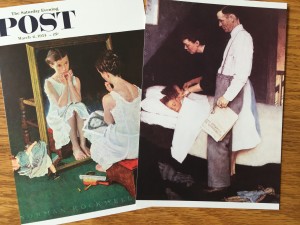
The first painting I noticed was Girl at the Mirror, from 1954, where a young girl is clearly absorbed in the self-analysis that accompanies puberty. A hairbrush, comb, and an open lipstick case are on the floor at her feet, a movie magazine in her lap, a wistful expression on her face. Her doll is posed in a position of rejection, tossed to the left of the mirror. She no longer has use for it.

Second was Freedom From Fear, one of the quartet of The Four Freedoms paintings which traveled the country raising money for the war bond effort. In Freedom From Fear, Rockwell used a doll placed on the floor at the foot of the bed to illustrate that the children being tucked into bed have freedom from fear. There’s black fabric on a chair—possibly to symbolize the blackout cloth that was used to block city lights during WWII. The father is even holding a newspaper with the headline of “bombings” and “horror”—a prop that the local newspaper printed for Rockwell to use in his layout. The docent who noted these details shared that the doll on the floor meant that the children didn’t need to cling to their dolls for security. They didn’t need a doll to comfort them.

The dolls, used as symbols of childhood shown here, are innocent. They don’t take into account the children for whom dolls represented a dark side.

That’s OK.

As I viewed The Saturday Evening Post covers of the 50s, I saw a lot of family values and reminders of every day events from a time that celebrated the innocence and good times, post-war optimism and prosperity. I saw the hair styles, the clothing, the cars—the scenes where my own childhood took place.

And symbolism? Good writers share the artist’s use of symbolism to evoke the feelings that they are wishing to convey. I was glad to receive the reminder.

Norman Rockwell


Norman Rockwell
Follow me on Facebook.

Subscribe to this blog at left. Receive the posts in your email.


Snowstorm

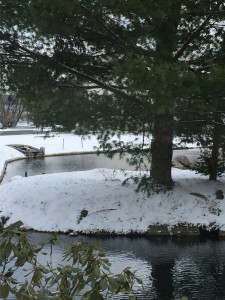
A spring snowstorm arrived overnight in the Berkshires, triggering more childhood memories.

Haven’t lived where snow is a regular event for more than twenty-five years.

There was plenty of warning. We all knew the snow was coming. I went to the Stop & Shop yesterday afternoon. Stocked up on groceries for a couple days’ worth of meals.

When the wind awakened me in the middle of the night, I got up and peeked through the blinds, still a little surprised to see the forecast snow accumulating. Turned the heat up a couple degrees and went back to bed, burrowing under the covers as I did when I was a child.

When I reawakened at seven, the snow was still blowing.

Suddenly it was as if I were listening to the behemoth wood-paneled Zenith radio that stood next to the kerosene stove in our kitchen in 1955.

I remembered the radio announcer and the “no school” bulletins. Heard the wind echoing in the chimney. Felt the cold linoleum floor beneath my feet on the way to the bathroom.

Smelled the coffee percolating on the counter. Sniffed the burnt toast that my mother grilled directly on the cast iron stove top. Given any feasable alternative, my mother always avoided dirtying a pan.

Smelled the wet wool from Mummy’s gloves drying in the open jaw of the warming oven. She helped Daddy broom off his car before he left for work.
This morning, after my own coffee, I returned to the memoir chapter that I was working on at bedtime.

“Winter.”

Synchronicity.

snowstorm


snowstormFollow me on Facebook.

Hiking the Appalachian Trail

Yesterday, I accidentally found myself hiking the Appalachian Trail.

How does one “accidentally” hike the Appalachian Trail?

hiking the appalachian trailBy hiking a trail that overlaps the A.T. for a short distance. Pleasant surprise!

I’m here in western Massachusetts visiting relatives for the Easter holiday. Under Saturday’s brilliant sky, I went looking for a trail to hike.

Decided on Beartown State Park, between Monterey and Great Barrington. Chose the Benedict Pond Loop Trail.

As soon as I got out of the rental car, the smell of wood smoke enveloped me with another blanket of memories from growing up on the farm.

In January, we always hiked to our back woodlot where my father and grandfather would fell oak trees for the furnace while we kids played in the snow.

Before they fired up the chainsaw, they’d set fire to the previous year’s brush piles. We always tucked in foil-wrapped potatoes from the barrels in the cellar along with a dozen or so ears of last summer’s Golden Bantam corn from the freezer. That was our lunch—the potatoes tender, the corn— sweet and just charred enough to stick to your teeth like candy.

beartown_camp

Not their site. But close by.

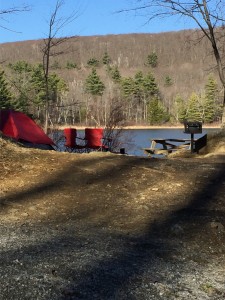
That’s what I was thinking as I headed out onto the trail, passing the campsite of two men who were splitting a pile of oak for the cold night ahead. 39 degrees. That’s what he said.

“We spend the whole day splittin’ wood so we won’t freeze all night.”

Eastern exposure campground. Good exposure for summer camping, but not so great for early spring. They wouldn’t be absorbing any of the late afternoon warmth that was shining on the opposite shore behind us. It was a dandy campsite though. Looked like they’d been there a few days. Pots and pans and a fire ring full of hot coals.

The trail didn’t have a sign-in/sign-out accountability sheet like we had in our Arkansas state parks, so I just talked to the campers for a few minutes on my way in. If I was waylaid, surely they would remember.

“Oh yeah, I remember that lady. Came by here about fer o’clock. Said she was gonna hike the Pond Loop. Blue shirt, black vest. Yeah, that’s her.”

I was annoyed that I forgot my Black Diamond trekking poles back at home in Washington. The folding kind are great for travel, and a great help in boosting myself up over rough terrain.

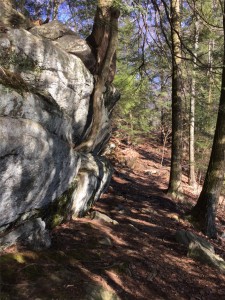
beartown_bouldersThe Pond Loop has lots of boulders strewn about from the Ice Age. Geology 101, UMASS, 1971. Lots of flat rocks handy as stepping stones too, but the trail is pretty dry. They didn’t get a lot of snow, and it seems like mud season might not arrive this year.

I followed the blue blazes, only having to backtrack once in an area where a blaze must have faded. Otherwise, a very well-marked trail.

Met a family of four that included two young girls about five and seven, rambling excitedly, the Dad telling the girls to follow the blue, the girls’ short legs stretching from one rock to the next.

Was tempted to ask if they’d seen any bears. “Beartown” State Park might have bears, right? Bit my tongue. Didn’t want to create any false anxiety.

Instead I just remarked on the crystal clear air.

The reason being that I might have been just a bit theatrical about bears when my own children were young. When our oldest son Chris was about two, I used to dance around the kitchen with him in my arms, singing “The Teddy Bears’ Picnic” a la Bing Crosby.

“If you go down to the woods today,

You’d better not go alone…”

The result was that Chris, with his imagination in overdrive, developed—unbeknownst to me—a fear of the Deep Dark Woods where the teddy bears picnic.

When he was five, we thought it’d be fun to attend the annual Teddy Bears’ Picnic, held on the Amherst Town Green. Packed up the boys and their teddy bears. Drove down from the hills and found a good parking space. Saw the tents. Saw the other children homing in with their teddy bears and picnic blankets.

Chris refused to get out of the car. No amount of coaxing could convince him that this was going to be a safe activity. He wanted no part of a Teddy Bears’ Picnic.

I hope that’s the only darkness I bestowed upon him.

I kept along the trail, by now on the opposite shore with the sun at five o’clock.

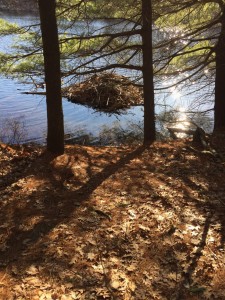
Saw an impressive beaver dam. Beavers, no doubt, asleep below in their cozy lair.

Met a couple, bearded Portlandia type and female friend in standard gear, who didn’t even seem surprised that I was alone. I told them that I wished I had my dog Lily with me. As soon as I said it, I thought:

Did I really just tell them that I’m out on this gorgeous day and I’m wishing I had my dog with me?

Yes. Yes, I did. She would have loved it.

At the restaurant earlier that day, it seemed that everyone wanted me to not be alone.

In line waiting for a table behind a young couple, “Are you together?” “No.”

At the head of the line with three or four people behind me, “Are you all together?” “No.”

While being handed a menu by the waitress, “Are you waiting for someone?” “No!”

Geez.

After a nice straight stretch of access road, I found myself facing a sign that marked the Appalachian Trail sharing the path. Nice.

Couldn’t resist stopping to take a selfie on the A.T.

Took about fifteen before I was satisfied. Not satisfied enough to upload it here. Ha.

Continued on. Met another young couple, this one with fishing rods.

Told them about the A.T. crossing up ahead. Showed them on the map.

They didn’t know. Were suitable impressed. Probably took selfies when they got there.

Returning to the car, I pulled my iphone out of my pocket to check my timing. 58 minutes, including stops. Just about aligned with the suggested timing on the map. A great day in the great outdoors.

Beartown State Park, Monterey MA.

hiking the appalachian trailFollow me on Facebook.

More Editing

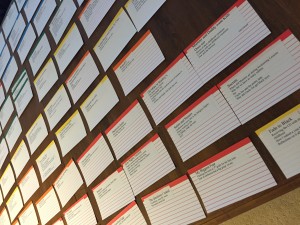
notecardsThree days after creating my chapter and scene notecards, I’m making sense of my category and themes, ready to continue editing.

The category is Coming of Age. The themes were not so obvious to me.

However, when you simplify the contents of your childhood into a patchwork pattern on a table, suddenly the themes that were so evasive begin to bubble up from the depths of your submerged life.

I stood over the cards for ten minutes, heartlessly pulling the cards that I’m sure represent boring topics. Putting them aside—not discarding yet—you never know.

With the table thinned out a bit, I began to stack similar themes and subjects.

Fear has a big pile. Fear of the draft horses on the farm, fear of being left alone, fear of fertilized eggs! Fear of being in charge of my siblings’ fears: the swimming lessons, the dentist!

notecardsThinnedMy shameful shyness and its related topics are an interesting stack, tied to childhood depression, longing, “girlfriendship” (and the lack thereof), and my mother’s questionable child-rearing methods. The unopened copy of Dr. Benjamin Spock’s Baby & Child Care—except for the part about chicken pox, measles and mumps. Or was that masturbation?

The Feminism stack surprised me. I knew that I was a child feminist, but the number of scenes that innocently demonstrated this budding characteristic in my busy little mind was amazing to me. From a very young age, I resented all of the special privileges that boys were privy to.

Another prominent theme is Secrets. (They wouldn’t remain secrets if I revealed them here.)

I discovered that there were three themes that saved my life.

Nature, Reading, Music. In that order.

Now that the cards are re-ordered, I can begin dragging the chapters and scenes into the Revision.

By no means am I near the end, but if I can get this content in proper order, then I can begin to refine the results.

editing memoir

Follow me on Facebook. Like me too, if you do.

Editing Memoir

Editing memoir is a long slog.

The first draft is easy. It’s bleed onto the page. Dance on the page. Sing on the page. Burn. Cry. Get angry. Pour it all out.

Dig back to the beginning. Try to remember every last detail.

Then the editing began. Editing is when the doubts creep in. Who is this book for? For me, or The Reader?

In my opinion, the first memoir draft is for the Writer. After that, IMHO, you have to walk the fine line between staying true to your memories and yet make them, not just palatable, but interesting to the reader.

Make the memoir something that the reader can relate to in terms of their own life.

If you don’t, it’s just a self-centered ramble through your own dirt or glory, as the case may be.

I’m on Week 3 of Draft 5, the fifth revision.

I’m holed up in an apartment north of town with a chair, a table, a laptop, and a foam mattress that I bought on Amazon Prime the day before I moved in with a basic black wardrobe and a box of socks and underwear.

One water glass, one wine glass, a couple plates and a handful of silverware.

The table is covered with index cards, post-its, a few favorite memoirs, Mary Karr’s The Art of Memoir,  and vitamins.

The landlady lives upstairs. I told her that the only person she’d hear me talking to is myself.

I’m hoping to communicate with the voice of my past clearly.

I want the voice of my past to greet the voice of my present and make sense of it all.

The original time frame was age three through eighteen.

Things change.

Fortunately, I write in Scrivener so I won’t lose any of my previous versions.

I’m making big changes to the voice as I’m now letting the adult Linda take charge.

Expanding to the present. Reflections, Lessons, Questions Answered.

Hoping for the best.

Editing Memoir.

editing memoirFollow me on Facebook. Like me too. If you do.

The Hunted

I was breathless. I darted barefoot across the length of my mother’s kitchen on the second floor of the creaky hundred-year-old farmhouse, bumping around chairs and pushing off the harsh edge of the table top as I cut a vee through the pungent scent of the morning’s coffee and burnt toast. The chilly floor was sloped with age, and the cracks in the linoleum threatened to topple my clumsy three-year-old self.

The young rabbit was enjoying the tender grass at the side of the gravel road when a beagle came over the rise, its nose to the ground, tail raised high and waggling back and forth with excitement. The rabbit scurried along the dusty stretch of pale dirt road, springing left, then right. Gravel sprayed.

I tripped over the shallow threshold of the back bedroom. My heaving chest hit the dirty floor hard. Sliding into the shadows, I sought asylum in my usual hideout.

The rabbit knew instinctively that the beagle was its enemy and made a quick choice. Deep alfalfa, stone wall crevice, abandoned rubber tire.

Under the bunk bed was dark and dusty. I clawed my way to the wall. “I’ve got the army belt!” she bawled. My dingy t-shirt rose up to my armpits, my tiny fingers brushing away the globs of dust.

The beagle was excited, sniffing with the concentration of the hunt, the imprint of previous canine generations fueling its quest. The rabbit froze, eyes bright and bulging.

Paralyzed with fear, I tried to slow my breathing. The floor shook with her angry footsteps. I listened intently, my ears trained for the source. White ankle socks and brown penny loafers paced back and forth inches from my nose. Lucky penny Lincolns, heads up.

The rabbit blinked once, a cautionary test of its security. At dawn, it didn’t expect the beagle to be in its path. Its fur was dotted with burrs from the chase. The rabbit waited. Long seconds became longer minutes.

My disheveled hair was tangled in the galvanized bedsprings. I couldn’t turn my head and pressed deeper into the chilling chasm. Claustrophobia set in.

“God-damned little brat,” she muttered to herself.

Soon Mummy was flinging Daddy’s army belt from one side to the other under the bed. Its heavy brass buckle clanged against the bed frame tolling my fate.

The rabbit’s mottled brown and gray fur blended into the grass.

I was scarcely noticeable in the shadow of the bunk bed. I scooted further back, and made myself small, afraid to be caught and dragged out by my dirty bare feet.

The rabbit didn’t make a sound. Its survival depended upon it.

I didn’t cry. Eventually she would stop.

Soon the rabbit sensed that the beagle was gone. It moved with one tentative hop at first, followed by a pause to listen. Then it resumed nibbling the grass at the side of the road.

When I was sure she had given up and gone away. I slowly crept out and brushed the fuzzy grey globs off my red corduroy pants. The wale had worn off the knees and the elasticized waist was no longer capable of resuming its original shape, but they were familiar and  soft as a rabbit on a roadside.

Subscribe to my blog here.

the huntedFollow me on Facebook.

Babci and Me. Courage.

My babci (grandmother), Róża, was only seventeen when she boarded the train to Antwerp—alone— near Kolno, in northeast Poland. It was December 1911, three years shy of the turmoil of  World War I.

Stars sparkled in the moonlight on the coarse crust of the deep frozen snow and young Róża drew her cheap coat closer against the bitter cold. She stamped her feet to warm them.

When the train left the station that night, its whistle merged with the whistling wind and the howling of wolves in the forest, lifting with it the spirits of passengers bound for the Christmas holidays in Western Europe. Others on board, like Róża, may have shed a few tears for Mama and Ojciec left behind.

Odwaga

nounon możliwość zrobić coś, co przeraża jedno.

I was eighteen, sitting silently in the back seat of my father’s Ford, when I began my own journey from our rural farm to Amherst, Massachusetts, bound for freshman orientation at the University of Massachusetts. I had never been to UMASS. The trip to Amherst— 49.7 miles—might as well have been across the ocean. Amherst would be my Antwerp.

Courage

noun– the ability to do something that frightens one.

I didn’t know a soul there, except for my orientation roommate. A classmate from my high school, she was, frankly, very sexy for a high school student and her voluptuous breasts made me feel even more like the boyish freak that I thought I was.

When we went to the Student Union Bookstore to buy t-shirts to show off our college student status to our peers back home, we held up the shirts to our bodies, trying to judge the sizes.

I knew right away that I was a t-shirt size Small.

Rifling through the stack of athletic grey shirts, my roommate asked, “What size do you think I should buy?”

Without hesitation, I said, “Extra-Large.”
“University of Massachusetts” would surely be distorted by the peaks and valleys of those breasts if she chose a smaller size.
We left the Student Union with our purchases and changed into our new t-shirts back at the dorm.

Mine fit perfectly, not too tight, not too loose, its hem reaching just a few inches below my waist.
Hers, unfortunately, fit like a nightgown.
I was shocked. At that moment I realized that our bodies were not all that dissimilar. Sure, she was sexier and she still had bigger breasts, but I suddenly grasped that my self-image was significantly distorted.
It was a testament to her good nature that she didn’t berate me for my poor judgment, but I’ll never forget my embarrassment.

We enjoyed the introduction to college life during that week. Not good enough to want to be freshman roommates, but good enough.

When it came time to leave home for the school year two weeks later, I once again sat silently in the back of my father’s Ford, this time with my mother in the front passenger seat and my youngest brother, a kindergartner, sitting in the back with me and my record turntable.

It didn’t take too long to unpack the car when we got to Amherst. One red Samsonite suitcase, one red Samsonite train case, my stereo and my milk crate of records. My family drove away without much comment. Certainly there were no hugs and kisses.

I lay back on my bed and listened to the quiet.

SS_Finland_underway_in_harbor_before_1917

SS Finland

At Antwerp, Róża boarded the gangplank of the passenger ship Finland with all of the other young people in steerage class. Was she also fleeing a less than happy home life?

She watched her trunk being stacked on the baggage wagon and hauled on board. Everything she owned was in that trunk. Her clothing, her Sunday church shoes, her rosary, a knitted shawl and a basket woven of native willow. Being peasant Polish, she couldn’t afford a stylish feathered hat like those she had seen en route. More likely, she wore a babushka, like the ones she wore almost every day for the rest of her life.

Steerage class on the Finland proved to be its own education, and Róża also was the victim of distorted information.

One day over cups of tea in her kitchen on the farm, Babci told me that she first saw people with black skin during that trans-Atlantic crossing. Someone told her they were devils. She laughed self-consciously when she said this. It was the slightly embarrassed character of that laugh that communicated to me—a ten-year-old who had only seen black people on television—that she might have actually believed it. She didn’t know better. Not any better than the 18-year-old college student who truly thought that her orientation roommate had a figure of outlandish proportions.

Oftentimes, I opened Babci’s trunk in the attic on the farm when I was sent up to fetch onions from the braids that hung from the rafters. The trunk stood near a window under the peak of the roof. It was empty inside, and its pale paper lining had flaked away in parts. I often opened and shut its lid multiple times, clasping and unclasping the draw-bolts, and running my fingers along its wooden slats while daydreaming of Róża, curled up in a bunk, trying to stay warm with her mediocre steerage-issued blanket, as the Finland rose and fell on the high seas.

The devils sometimes infiltrated the dreams that she had of a new life in America as she slept in her bunk in the Finland.

A couple years later, the devil in her world became the man whom she would meet in a small town in Connecticut and marry, beginning a life within the farmhouse where the trunk sits in the attic, empty of her dreams.

My red Samsonite cases traveled with me for quite a few years, and they too eventually crossed the Atlantic. When their linings began to smell slightly of mildew and they had served their purpose, I donated them to the Salvation Army.

Babci’s willow basket sits in my kitchen today where it contains my last memories of my grandmother and the times we spent together. I think that she’d be surprised to learn that not long after college, I became quite a proficient basket weaver.

At eighteen, I was navigating my own troubled waters. Having grown up in a cold and hostile household where animosity always seemed to be simmering beneath the surface, I had not yet learned how to communicate properly with others. I’d always been a loner.

At sea on the Finland, Róża was alone too, preferring to keep to herself as Christmas came and went.

Three days later, when Róża processed through the Great Hall on Ellis Island on December 28, I suspect that she received the greatest Christmas gift of her life. For her, Ellis Island was the “island of hope.” The Ellis Island Immigration Museum describes how others, who were not permitted entry, found Ellis Island to be an “island of tears” as they were put on ships and returned to their countries of origin.

What if Babci had never arrived in the America? What if her spirit had not harbored the desire to surpass her humble beginnings? What if she had placidly continued to live the peasant life somewhere in Eastern Europe, killing and plucking chickens on a tree stump in her barnyard?

What if, supposing that I still had been born—but with different genealogy—I had never arrived at UMASS? What if I had stayed at home and, as my father had proposed, had gotten that job operating a keypunch machine at the factory? Or, barring that, apprenticed to become a bank teller, in spite of my absolute incompetence with numbers?