The Metaphor of Me

Today I listened to an interview in which it was suggested that we look inward for the metaphor of who we are and what we do in the worldwhat’s going on in our life.

My metaphor popped up instantly.

metaphor of meI am a conch shell.

A conch shell may be empty

but it once was a full, living, breathing creature.

It has been deep in the sea and

it has drifted in the shallows.

Its inner surface has become smooth and shiny and beautiful

from its body reaching out

over and over again

in order to move through the sea.

It has churned in the surf,

Become faded,

Scratched and cracked,

but it still has value, and now, a new role.

Although its core has been removed

(the food, the conch)

it has begun a new life.

Even when it’s damaged,

with its tip broken off,

it can be sounded like a horn.

Now it’s the voice of a musical instrument,

or a reminder to look up and listen for the message.

As an empty shell,

it can be held to someone’s ear

where the sound gets reflected back.

It still has something to contribute.

The shell will never be completely empty

as long as it can reflect back

someone else’s beauty,

or

a reminder

of where it once was,

and what it took to get here.


What’s your metaphor?


Show, Don’t Tell

“Show, Don’t Tell” is the closest thing I know to a writer’s mantra.

For every sentence that I write, I’m constantly berating myself—Did I “show”? Or did I “tell”?

Did I remain “in scene”?

Remaining “in scene” is my nemesis write now.

Yes, write now. You read that write. Writing is all I care about, but righting is what’s driving me bonkers.

It seems that the more I struggle with the editing of my memoir—the more advice I get from various sources—the more confused I get. I should insert “LOL” here, but it’s clearly not amusing.
The one thing that I’ve noticed in this week’s reading (not writing—this week’s reading) is that everywhere I look, writers are all stating that there is a really rough patch where you want to throw out the whole thing and go back to bagging groceries at the A&P or whatever you’re destined to do. And no offense to bagging groceries at the A&P. I don’t know what job I could tuck in here without offending someone.

That’s where I’m at right now.

I think I’ve got the “Show, Don’t Tell” part, but remaining “in scene” is driving me berserk. It’s depressing. I keep telling myself that this is just part of the process.

I have a half dozen books scattered around me. I keep opening them for style comparisons. Like lots of dialogue in the showing vs. just a little dialogue in the showing.

I’m weeding out anything that’s the voice of the present day survivor commenting on the events of the child. At least, that’s what I’ve been told to do, and it seems to make sense. Stay in scene!

I’ve been looking through The Glass Castle (Jeannette Walls) to see if she comments on her childhood from the adult point of view as she’s Showing, Not Telling. The Glass Castle, of course, because it’s a whacko childhood memoir. wink wink.

I downloaded a volume of Alice Munro’s stories onto my Nook yesterday and read her introduction as I waited in the ferry line. The introduction has Excellent Writer Advice. Munro describes how her stories are born—from bits and pieces of events in real life combined with her imagination. Writer advice and how she does it.

Everyone’s technique is different, of course…and combined with your voice, your writer style should make your story unique.

I just found Mary Karr’s The Art of Memoir lost in the bed covers between my quilt and sheets. I’ve been falling asleep with these writers every night.

The Liar’s Club (Mary Karr) is on the floor next to my bed. Another wacko childhood memoir. Her momma and daddy could give Jeannette Walls’ momma and daddy a run for their money in the OMG category.

In The Liar’s Club, Karr frequently makes present day statements, then expounds upon them. Isn’t that going “out of scene”? Apparently, not.

I need another cup of coffee.

show, don't tell

show, don't tell Follow me on Facebook.

Go ahead and Like my page while you’re at it.

The Scent of Writing

The scent of writing is all around me this morning in the form of a bouquet of lilacs. Yesterday, I placed the Mason jar bouquet on the shelf next to my bed, where I begin my morning reading and writing with my first cups of coffee.

The scent of lilacs. How that returns me to my childhood! All those times that I cut the stems for our apartment. All those times that I wished I could carry a bouquet of lilacs to school for my teachers—but was too painfully shy, year after year—to carry out my fantasy of standing before my teacher with the sweet blooms.

A smell from the past is often what one needs to jump start a memory.

The science behind this is that the olfactory bulb accesses the amygdala, which processes emotion, and the hippocampus, which is responsible for associative learning.

When we first smell a new scent, we link it to an event, a person, a thing or a moment in time. Our brain creates a link between the smell and a memory so that when we encounter the smell again, the link is already there, ready to elicit a memory or a mood—positive or negative.

I don’t know if it’s my imagination or not, but it seems that since I placed that bouquet on the shelf yesterday, I’ve been better able to fine-tune the outdoor chapters of Spring in my memoir. More details have come into focus.

Tomorrow, cinnamon.

scent of writing


Follow me on Facebook.

scent of writing

Humor in Memoir

On March 8th, I posted on Facebook that I was going to add Humor to my memoir. Humor. What was I thinking?

Those who know the story of my challenging childhood were probably taken aback because only one person “liked” it (That was you, Nancy Harris.) and no one commented.

With Facebook “likes” being the modern measure of approval, I’ll admit that my insecure self began to unravel a bit on the edges, wondering if I had made the right decision.

My essay writing in high school had always tended to be self-deprecating.

I remember that even as my peers sat sullenly watching the clock as it ticked towards lunch, my teacher usually shuddered with laughter as she read my work aloud. Mrs. Davis’ reading glasses shook down the length of her nose until she stopped and readjusted them several times. Fortunately, she had those chain thingies tied to the ends of the frames.

It was that memory of humor successfully covering my sadness that led me to decide. I can laugh about this.

I began a halfhearted attempt at yet another revision, this time injecting it with what I hoped might be laughable. I looked for the humor behind the angry glances, harsh words and tough times. Mummy’s meanness, Daddy’s sullenness. The 720 high school days when I ate my lunch alone. (Yes: 180 x 4)

Et cetera. 

I wasn’t sharing the results with anyone. I tried to judge for myself. Not always easy. Would this fly? Maybe.

This weekend, a month after my decision, I had a turning point. (Right. Yet another turning point. This is getting old.)

I spent a couple of weeks holed up with my manuscript in a timeshare in the Berkshires, and after seeing Augusten Burroughs’ Lust & Wonder quoted in GoodReads, I knew I had to run out and buy it immediately. I tucked it in my tote bag for the flights home.

Augusten Burroughs is the man who was Running With Scissors in Amherst while I was running away to UMASS. We were living within the same coordinates during the 70s— and I didn’t even know it until this past weekend! (Neither did he—but it’s probably not that big a deal to him.)

I opened to page one as soon as my first flight left the tarmac. Soon I was laughing out loud and hoping I wasn’t disturbing anyone.

Burroughs’ story is not a funny one. It’s about love, misunderstandings, disease, and broken hearts (multiple times), but Burroughs manages to inject hilarity into his memoir while still telling his true, sad story. It’s beautiful.

One of the craziest, most relevant, points he made— that really hit home with me—is that when your childhood is as insane as ours, of course you always think your life is going to go to hell when something good happens!

You can’t believe that life could really be that good without falling apart, and more than likely, in the very near future.

I always thought that I had simply inherited the Worst Case Scenario gene.

But no, that wasn’t it at all.  I had been programmed from a very young age to fear all good things falling apart and I managed to not notice this until now.

Wham.

Suddenly I was back in Mrs. Davis’ class. Tragedy can be funny. Very funny, in fact.

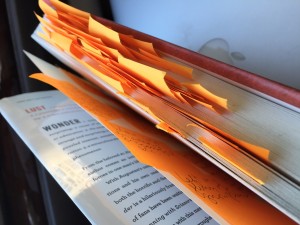
I had decided to tag pages that clicked with me, never imagining that when I was finished, the book would be thick with sticky notes and scribbles.

After crossing four time zones, I was landing at Sea-Tac just as I completed his Acknowledgements. (Seriously, I read it from one tarmac to another. East coast to West.)

The next morning, I had a Memoir class in Issaquah. Memoirist Bill Kenower, teaching. Jet-lag be damned, I made it onto an early morning ferry.

Each of us brought a few pages of work to share for critique. Bill read each student’s piece aloud as we followed along and later responded to his queries.

I have to say, my fellow students are damned good writers. (There are four of them.)

For my writing sample, I selected a chapter from my memoir that fit the criteria of “three pages long”. It didn’t matter about the humor part. They didn’t know my revised goals.

When Bill began to read my piece, I was surprised to hear—within two sentences of the beginning—chuckles. Then a few sentence along, more chuckles. They laughed periodically throughout the whole darn piece!

I shared that I honestly did not realize that this chapter was funny at all, but then Bill pointed out specifics of hilarity and understatement.

I got it. I get it.

It was funny. It is funny. What a funny day!

Now, if only someone can cure my phobia of looking in mirrors.

Humor in Memoir

humor in memoir

editing memoir


Follow me on Facebook.

Norman Rockwell and the Dolls

The Norman Rockwell Museum in Stockbridge had only three cars in the parking lot on this cool wintry-looking April day. I parked, knowing that I’d enjoy the luxury of having the museum almost entirely to myself.

I tried to get here on a couple of other days, but made the mistake of beginning to write early in the morning, not noticing the clock until it was past three. Too late to set out. This time I planned ahead.

The building itself is a perfectly classic white complement to the Americana style of Rockwell, its peak topped with a cupola that pours light into the space below. There are a lot of cupolas in this area of the Berkshires. Even the barns have cupolas—more than likely designed to let light into the barns during the dark sunset hours when candles and oil lamps were dangerous in barns filled with hay.

As much as I wanted to wander around outside, I crossed to the main building following the sidewalk that was the only surface empty of snow. Strong snow glare and sunglasses.

A visit begins with a brief biographical film in the basement where I sat alone,  front and center, surrounded by a collection of framed The Saturday Evening Post magazines, in a gallery full of empty chairs waiting to greet the summer crowds.

There’s a lot I didn’t know about Norman Rockwell.

I knew that Norman Rockwell painted the cover art for the countless Saturday Evening Posts that I pored over in the privacy of the screened porch at my grandparents’ lake house. A large cardboard box full. I dug deep into this box of buried treasure, pulling up one after the other on Sunday afternoons while my cousins played with their blond bitch Barbies in the upstairs bathroom. (Sorry. My doll feelings are showing.)

I knew that Norman Rockwell’s skill as an illustrator was epic. His dedication to creating charcoal sketches of the desired work, then progressing to an oil study, followed by the final painting, went far beyond mere illustration. He used local people as models for the paintings, photographing them in multiple poses to have his own stock of expressions and inspiration. Frequently, he added his own image—often playfully.

What I didn’t know was that Norman Rockwell was a natural-born illustrator with skills that surfaced at a very young age. He often interrupted his father’s story-telling so that he could sketch out what was being described.

Fortunately his parents recognized his gift and he dropped out of traditional high school to attend art school in NYC. His first job after graduation was at Boys Life, the Boy Scout magazine, at the age of seventeen. By nineteen, he was their Art Editor.

I attended a gallery talk by a talented docent who shared insight into Norman Rockwell’s creative style, his influences and especially, his symbolism.

The use of symbols to convey meaning is common in master works, in what we consider “museum art”, but illustration art has often been overlooked as lacking in this sense. Norman Rockwell was far ahead of his time in uplifting the art of the illustrator.

While many viewers may have seen only the subject matter of the Post covers, each painting had been planned with intricate attention to detail. The use of triangulation to draw the viewers eye to the message. The use of color and symbolism to project the message.

Which leads me to the dolls in some of his work.

If you’ve read some of my essays, or work-in-progress excerpts from my childhood memoir, you already know. I never liked dolls. In fact, I despised them. I didn’t know what you were supposed to do with a doll.

Sixty-something years later, I couldn’t escape the dolls, even here at The Norman Rockwell Museum. Like the snowstorm of a few days ago that carried me back to the snowy winters of my childhood, the dolls in the paintings of Norman Rockwell carried me back to the phases of my childhood where dolls were supposed to be part of a normal child’s play.

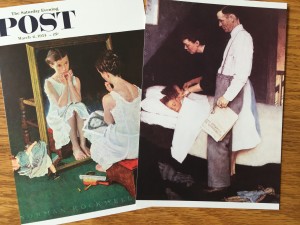
The first painting I noticed was Girl at the Mirror, from 1954, where a young girl is clearly absorbed in the self-analysis that accompanies puberty. A hairbrush, comb, and an open lipstick case are on the floor at her feet, a movie magazine in her lap, a wistful expression on her face. Her doll is posed in a position of rejection, tossed to the left of the mirror. She no longer has use for it.

Second was Freedom From Fear, one of the quartet of The Four Freedoms paintings which traveled the country raising money for the war bond effort. In Freedom From Fear, Rockwell used a doll placed on the floor at the foot of the bed to illustrate that the children being tucked into bed have freedom from fear. There’s black fabric on a chair—possibly to symbolize the blackout cloth that was used to block city lights during WWII. The father is even holding a newspaper with the headline of “bombings” and “horror”—a prop that the local newspaper printed for Rockwell to use in his layout. The docent who noted these details shared that the doll on the floor meant that the children didn’t need to cling to their dolls for security. They didn’t need a doll to comfort them.

The dolls, used as symbols of childhood shown here, are innocent. They don’t take into account the children for whom dolls represented a dark side.

That’s OK.

As I viewed The Saturday Evening Post covers of the 50s, I saw a lot of family values and reminders of every day events from a time that celebrated the innocence and good times, post-war optimism and prosperity. I saw the hair styles, the clothing, the cars—the scenes where my own childhood took place.

And symbolism? Good writers share the artist’s use of symbolism to evoke the feelings that they are wishing to convey. I was glad to receive the reminder.

Norman Rockwell


Norman Rockwell
Follow me on Facebook.

Subscribe to this blog at left. Receive the posts in your email.


Snowstorm

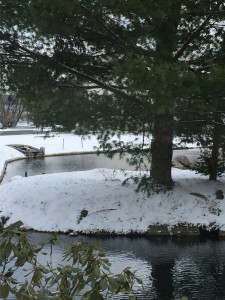
A spring snowstorm arrived overnight in the Berkshires, triggering more childhood memories.

Haven’t lived where snow is a regular event for more than twenty-five years.

There was plenty of warning. We all knew the snow was coming. I went to the Stop & Shop yesterday afternoon. Stocked up on groceries for a couple days’ worth of meals.

When the wind awakened me in the middle of the night, I got up and peeked through the blinds, still a little surprised to see the forecast snow accumulating. Turned the heat up a couple degrees and went back to bed, burrowing under the covers as I did when I was a child.

When I reawakened at seven, the snow was still blowing.

Suddenly it was as if I were listening to the behemoth wood-paneled Zenith radio that stood next to the kerosene stove in our kitchen in 1955.

I remembered the radio announcer and the “no school” bulletins. Heard the wind echoing in the chimney. Felt the cold linoleum floor beneath my feet on the way to the bathroom.

Smelled the coffee percolating on the counter. Sniffed the burnt toast that my mother grilled directly on the cast iron stove top. Given any feasable alternative, my mother always avoided dirtying a pan.

Smelled the wet wool from Mummy’s gloves drying in the open jaw of the warming oven. She helped Daddy broom off his car before he left for work.
This morning, after my own coffee, I returned to the memoir chapter that I was working on at bedtime.

“Winter.”

Synchronicity.

snowstorm


snowstormFollow me on Facebook.

Return to Kripalu

A return to Kripalu is always a full sensory immersion. Even while parking the car in the upper parking lot, I opened my door and the pungent scent of the forest immersed me in positivity. I walked down the hill, enjoying the view of the lake below and relishing each step, bringing me closer to the place that I have raved about to so many people—the place that changed my way of looking at life. Life with a capital “L”.

I found myself smiling continuously, the corners of my mouth curved softly upward, as I made my way around to the entry where the boot scraper and snow shovel reminded me that this is indeed a year ’round facility, ready to share its love and knowledge with us at any time that we’re able to arrive.

“Love and Knowledge”. I don’t say that lightly. Kripalu Center for Yoga & Wellness—as I’ve said in the past—is not some woo-woo kind of place. Maria Sirois, my first teacher here, reminded me of that. Kripalu is real.

When I visited last fall, I was introduced to Ayurveda and went home to seek an Ayurvedic counselor of my own. Lucky me. We have one on our island—and a very fine one indeed. I met with Melanie Farmer after filling out pages and pages of pre-appointment information. She read my health history, my health desires, and scrutinized my skin. She asked me about my life, my current situation, my daily patterns, my diet, my desires, my goals. After our lengthy consultation, I did the unspeakable! I eliminated processed sugar from my diet. Amazingly, it was easy. After the first ten days, I felt so fine that I couldn’t imagine returning to my previous relationship with M&M Peanuts. Lost twenty pounds. Regained my energy and self-confidence. Began to eat in alignment with the seasons.

Would I have done this without Kripalu?

Not a chance.

So here I was again. This time, I knew what I was in for.

Gentle yoga delivered with the softest of voices, coaxing us from one posture to the next. Bending, flexing, rolling, breathing. Ah, savasana!

Then a silent breakfast of fine whole foods, organic and Ayurvedic choices. Mmmm.

Followed by Introduction to Ayurveda: Life in Balance, with Cat Pacini.

“Simple, everyday approaches for increasing your health and vitality through Ayurveda, the ancient approach to health care that originated in India. Ayurvedic wisdom teaches us to connect with our deepest selvers, the source of all healing.”

After that, I couldn’t get to YogaDance fast enough. Still managed to consume my lunch “mindfully” before heading to the studio.

“Mindfully” is how you try to do everything at Kripalu. A little sign on the refrigerator door in the cafe reminds you to “be mindful of shutting the door”. A sign in the basement on your way to the sauna reminds the staff to be “mindful” of closing the office doors quietly. As you exit the property, a street sign advises to “Drive Mindfully”. Mindful works. It’s not a New Age joke. Do what you do “mindfully” and it will have so much more meaning. Everything.

I didn’t have time to tell Dan Leven how his YogaDance—last fall— had changed me from a non-dancer to a fully-evolved, celebratory dance-all-the-time individual.

I’m fortunate to live on a small island in Puget Sound where experience is not defined by age, where we celebrate our joy in any number of venues. My favorite is “One Night in Bangkok”, a first Friday dance event when the local Thai restaurant reopens after hours from 11 PM to 2 AM for a lively celebration of contemporary music amid scribble lasers. Sure, I’m 65 years old, but that’s what 9 PM caffeine is for. Or dark-chocolate-covered coffee beans.

The noon time YogaDance fulfilled my expectations again. New moves. New flows. Individuals becoming small groups, feeding off each others’ moves. Joy.

I do regret that I had to leave YogaDance fifteen minutes early to get to Aruni Nan Futuronsky and Izzy Lenihan’s Sharing Circle. They are wellness coaches of the nth degree. I didn’t want to miss a minute of what they had to share.

I was doing a self-imposed R&R Retreat, a day long visit with lots of options for classes, meals, hikes, kayaking. You choose.

Next I moved on to Kripalu’s Food Philosophy, with Annie B. Kay, the lead nutritionist at Kripalu. In a perfect world I would have learned more about Buddha bowls. But that’s OK. I learned how Kripalu designs food for health and more.

“Transform your health by deepening your awareness and understanding of food and nourishment. Explore a whole-being approach to nourishment drawn from the wisdom of yoga, and discuss how to cultivate compassionate self-observation.”

In my small class, there were fifteen pre-med students on retreat from the University of Connecticut. How wonderful that our American medical schools are acknowledging the power of non-mainstream, non-U.S. medicine and nutrition!

This was followed by another soothing yoga class. Happiness on the mat. And dinner. Another delightful mindful menu.

I happened to observe more of the participants this time. There were the usual young women, the largest segment. But Lots more men this time. All ages. Not just guys with man buns. Although I kind of like man buns.

Men and women older than I, too. 70s, 80s. Yoga and Ayurvedic are for all. It’s never too late.

As I spread a slice of flaxseed bread with organic apricot jam (for dessert), I enjoyed a cup of chamomile tea, and anticipated my path to the basement. As usual, I took the stairs. Why take the elevator when you can take advantage of a cardiovascular opportunity—and enjoy the inspiring posters in the stairwell?

I should add that in between these classes and meals, I had plenty of break time to visit the cafe, to record my thoughts, and to enjoy a snack of dark chocolate. Yes, I love the 35 cent teeny-tiny bite that gives me a boost without the guilt!

In the basement sauna, I ended my day as I had so many times before during my previous visit. Horizontal, naked on a warm wooden bench, eyes closed in reflection on such a fine day.

I thought of a brief encounter that I had at the main desk earlier that day.

I was crossing the carpet when a man—a bit younger than I—but not much—leaned forward, lifting his left leg behind him casually in a move that just happened to karate-chop me across the shins. I fell forward, convinced that I was going to be flattened—maybe injured—in that brief second.

But no. I caught myself by grasping the edge of the wooden counter as I was catapulted forward. The sweet man was horrified.

The desk staff looked on, eyes wide. He apologized over and over. I said it was “OK”. Over and over.

We were stuck in an endless circle of apologies and forgiveness. The two minutes felt like forever.

Suddenly, I knew what I had to do. I crossed the carpet and raised my open arms, inviting him to join me in a hug. He smiled in surprise, and we hugged warmly as the staff laughed in relief.

The moment was diffused. Mindfully.

This is what the Kripalu experience is all about.