
Frank McCourt was my Inspiration

About once a year, I do a Google search for Noah Adams’ NPR interview with Frank McCourt so I can hear McCourt’s lovely Irish voice and once again, be inspired.

Why was is Frank McCourt my inspiration?

  1. Because it was after hearing NPR’s 2009 interview with Frank McCourt, that I knew I wanted to write my own memoir.
  2. Because when Frank McCourt published his first book, Angela’s Ashes, at the age of 66, I thought maybe I could still be considered an “emerging” writer at my age.
  3. Because I loved the way he managed to write the dreadful conditions of his childhood in a comic manner.  Wikipedia calls it a “tragicomic memoir of the misery and squalor of his childhood.”
  4. Because I had first-hand knowledge of a painful childhood.

No, I didn’t grow up in squalor. We lived on a 3-generation farm where we had plenty of food to eat, and a hundred acres to run around. Of course, the reason we had a hundred acres to run around was that my mother commonly locked us out of the house so she could watch “her stories” on television and smoke cigarettes. I was in charge of the younger kids and, for their entertainment, I led them over hill and dale, dodging cow patties, grazing on wild strawberries, and building stick forts until the cows came home.

When I heard the NPR interview, I was 59.  It took me more than a few years until I got started. I was naive enough to think that my memoir would be ready after two or three rounds of editing. Ha! It’s taken seven drafts to get it right.

But enough about me. My mother would always accuse me of “getting a big head” if I said anything positive about myself. 

I think I’ve managed to write some decent tragicomedy in my 371 pages of The Girl with the Black and Blue Doll. (McCourt’s has 369 pages. A coincidence.)

But I can’t match McCourt’s “we were so poor” story.

He told of how they were often without food.

One night he asked his uncle about food to eat and his uncle said there was none, so after the uncle went to bed, young Frank saw his uncle’s discarded fish and chip newspaper on the floor.  He retrieved it and began to lick the oil out of the newspaper pages.  Licking the obituaries and the sports pages and the headlines of World War II (and more!) until there was no more oil to lick.

I still think that fish and chip newspaper is the most tragicomic story I’ve ever read.  In my own memoir, the fish and chips were a bit more serious. Here’s the short version.

Like McCourt, we also were Catholics. One day when my mother had just put the Crisco on the stove to heat for the fish on Friday that she was going to cook, she got distracted. She heard the bread man toot his arrival in the driveway, and since Mummy was always very chatty, she and Norman always spoke at great length. The next thing she knew, Norman saw black smoke pouring out the screen door. A fire! The firetrucks, my baby brother being brought out to his carriage, my siblings and I running down the road from the school bus to discover the disaster. I saw my 10-year-old brother being flung horizontally from the front step by a fireman.

“Get outa here!” snarled the fireman.

“It’s my house!” screamed my brother.

That night as we sat around the kitchen table, my mother cried. Then, my father began to cry. I don’t know what we had for supper, but it wasn’t fish and chips.

And the next day? We went to school as usual. Dirty hair, smoky clothes. Sad.

I was in the girls’ room when I heard Sister Florentine’s voice, “Where’s Linda?”

That concerned me but I eventually came out of the stall and she ran to throw her arms around me. I remember her wooden cross pressing into my chest, her scratchy wool habit, and the feeling of being held like a baby.

It was my very first hug. I was in eighth grade.


Here’s a link to the NPR interview. Noah Adams reveals a great deal of the man in this 9-minute listen. Enjoy!

https://www.npr.org/1996/10/01/1045022/frank-mccourt-on-angelas-ashes
Willpower

Willpower is not my strong suit. It’s not my weakest weakness, but I could do better. What are the biggest weaknesses in my willpower folder?

Writing and Reading.

Writing should not be an issue for a writer. When I get these ideas in the middle of the night, when I awaken with my teeth clenched in my mouthguard and my eye mask askew, my hands shaking with the visage of the ethereal nightmare that I’m watching grow smaller and smaller as it drifts out the window, lifting up into the naked branches of the cherry tree, and beyond, into the clear clear clear dark sky, I reach for my laptop.

I open a Word doc and type the sentence I want to remember, the sentence that will fuel my message later. Much later. I have too many writing prompts on too many topics.

But Reading. That’s my biggest downfall, my Achilles’ heel.

I am constantly finding one thing after the other to read online! (Exclamation points are another weakness but I have almost conquered that one, and you’ll note that the previous exclamation point is warranted!.)

“The anatomical basis of Achilles’s death is more likely to have been injury to his posterior tibial artery behind the medial malleolus, in between the tendons of the flexor digitorum longus and the posterior tibial vein. This area would have been included in Thetis‘s grip.” See what I mean? I’m pathetic.

The New Yorker tells me that I’ve hit the wall. I’ve read all the free articles they’re going to allow me. “Subscribe for $1 a week and get a tote.” I have too many totes, but I very nearly do it. I fear that if I subscribe to one, the rest will follow like literary dominoes. The Wall St. Journal, The Washington Post. Like the 12 Temptations of Christ, they’re calling out to me from their individual browser windows until I have filled way too many hours of my day with an endless loop of reading.

The New York Times is a deep bottomless pit of content. Yes, I do subscribe to The New York Times, digital edition, so it’s my own fault. I had been a faithful print subscriber to The Wall Street Journal for years, and then, damn it, the he/she faceless, anonymous paper delivery person kept forgetting (even when I left notes) that on Wednesdays, if he/she left my Wall St. Journal in the Beachcomber tube, the weekly Beachcomber would not be delivered. They penalize us like that. (Fair enough.)

I finally had enough of occasionally missing out on Wednesday’s local news, obits and the Calendar. I called The Wall St. Journal and told the man in India about the tube that the he/she, faceless, anonymous paper delivery person was hijacking everyday and, with unfortunate results, on Wednesday’s. “I would like to cancel my subscription.”

I would miss Dan Neil, the automotive columnist, whose blend of wit and mechanical knowledge is quite attractive to me. I wouldn’t miss the $5000 Gucci handbags in the monthly magazine section. I wouldn’t miss the Financial pages because I never read the Financial pages. I wouldn’t miss that humor guy whose pieces appear in the lower right spread “below the fold” on the Opinion page. (Below the fold is where they put the lesser content.) I can’t remember his name, but I sincerely believe that I could write a humor piece as good as he. (And don’t tell me it’s “as good as him”. When did the world switch from “he” to “him” in this context? It’s everywhere. Don’t they read Grammar Girl?)

Here I go again, off an another reading tangent. I googled* “Wall St Journal opinion page humorist” and after Peggy Noonan (!) I find a list of Top Humorists. Stephen King is #1 on this list. Joan Collins is #3. What? Art Buchwald, my childhood idol (You think I’m joking?) is #7. Tsk.

The man in India asked if I would keep my subscription if he directed the he/she, faceless, anonymous paper delivery person to install a proper tube for The Wall St. Journal. Like a good customer service rep, he diffused my annoyance and I agreed to allow 2 weeks for the tube to be installed.

I waited 4 weeks. Still no tube, and yet another lost Beachcomber issue. I called and there was no distracting me this time. I cancelled my subscription and went online to subscribe to The New York Times. I’m sure that Rupert Murdoch is not going to miss my $99 per half year.

Now I’m reading a whole new litany of favorite columns. Modern Love is best. I crave warmth like the Pillsbury Doughboy.

Facebook is my love/hate relationship. Why does someone have to ask a question of their readers that I feel responsible to answer?

This morning a fellow writer, a friend, who is writing a novel set in the time of Boccacio, posted “Who can tell me what the paste left after the oil is pressed from olives is called in Italian? In medieval times, it was a treatment for arthritis and joint pain.”

I responded,
“No, I cannot. However, thanks to your question and my lack of self-control with Google, I now know more than I need to about olives— production, harvest and economics!”

I’m incorrigible.

I found a solution to my lack of willpower with respect to Reading online.

I decided that, beginning today, I shall unplug my laptop when I begin to read online. When the power percentage reaches 0% and my MacBook powers down, that’s it. Tough luck. I’ll have to proceed to the items on my “To Do” list.

Did it work? No. As soon as the pop-up warned me that I was at 5%, I ran for the charger. I needed to finish “How Weed Got Me in the Best Shape of My Life”. What? I don’t need weed to exercise. But I was curious. This is Washington state, after all.

I should note that the day after I cancelled my Wall St. Journal subscription, I found that a shiny new Wall St. Journal tube was in place at the end of my driveway with the morning’s issue.

The very next day, it was unceremoniously removed.


*Is the verb “google” upper case or lower case? When I google it, I get everything to do with the search engine and nothing to do with the verb. 😉

Like me on Facebook.

Read more stuff.

The Easy Way Out?

This summer, I’m taking a series of twelve tap dancing classes for adults at our local arts center. It was a last minute decision. I saw an ad in the local newspaper that triggered one my childhood desires.

Remember Shirley Temple and Bojangles tap dancing up and down that steep flight of stairs? Shirley’s banana curls bobbed up and down while the tails of Bojangles’ morning coat fluttered with the movement of his feet.

When I was five, I had the banana curls, but I never got the tap dancing lessons, so I thought, “Why not?”

The concentration required for tap dancing might be a good exercise for my brain, especially since I’m somewhat rhythm-challenged. Anyway, that was my excuse, and it turns out that tap dancing is a good brain exercise. Like rubbing your belly and patting your head at the same time.

As soon as I registered for the class, I ordered my black tap dancing shoes. Amazon Prime.

And before the UPS man was even out of the driveway, I was lacing them on in the front hall. I walked across the tile floor. Click, clack, click, clack. Then across the hardwood. Click, clack, click, clack. Out the back door. Click, clack, click, clack. Across the wooden deck…

Suddenly I knew why those boys in junior high had cleats attached to the heels of their shoes. What a cool sound!

Our dance instructor says that tap dancing is making music with your feet.

I never thought of it that way, but now walking to the refrigerator for a handful of cherries has taken on new meaning. Suddenly it’s fun, clickety-clack, clickety-clack. Toe, toe, heel, heel. Stomp, step, brush, step.

As our instructor introduces new combinations of steps, I’m willing my feet to follow my brain, and soon I’m tapping a little faster, and faster still, as the lessons progress. I’m even managing to keep up with the midriff-baring, college-age females in the class. Just barely.

Our teacher says we’re doing really great and so she’s pushing ahead of the lesson plans.

That doesn’t stop me from having my doubts. I practice indoors and out with my tap dancing cheat sheet in one hand and my other hand extended  for balance. Toe, toe, heel, heel. Dig, spank, step, heel.

At home, without the distractions of ten other pairs of feet clacking next to me, and without the rafter-raising volume of Billie Jean pulsing to my core, I’m doing quite well. I’m surprising myself.

Then I set out for class and—like clockwork—about half way through the session, I get a wave of self doubt and my smile fades.

Am I ever going to be able to connect the movements on my own without someone calling out the steps? Maybe I shouldn’t have signed up for this. It was a dumb idea. How do four-year-olds even do this?

I’m going to tell the instructor that the tap dancing is stirring up an old knee injury. Or maybe I’m getting shin splints. I have a stomach ache. I have to be somewhere else. That’s it. I have an appointment that I forgot about.

Just as suddenly as the hesitation appears—every single week—I figuratively slap myself and carry on. I put the smile back, and concentrate harder. The music is fun, after all, and the clickity-clack feels good. And the sweat! The back of my neck doesn’t feel too pretty. Hot now. Summer in the city.

I realize that maybe it’s because tap dancing is not easy for me. I’m not in the habit of selecting really challenging activities as recreation. I know the things that I’m good at, and those are the things that have become my hobbies.  Isn’t the point of recreation to have fun?

This tap dancing thing is a good lesson for me. I’m showing myself that if I stick with something that’s not easy, maybe I’ll be better prepared mentally when I need to hang in there through a challenging life experience.

Clickety-clack. Brush, spank, hop, step. Dig, spank, step, heel.

And repeat.


tap dancing  Follow me on Facebook.tap dancing

Subscribe to my Blog. No spam. Your info never shared.

Inspired by The New Yorker. Writer needs forever home. Adoption listing.

Linda Summersea May 2016Meet Linda. She came to us with a BFA and MFA, but sadly, these degrees were not in Creative Writing. Her shame for advanced degrees in a field outside of writing has left her cowering in self-doubt but she no longer piddles when addressed in a loud voice and rarely bites back—providing she is given lots of affection. As she is of advanced age, we have been having a difficult time placing her in a tolerant environment where she can thrive. Although easily distracted Linda can be kept on task with black coffee and BoomChickaPop. She benefits from a long walk every day, preferably in the shade of a forest with someone who is open to discussing writing prompts. In the past, Linda has run off to foreign countries without warning and been difficult to locate. She has recently been micro-chipped. Problem solved. Linda’s current wardrobe is almost entirely black, but since she responds well to tie-dyed garments, we’re hoping to add other colored garments in the near future. Linda would do best in a one-writer home with access to a hot tub.

I wish I could say that the topic of writer-as-pet-needing-forever-home was my own brilliant idea. Alas, Sarah Hutto beat me to it. Read her hysterical piece Writers Looking for Forever Homes here in The New Yorker. And thanks to Seattle writer Camela Thompson for the heads up. It made my day. Still laughing.

Are you a writer? Surely you are now opening a Word doc to pen your own adoption listing.


New YorkerFollow me on Facebook or I’ll bite you.

The Best Stand-Up Comics

Rolling Stone magazine has just revised its list of The Best Stand-Up Comics (top 50) and Richard Pryor has risen to #1. Quote:

“As is the case with all great artists, Richard Pryor went through an evolution in his life and work: He survived a disturbing childhood whose scary and colorful personalities shaped the basis of his early act.”

Wait.

I knew that.

Disturbing childhoods have always provided great material for comedy. While writing my memoir, The Girl with the Black and Blue Doll, A Not-Very-Depressing Memoir of Childhood Depression, I had to pull up dozens of those tragicomic scenes. Wanna know my Top 3?

3.  One Christmas, Mummy buys Daddy the ultimate hot new gift, an 8mm Brownie movie camera. After we kids have opened our gifts, she brings it to him in bed (since he never participated in Christmas)  and we stand behind her eagerly anticipating his response. What follows is an ominous crack on the wall across from his bed as Daddy propels the camera with a pass Tom Brady would have envied. I was 7.

2.  At age 8, I’m finally going to have my first birthday party, on the lawn in front of our farmhouse, and everything is perfect—right down to the monarch butterflies fluttering through my grandmother’s perennial beds. That is, until my grandfather enters the scene, stumbling amidst the guests, raving mad and accusing my mother of dropping me and my siblings off at a movie theater so she can drink in bars. The guests run to their vehicles and flee.

1.  Daddy’s ’49 Plymouth coupe—with 9-year-old me in the back seat—loses its breaks on the steepest hill in Worcester, Massachusetts, the one heading down Route 9 to Shrewsbury with the heaviest traffic in the city on Saturday mornings. And guess what? It’s all my fault. I was a jinx.

I wish I could say this is fiction, but—hey—I survived. LOL.

Yes. LOL. Laughing Out Loud!

Once you survive the tragedy, you have to celebrate the comedy.

In writing my memoir, I was careful to make it uplifting. We’re told to give the readers a protagonist to root for. At the end, I checked off the chapters in a spreadsheet, marking each one as either “happy” or “sad”. I was pleased to see that my memoir’s content was equally divided between the up and down moments.

The “sad” scenes were more like WTF scenes, and that’s good. We all have to have something to motivate us in life, right?

I would have preferred a few more happy chapters, but, all in all, it makes good comedy. If this writer gig doesn’t work out, I can always try stand-up.

the best stand-up comics


Subscribe to my blog here. No spam. I promise.

Follow me on Facebook for more WTF adventures while I continue my search for agent and publisher.

Read the entire Rolling Stone list of the 50 Best Stand-Up Comics here.

Humor in Memoir

On March 8th, I posted on Facebook that I was going to add Humor to my memoir. Humor. What was I thinking?

Those who know the story of my challenging childhood were probably taken aback because only one person “liked” it (That was you, Nancy Harris.) and no one commented.

With Facebook “likes” being the modern measure of approval, I’ll admit that my insecure self began to unravel a bit on the edges, wondering if I had made the right decision.

My essay writing in high school had always tended to be self-deprecating.

I remember that even as my peers sat sullenly watching the clock as it ticked towards lunch, my teacher usually shuddered with laughter as she read my work aloud. Mrs. Davis’ reading glasses shook down the length of her nose until she stopped and readjusted them several times. Fortunately, she had those chain thingies tied to the ends of the frames.

It was that memory of humor successfully covering my sadness that led me to decide. I can laugh about this.

I began a halfhearted attempt at yet another revision, this time injecting it with what I hoped might be laughable. I looked for the humor behind the angry glances, harsh words and tough times. Mummy’s meanness, Daddy’s sullenness. The 720 high school days when I ate my lunch alone. (Yes: 180 x 4)

Et cetera. 

I wasn’t sharing the results with anyone. I tried to judge for myself. Not always easy. Would this fly? Maybe.

This weekend, a month after my decision, I had a turning point. (Right. Yet another turning point. This is getting old.)

I spent a couple of weeks holed up with my manuscript in a timeshare in the Berkshires, and after seeing Augusten Burroughs’ Lust & Wonder quoted in GoodReads, I knew I had to run out and buy it immediately. I tucked it in my tote bag for the flights home.

Augusten Burroughs is the man who was Running With Scissors in Amherst while I was running away to UMASS. We were living within the same coordinates during the 70s— and I didn’t even know it until this past weekend! (Neither did he—but it’s probably not that big a deal to him.)

I opened to page one as soon as my first flight left the tarmac. Soon I was laughing out loud and hoping I wasn’t disturbing anyone.

Burroughs’ story is not a funny one. It’s about love, misunderstandings, disease, and broken hearts (multiple times), but Burroughs manages to inject hilarity into his memoir while still telling his true, sad story. It’s beautiful.

One of the craziest, most relevant, points he made— that really hit home with me—is that when your childhood is as insane as ours, of course you always think your life is going to go to hell when something good happens!

You can’t believe that life could really be that good without falling apart, and more than likely, in the very near future.

I always thought that I had simply inherited the Worst Case Scenario gene.

But no, that wasn’t it at all.  I had been programmed from a very young age to fear all good things falling apart and I managed to not notice this until now.

Wham.

Suddenly I was back in Mrs. Davis’ class. Tragedy can be funny. Very funny, in fact.

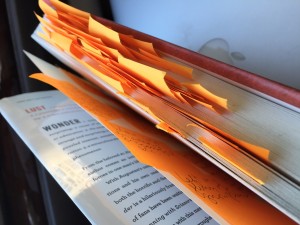
I had decided to tag pages that clicked with me, never imagining that when I was finished, the book would be thick with sticky notes and scribbles.

After crossing four time zones, I was landing at Sea-Tac just as I completed his Acknowledgements. (Seriously, I read it from one tarmac to another. East coast to West.)

The next morning, I had a Memoir class in Issaquah. Memoirist Bill Kenower, teaching. Jet-lag be damned, I made it onto an early morning ferry.

Each of us brought a few pages of work to share for critique. Bill read each student’s piece aloud as we followed along and later responded to his queries.

I have to say, my fellow students are damned good writers. (There are four of them.)

For my writing sample, I selected a chapter from my memoir that fit the criteria of “three pages long”. It didn’t matter about the humor part. They didn’t know my revised goals.

When Bill began to read my piece, I was surprised to hear—within two sentences of the beginning—chuckles. Then a few sentence along, more chuckles. They laughed periodically throughout the whole darn piece!

I shared that I honestly did not realize that this chapter was funny at all, but then Bill pointed out specifics of hilarity and understatement.

I got it. I get it.

It was funny. It is funny. What a funny day!

Now, if only someone can cure my phobia of looking in mirrors.

Humor in Memoir

humor in memoir

editing memoir


Follow me on Facebook.