Hiking the Appalachian Trail

Yesterday, I accidentally found myself hiking the Appalachian Trail.

How does one “accidentally” hike the Appalachian Trail?

hiking the appalachian trailBy hiking a trail that overlaps the A.T. for a short distance. Pleasant surprise!

I’m here in western Massachusetts visiting relatives for the Easter holiday. Under Saturday’s brilliant sky, I went looking for a trail to hike.

Decided on Beartown State Park, between Monterey and Great Barrington. Chose the Benedict Pond Loop Trail.

As soon as I got out of the rental car, the smell of wood smoke enveloped me with another blanket of memories from growing up on the farm.

In January, we always hiked to our back woodlot where my father and grandfather would fell oak trees for the furnace while we kids played in the snow.

Before they fired up the chainsaw, they’d set fire to the previous year’s brush piles. We always tucked in foil-wrapped potatoes from the barrels in the cellar along with a dozen or so ears of last summer’s Golden Bantam corn from the freezer. That was our lunch—the potatoes tender, the corn— sweet and just charred enough to stick to your teeth like candy.
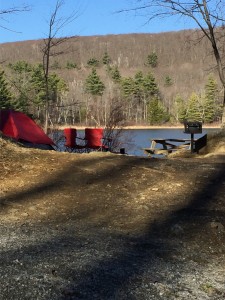
beartown_camp

Not their site. But close by.

That’s what I was thinking as I headed out onto the trail, passing the campsite of two men who were splitting a pile of oak for the cold night ahead. 39 degrees. That’s what he said.

“We spend the whole day splittin’ wood so we won’t freeze all night.”

Eastern exposure campground. Good exposure for summer camping, but not so great for early spring. They wouldn’t be absorbing any of the late afternoon warmth that was shining on the opposite shore behind us. It was a dandy campsite though. Looked like they’d been there a few days. Pots and pans and a fire ring full of hot coals.

The trail didn’t have a sign-in/sign-out accountability sheet like we had in our Arkansas state parks, so I just talked to the campers for a few minutes on my way in. If I was waylaid, surely they would remember.

“Oh yeah, I remember that lady. Came by here about fer o’clock. Said she was gonna hike the Pond Loop. Blue shirt, black vest. Yeah, that’s her.”

I was annoyed that I forgot my Black Diamond trekking poles back at home in Washington. The folding kind are great for travel, and a great help in boosting myself up over rough terrain.
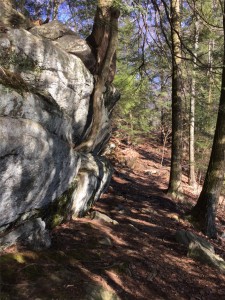
beartown_bouldersThe Pond Loop has lots of boulders strewn about from the Ice Age. Geology 101, UMASS, 1971. Lots of flat rocks handy as stepping stones too, but the trail is pretty dry. They didn’t get a lot of snow, and it seems like mud season might not arrive this year.

I followed the blue blazes, only having to backtrack once in an area where a blaze must have faded. Otherwise, a very well-marked trail.

Met a family of four that included two young girls about five and seven, rambling excitedly, the Dad telling the girls to follow the blue, the girls’ short legs stretching from one rock to the next.

Was tempted to ask if they’d seen any bears. “Beartown” State Park might have bears, right? Bit my tongue. Didn’t want to create any false anxiety.

Instead I just remarked on the crystal clear air.

The reason being that I might have been just a bit theatrical about bears when my own children were young. When our oldest son Chris was about two, I used to dance around the kitchen with him in my arms, singing “The Teddy Bears’ Picnic” a la Bing Crosby.

“If you go down to the woods today,

You’d better not go alone…”

The result was that Chris, with his imagination in overdrive, developed—unbeknownst to me—a fear of the Deep Dark Woods where the teddy bears picnic.

When he was five, we thought it’d be fun to attend the annual Teddy Bears’ Picnic, held on the Amherst Town Green. Packed up the boys and their teddy bears. Drove down from the hills and found a good parking space. Saw the tents. Saw the other children homing in with their teddy bears and picnic blankets.

Chris refused to get out of the car. No amount of coaxing could convince him that this was going to be a safe activity. He wanted no part of a Teddy Bears’ Picnic.

I hope that’s the only darkness I bestowed upon him.

I kept along the trail, by now on the opposite shore with the sun at five o’clock.
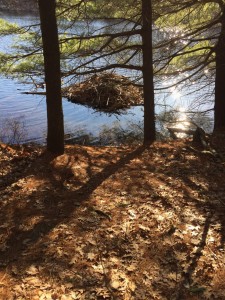
Saw an impressive beaver dam. Beavers, no doubt, asleep below in their cozy lair.

Met a couple, bearded Portlandia type and female friend in standard gear, who didn’t even seem surprised that I was alone. I told them that I wished I had my dog Lily with me. As soon as I said it, I thought:

Did I really just tell them that I’m out on this gorgeous day and I’m wishing I had my dog with me?

Yes. Yes, I did. She would have loved it.

At the restaurant earlier that day, it seemed that everyone wanted me to not be alone.

In line waiting for a table behind a young couple, “Are you together?” “No.”

At the head of the line with three or four people behind me, “Are you all together?” “No.”

While being handed a menu by the waitress, “Are you waiting for someone?” “No!”

Geez.

After a nice straight stretch of access road, I found myself facing a sign that marked the Appalachian Trail sharing the path. Nice.

Couldn’t resist stopping to take a selfie on the A.T.

Took about fifteen before I was satisfied. Not satisfied enough to upload it here. Ha.

Continued on. Met another young couple, this one with fishing rods.

Told them about the A.T. crossing up ahead. Showed them on the map.

They didn’t know. Were suitable impressed. Probably took selfies when they got there.

Returning to the car, I pulled my iphone out of my pocket to check my timing. 58 minutes, including stops. Just about aligned with the suggested timing on the map. A great day in the great outdoors.

Beartown State Park, Monterey MA.

hiking the appalachian trailFollow me on Facebook.

More Editing

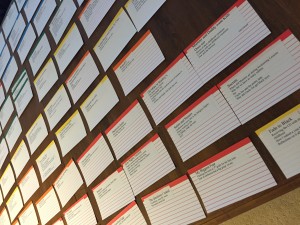
notecardsThree days after creating my chapter and scene notecards, I’m making sense of my category and themes, ready to continue editing.

The category is Coming of Age. The themes were not so obvious to me.

However, when you simplify the contents of your childhood into a patchwork pattern on a table, suddenly the themes that were so evasive begin to bubble up from the depths of your submerged life.

I stood over the cards for ten minutes, heartlessly pulling the cards that I’m sure represent boring topics. Putting them aside—not discarding yet—you never know.

With the table thinned out a bit, I began to stack similar themes and subjects.

Fear has a big pile. Fear of the draft horses on the farm, fear of being left alone, fear of fertilized eggs! Fear of being in charge of my siblings’ fears: the swimming lessons, the dentist!

notecardsThinnedMy shameful shyness and its related topics are an interesting stack, tied to childhood depression, longing, “girlfriendship” (and the lack thereof), and my mother’s questionable child-rearing methods. The unopened copy of Dr. Benjamin Spock’s Baby & Child Care—except for the part about chicken pox, measles and mumps. Or was that masturbation?

The Feminism stack surprised me. I knew that I was a child feminist, but the number of scenes that innocently demonstrated this budding characteristic in my busy little mind was amazing to me. From a very young age, I resented all of the special privileges that boys were privy to.

Another prominent theme is Secrets. (They wouldn’t remain secrets if I revealed them here.)

I discovered that there were three themes that saved my life.

Nature, Reading, Music. In that order.

Now that the cards are re-ordered, I can begin dragging the chapters and scenes into the Revision.

By no means am I near the end, but if I can get this content in proper order, then I can begin to refine the results.

editing memoir

Follow me on Facebook. Like me too, if you do.

Editing Memoir

Editing memoir is a long slog.

The first draft is easy. It’s bleed onto the page. Dance on the page. Sing on the page. Burn. Cry. Get angry. Pour it all out.

Dig back to the beginning. Try to remember every last detail.

Then the editing began. Editing is when the doubts creep in. Who is this book for? For me, or The Reader?

In my opinion, the first memoir draft is for the Writer. After that, IMHO, you have to walk the fine line between staying true to your memories and yet make them, not just palatable, but interesting to the reader.

Make the memoir something that the reader can relate to in terms of their own life.

If you don’t, it’s just a self-centered ramble through your own dirt or glory, as the case may be.

I’m on Week 3 of Draft 5, the fifth revision.

I’m holed up in an apartment north of town with a chair, a table, a laptop, and a foam mattress that I bought on Amazon Prime the day before I moved in with a basic black wardrobe and a box of socks and underwear.

One water glass, one wine glass, a couple plates and a handful of silverware.

The table is covered with index cards, post-its, a few favorite memoirs, Mary Karr’s The Art of Memoir,  and vitamins.

The landlady lives upstairs. I told her that the only person she’d hear me talking to is myself.

I’m hoping to communicate with the voice of my past clearly.

I want the voice of my past to greet the voice of my present and make sense of it all.

The original time frame was age three through eighteen.

Things change.

Fortunately, I write in Scrivener so I won’t lose any of my previous versions.

I’m making big changes to the voice as I’m now letting the adult Linda take charge.

Expanding to the present. Reflections, Lessons, Questions Answered.

Hoping for the best.

Editing Memoir.

editing memoirFollow me on Facebook. Like me too. If you do.

My Young Friend Antwan

Today I was reading a sample issue of the literary journal The Sun, July 2013, to see what style of memoir essays they publish. I came across a superb piece by Afro-Am author and University of Illinois Professor of Creative Writing Ross Gay about being a black man in the U.S. About the fear of being pulled over by police (which he has since eliminated from his response mode) and about the survival mode skills that blacks learn from a young age. Plus lots more of his memories and experiences.

It reminded me of the many months that I spent teaching in the Arkansas Delta where I witnessed frequent instances of racist behavior.

Clearly, there are many wonderful non-racist residents of that area, but the old ways are often hard to overcome. You see it here and there in the day to day.

Like the time I stopped at a fruit stand and the white proprietor promptly asked me what I needed, while ignoring the black man who had been standing patiently in front of the peaches. What I needed was for him to wait on the black man—who had been there first! (and I said so…)

The article also reminded me of a memoir piece that I wrote about twenty years ago as part of my Arkansas Artist-in-Education residency report. I had forgotten all about it until cleaning out some old report files when we moved from Arkansas.

The report—A Conversation with Antwan—is about a friendship that I developed with an 8-year-old boy.

I had been painting a 32′ mural at the rear of the Delta Cultural Center on Cherry Street—right above the levee. It illustrated the flora of the Delta. If you climbed up onto the levee, you could see the Mississippi flowing not far away. The temperature was 106 degrees for several days in a row. I had become acclimated to the heat, and my only concession to it was wearing my wide-brimmed straw hat with the black grosgrain ribbon that dripped off the brim onto the back of my sweaty neck. And sunblock, of course.

I was staying at a cheap motel outside of town, and I often saw the prison guards on horseback, wearing looks of smug superiority with their pressed jeans, big hats and aviator sunglasses as they supervised the chain gangs. They held their rifles crosswise in the saddle as the prisoners busted sod in the 100+ degree heat—sod that a brush hog with a harrow attachment could have wiped out in thirty minutes.

I was driving an old burgundy Dodge Omni. It had a hatchback where I could sit in the shade to take a break. One day at the mural, a small boy appeared from a house on the corner and crossed the street to speak with me.

“I been watchin’ you paint. I thought you were a school girl. You doin’ a good job!”

“Why thank you,” I said. “I’m glad you like it.”

“My name is Antwan. I live over there. Would you like to buy a freeze-pop? My mama makes them. They’re a quarter.” He pointed back at the house.

(It’s part of the community culture there for women to earn extra money by selling homemade cakes and such.)

“Sure,” I said, and I dug a couple of quarters out of my wallet.”

“Get one for yourself too,” I said.

“What kind you want?” Antwan asked.

“Surprise me,” I said.

Antwan returned a couple minutes later and handed me a cherry freeze-pop.

“I thought you’d like cherry.” As he handed it over, he said “It’s OK. I didn’t lick it or nothin’.”

We became good friends. Every day he crossed the street to watch me paint, and I let him paint on the mural with me, teaching him to mix colors in a Dixie cup.

To the passersby who slowed their vehicles to view the mural in progress as they drove on by, we must have been an amusing duo.

Antwan took this opportunity to ask a white lady the questions that he’d always wanted to know the answers to.

“How come—when I wave to white people—they don’t wave back?” he asked.

“They’re just rude.”

“Do you like all white people?” he wondered.

“Heck no. Just like you, I like people who treat me the same as they would like to be treated.”

And so on.

I wish I could share the entire Conversation with Antwan here on this page, but then it would be considered “published”. It would be ineligible for submission to literary journals and other venues. I think I’m going to dig it out again and submit it somewhere.

Those were good days. Even though it was hot as hell during the summer months, I enjoyed the smell of the catfish frying at the cafe on the corner. I enjoyed hearing the tugboats whistle as they pushed their barges south towards New Orleans. Even the kudzu swallowing up the terrain on neighborhood hillsides created a lush cool camouflage of dark, darker and darkest green.

The Delta was a good to me.

I wrote my only poetry there, sometimes pulling over to the side of the road as the last ghosts of summer rose up over the cotton fields—misty mornings. I cut and hand-pieced my Quilting With the Blues series in a classroom in rural Barton, and designed the Children’s Activities Block at the King Biscuit Blues Festival the year that Buddy Guy headlined.

The most inspiring times I spent in the Delta were teaching with legendary blues guitarist Johnnie Billington, the most generous teacher I have ever met.

He and I were Arkansas Artists-in-Education fulfilling a grant award. I was “Miz Linda”, teaching an inter-generational Afro-Am quilting project in a community center where I paired grandmotherly senior citizen ladies with rambunctious pre-schoolers around the quilt frame.

“Mr. Johnnie” was on the other side of the wall, tuning up his guitar, and then patiently giving the 9-year-olds and up—the ones who were truly interested— a priceless opportunity to learn the classic music of their home from an unassuming master. He gave his all to the children of the Delta. Read his story here and be inspired.

Good memories.