You CAN Go Home Again

It’s the time of year when most of us make the trek to the scene of our origins. It’s a return to where we grew up, or where the siblings that we’re still speaking to reside, or where our parents—if they’re alive— might still be hosting a neutral setting for others to come together.

When I was in my twenties, this holiday renewal took the form of careful baby steps.

My parents and I had had many confrontations during my high school and college years over politics and lifestyle, but once I had a “real” job (teaching), we all seemed to calm down a bit.

A detente of sorts.

My parents accepted that I had finally joined the mainstream of brassiere-wearing professional females, and I chose to ignore my parents’ many hair-raising inconsistencies.

My mother had always modified the truth to suit her view of circumstances.

Her Big One was lying to us about her high school graduation status. I always suspected she hadn’t graduated, and I was right. How did I know? Well, of course, I checked her graduation class stats in the yearbooks of the largest online database of high schools in the U.S. You know the one. They send you cryptic emails all the time, tempting you to see who remembered whom.

To Mummy’s way of thinking, if she had admitted that she dropped out of high school, she was convinced that we also would drop out of high school. Because of course, we would want to emulate our mother.

Not much chance of that—but that’s how she thought.

Big One #2. She lied about never having tried cigarette smoking. Not only did she exclaim boldly that she was “so glad” she had never tried cigarettes, but she said this in spite of the fact that we all knew—from the billowing clouds of nicotine that she left in the bathroom on winter mornings when she couldn’t open the window—that she was a bold-faced liar. The only person she was fooling was my father, himself a lifelong smoker with a permanent aura of cigarette vapors clinging to his clothes.


I had always yearned to have a wise mother figure with whom I could talk about boys or my period or the state of my ambiguous future. Someone like Barbara Billingsley or Donna Reed. Someone who might tell me where babies came from.

Instead, by the luck of the draw I got the antithesis of the nurturing stereotype. But things weren’t all bad. My siblings and I were allowed to run untethered from dawn till dusk from a young age. Yes, Mummy locked us out of the house—but we had more freedom than any of our schoolmates. We developed independence.

By the time I married and had children, I continued to visit periodically and kept my mouth shut about my early years. Let sleeping dogs lie, as it were. Mummy had her grandchildren to gift with polyester rompers and I could monitor her interactions, ignoring her parenting suggestions as I felt appropriate.

“Don’t pick up the baby when he cries. You’ll spoil him!” she said.

Year after year, my memories sifted to the surface with bits and pieces of long-forgotten trauma.
My father is gone. My siblings and I all get along fine, in spite of childhood years where we were pitted against each other. (My father’s special talent was his ability to make each of us feel that we were the least loved.)

My mother is now a remarkable 87 years old. I suppose it’s not surprising. She certainly acquired her share of immunity, and she passed it on to us.

“You’ll eat a pound of dirt before you die!” she always exclaimed when she picked up the slice of our cake that had fallen in the dirt and returned it to our grimy little hands. No forks and plates for us! No siree, Bob! No napkins either. We used our sleeves for wiping our mouths and our noses in no particular order.

At 87, I thought that she might be in a position to answer some of the questions I’ve long wondered about but never had the courage to ask. I tried for years, but always stopped short of confrontation. I had shed my tears long ago. No need to start them flowing again.

Last week, as Mummy sat at the kitchen table completing page after page of dementia-fueled word search puzzles—her obsession—I dared to ask where she had gone during those times when she dropped us off. At swimming lessons. At the movies and such.

She looked up confused. Did we go to swimming lessons? Yes, Mum, we did.

Was it indoors or out? It was outdoors, Mum. It was at the town pool where the other mothers sat in the bleachers sipping Coca-Cola through straws tipped with red lipstick while tapping their cigarette ashes against the cold metal benches and squinting into the sun at the swimmers flailing below.

I realized last week that I’m never going to get answers to the questions I have had for so long. And point would it serve?

We each have our own memories. How we choose to allow our memories to color our lives is up to us. We can use our past as a lesson, we can dwell upon it, or we can move on.

 

Follow me on Facebook.


Thanksgiving in a Changed Land

In my youth, Thanksgiving was always a rock solid holiday in the United States. Norman Rockwell solid.

Family and friends sitting around a table with a roasted symbol of plenty in the middle. A home-grown turkey so big it filled the oven like one of those Japanese melons grown in boxes so they’ll be harvested square and stackable. Began roasting at 5 AM, vegetables simmering by 10, mashing the potatoes at noon.

As predictable as pumpkin pie.

Tepid hugs from ancient relatives greeting you at the door to see how you’ve grown. Young boys in white shirts, half untucked and soon to be smudged with lawn. Me, sitting at the empty dinner table, talking to no one. No expectations.

Multiple generations passing the cranberry sauce, eyeing each other up with unspoken judgments. A little bickering amongst the kids. He hit me first. The women, clad in calico aprons, doing the dishes after dinner. The men, buttoned up in hand-knit cardigans, tapping their cigarettes into beanbag ashtrays in the living room. Me, sitting at the empty dinner table, talking to no one. No expectations.

The older folks shaking their heads over Beatle haircuts. Football games on the TV. Not too much to complain about. Yet.


In ’65, Bob Dylan stood before us on a stage in Worcester, Massachusetts and sang “The Times They Are A’ Changin’.,” and the next time the curtains parted, the folk icon had gone electric. Tradition be damned.

Polarity in the country grew slowly and soon there was revolution in the air. Easy Rider hit the theaters. Janis Joplin played our college homecoming concert and I smelled marijuana drifting in the air for the first time.

A few days before Thanksgiving in ’69, we hitchhiked to Washington DC to join the Moratorium to End the Vietnam War. The air was crisp, the sky was blue, and as far as the eye could see, the crowd of students was elbow to elbow. I never got close enough to hear the speeches.

That night I slept on a cushioned window seat in a kind woman’s home. She served us lentil stew from a recipe in the New York Times cookbook.

I remember the kitchen.

I remember the kindness of strangers.

That Thanksgiving, my family didn’t discuss the Moratorium March. We didn’t even discuss the War. My father ruled the conversation with a cold, tight fist. Nixon was President.

We students thought we were liberal but most of us weren’t even close. I can’t pretend to have been an activist. I was caught up in a survival loop at home. My non-conformist ways began with baby steps. The first time I went without a bra, my mother cried. She needn’t have been so upset. My boyish chest wasn’t going to attract much attention.

There were many other causes still under the radar. At the time, I didn’t even recognize that my beloved godfather and his best friend were gay. It wasn’t until Uncle Joe was in his eighties that I was able to write “that letter” expressing condolences over the passing of his lifelong partner.


In 2000, Bob Dylan wrote, “Things have changed…”

Our own children were growing up, and we thought things were going along pretty well but— things have changed.


Now we are the older generation.

My father’s been dead a few years. My mother lives with dementia. I don’t even know if she’s aware there was an election.

I’m going to visit her across the country, but there won’t be a Thanksgiving dinner this year. Everyone’s gone and the house where we sat around the turkey in our tie-dyed t-shirts and peace symbols stands empty.

I’ll still be sitting at a table. Maybe making a jigsaw puzzle or playing dominoes, my mother’s two favorite activities. No expectations.


We never know what’s coming in this life.

Our country is in a state of radical change once again. Surely peace symbol bumper stickers will become popular again. We need some kind of symbol—some hope that it’s going to be alright.


I really don’t know what to think. I don’t know what else to say.

I hope your Thanksgiving is peaceful, and that you’re able to find a place of calm in the coming days.

Things have changed.


“Come senators, congressmen
Please heed the call
Don’t stand in the doorway
Don’t block up the hall
For he that gets hurt
Will be he who has stalled
There’s a battle outside ragin’
It’ll soon shake your windows
And rattle your walls
For the times they are a-changin’.”

Bob Dylan, 1964

thanksgiving

thanksgivingFollow me on Facebook.


How to Tell a Damn Good Story

Pat Conroy said, “The most powerful words in English are ‘tell me a story.'”

Imagine our ancestors sitting around the glowing embers of a dying fire, the fire reflected in their eyes, their rapt attention inspiring the storyteller to go deeper and deeper still.

Storytelling surely has instinct and intensity in primal roots and gut feelings.

Storytelling is personal. It’s emotional. It’s a connection.

So how do you make it work for you, the writer, and for them, the listeners?


I told a story last weekend during Lit(erature) Lounge, a storytelling event at The Open Space for Arts & Community. I must admit that what I enjoy most is that moment when the room goes pin drop quiet and mouths fall open as ears tighten and focus on the content that’s flowing over the crowd. This moment is a rush for the storyteller because you know that you’ve caught the attention of your audience.

They’re not going anywhere. They’re not getting up to get a glass of wine. They’re not heading to the rest room. They’re not checking their iPhone. It all can wait.


Whether your story is five minutes or a continuum the likes of Scheherazade, it continues to ebb and flow. It travels between the lips of the storyteller and those who have gathered to listen.

For me, that pin drop quiet creates a zen experience when the audience and I become one.  It emboldens me to connect with changes in volume and pacing, vocal style and very subtle body language, small gestures.

But—here’s the thing—storytelling should never be about ego. It always needs to be about sharing.

When you have the attention of the audience, your story needs to move them, to give them hope, teach them a lesson. It has to subtlely be about them, not you.

As Brook Warner of She Writes Press and Linda Joy Meyers of the National Association of Memoir Writers have shared in their lessons on what they call “takeaway”:  “Takeaway is the arrow that pierces the reader’s heart.”

Powerful, right?


So how do you do it successfully?

By helping the audience become part of the story, even as they listen without responding verbally.

By having a story arc with strong imagery.


When you were a child, it began with “Once upon a time…”

The protagonist (the main character—Cinderella or Gulliver or Bilbo Baggins) appears in a situation. Then, like in real life, stuff happens, everything goes to hell, and we watch them wiggle their way through to a satisfying ending.

Your storytelling has no stage set, no images, no costumes. Your words must create the scene and enable the listeners to become part of the experience. They create images in their minds by combining your words with their own history.

If you’re successful, your storytelling will provide the audience with something satisfying to gain.

They’ll lean in.

You’ll make eye contact. First one, then another, then another. And another. Your eyes will convey that you want them to know that this is their story.

You’re telling it for them.

You want them to feel the magic.


Write your story. Read it aloud to yourself, underlining the words that jump out in your diction.

Then go back and edit the page with a way to remind yourself of the words that need emphasis and the places where pauses are effective—essentially the pacing of your storytelling.

I like to use italics or bold print as cues to my verbal emphasis. Then practice your story on a friend or your writing circle.

Tighten up the story so that there are no points where the audience glazes over.


Have you ever noticed that when you’re given parameters for a written piece that are smaller than your written piece, you manage to cut out the chaff and the shorter piece is stronger?

Example: you want to submit a story to a publication or contest but the limit is 3000 words. Your story is 4000 words.

I’ve found that the challenge of shortening a piece of existing work always makes it better. That might be just me… I tend to go on… but I do think it’s applicable to most every writer.


So polish your story, make it relevant to the audience with takeaway. Make sure that it paints imagery as vividly as an artist’s brush. And not just visual imagery. Let them hear, and smell, your story too.


Then, when you step away from the mike, the spell will break with a snap. Your audience will have something to carry home, to muse over in later days.

If not, your storytelling is nothing more than a dark shadow on the wall of a cave.

storytelling


writing the nightmaresFollow me on Facebook.

Writing the Nightmares

This morning I awakened at four, as is not uncommon for me. I rolled over and thought happy thoughts, took a few deep belly breathes and fell back asleep, only to reawaken two hours later with a vivid nightmare shaking me by the shoulders.

Writing the Nightmares

When I attended The Magic of Memoir conference in Oakland CA two weeks ago, I was witness to a lot of amazing stories told by brave, wounded, survivor writers. It made me realize that writers with those kinds of memories are more likely to write about them—in memoir or as the basis for fiction—than the fortunate souls who leaned back and pumped their swings higher and higher into blue skies and fluffy white clouds.

Last night I was reading one such story and it combined with my personal memories to produce this morning’s nightmare in full living color. (I don’t often dream in color.)

The content is not so important. I wanted to forget it quickly—but I haven’t. I could tell you about the multiple layers of the dream—but I won’t.

Instead I’d rather tell you about where my mind wandered after that.

I clicked open the piece that I’m fine-tuning for The Lit(erature) Lounge storytelling event next Sunday at the Open Space for Arts and Community on Vashon Island, WA. It’s partly about my grandmother Mémère. My chain of thought this morning went something like this. Not the writing piece, just the musing. I’ve left out the punctuation. Ha. Too many apostrophes.

“Mémère. French.

Memoir. It sounds French, but it isn’t spelled French. We spell armoire with the e, so why not memoir with the e? If it were, we’d be spelling it memoire. Our memories. Another inconsistency of the English language.

Memoire of Mémère.

Mémoire. Like armoire. An armoire is a chest. And isn’t a memoir like a chest? A chest of memories?

Except that armoires were originally used to store weapons. Memoire then is not so far-fetched, since doesn’t a memoir-née-memoire also store weapons?”

Writing the Nightmares

As I read the memoir last night, I thought of the woman who wrote it, who lives here on this island. Another survivor walking around with a smile on her face in the midst of all these other survivors walking around with smiles on their faces.

Because we all survive something.

It might not be the stuff of memoirs, but it’s another layer that has made us who we are. If we’re lucky—and we can make our own luck—we get to put it behind us and let the good days, the now days, the tomorrow days, outshine the nightmares.

Once we have finished writing the nightmares, we’ll be on the other side, ready to pump our swings higher and higher into the blue skies and fluffy clouds.

writing the nightmares


writing the nightmaresFollow me on Facebook.

Subscribe to this Blog by click here or the Subscribe button at the top of the page. Go ahead. I’m never gonna Spam you. 🙂

The Value of Writer Critique Groups

The value of writer critique groups was brought home to me this week.

I finally located a Memoir-specific critique group and joined their Write & Share meet-up on Wednesday at the Greenwood branch of the Seattle Public Library.

Frankly, I arrived a little shell-shocked.

Riding the ferry is always relaxing. Seagulls and sea spray off the bow, and I, optimistic as always for the very slight chance of seeing otters or orcas. Maybe just sipping my coffee and reading a few pages of a book that I’ve brought along.

But battling the morning commuter traffic for over an hour was a shock to my country girl chill.

I was beginning to doubt my decision. I told myself that I’d participate in this meeting but probably wouldn’t return because the wild drive might be just too much.


A little backstory. The Memoir group has 63 members and has been meeting for two years. They have two meetings per week, and in order to keep the critiques productive, a maximum of five members—first come, first served—are allowed to sign up for any one meeting.

The meet-up schedule is writing from ten to noon, followed by an hour of reading and critiquing. It works because most members have other jobs and responsibilities so many aren’t available for meetings on a regular basis.


The Value of Writer Critique Groups

the value of writer critique groupsMy previous critique group experience was two years ago. We met in Eureka Springs, Arkansas, and I was a member of that group for almost two years. Since then, I’ve had writer friends and reader friends critique chapters here and there, but nothing in a live, small group setting where a discussion can take place.

I’ve benefited from their friendly but professional feedback, but I recently found myself stuck in the “muddy middle”, as the middle of a manuscript is often called when you get bogged down with uncertainty about your direction.


So here I was, entering a new-to-me library at Storytime with a dozen strollers in the hall and gurgling babies everywhere. Sweet.

I saw two likely members of the Memoir group seated at a table tapping away. They were together, but they weren’t, somehow, “together”, and each was absorbed in working.

I took a chance and asked if they were the writers’ group. They were.

Introducing myself, in that brief moment, I knew that this was going to work out fine. I found a spot for myself and tried to write.

Couldn’t concentrate. No matter.

I had come prepared with printed copies of a piece for Write & Share so I wasn’t under stress to produce something new on the spot.

At noon, we moved into a reserved study room, everyone introduced themselves, and a productive session of reading and critiquing began.

Most of all, I appreciated the reading and critique of the other writers’ work. So much of what was said about their chapters could apply to mine. Structural reminders, scene notes, characterization, pacing, and so on. As a result, I was able to learn from far more than just a critique of my two double-spaced pages.

Sometimes, it’s just nice to be with others who are walking the same path. I think that one doesn’t choose writing. Writing chooses you. Every writer I’ve ever met agrees with one thing: we can’t stop writing.


The pages I had chosen to share were a memoir chapter that I’m planning to read at an Open Mike in Oakland CA next weekend during The Magic of Memoir conference. It was great to receive feedback confirming what I had selected.

They suggested a couple of tweeks that I hadn’t noticed and gladly accepted. We try very hard to look for flaws in our work with an open mind but oftentimes we miss obvious places where a better word might be swapped in or something that we take for granted might need clarifying.

One of the writers had questions about changes he was considering for the beginning of his manuscript. I could identify with that—I’ve changed the opening chapter of my memoir three times this year!

The group said, “No! Don’t change it.” And that was that. Within reason, we trust another writer’s opinion, especially when they explain why something does or doesn’t work.

I can see that I’m going to brave the traffic. Certainly not weekly. Not even bi-weekly. I think I can safely commit to every third week. It’ll keep me on track.

Besides, I want to know which of my opening chapters is the one that works.


the value of writer critique groupsFollow me on Facebook.

New Yorker Envy

I refer to New Yorker subscription envy. Not New Yorker resident envy.

Sure, it would be fun to live in NYC—maybe for a month or a semester. (It’s been decades, but maybe once again I’ll find myself with a syllabus.)

I see myself hitting up the museums I’ve not gotten around to. The Cloisters, for example.

The museums I’ve not gotten to the finish of. The top of the Guggenheim ramp, e.g.

And I would take the bus to museums that were closed on the day that I visited. The Whitney.

When I needed a break, I would sit on the stairs at the Metropolitan and eat a hot dog with sauerkraut while watching the tourists pass by on the Double Decker Bus. This is the only place where I eat hot dogs with sauerkraut. I’ll enjoy the hot dog as much as the martinis and the view of Central Park from the Met’s Roof Garden Cafe. Martinis make me tipsy. Very. Is that why I usually stick to wine? I think I’m now old enough to let my guard down.

Every night I would take a cab to Broadway and see a show, since I have never seen a Broadway show. Broadway cast shows on tour, yes. Actual Broadway cast, no. Yes, I have Broadway envy, too.

And when I missed rolling around in the grass, I would head to Central Park  with a blanket and a thorough spraying with DEET for a total immersion in their microcosm of nature, placed as it is like an open terrarium in the midst of Lego block skyscrapers.

I digress.

I love The New Yorker. I envy a friend’s subscription. The issues are stacked on her coffee table when I visit. I put down my glass of wine and turn to the cartoon. Why can’t I be so witty as that?

I read a paragraph or two, but then my friend has returned to her place across from me on one of her delightfully unique and artistic chairs. Her taste is impeccable.

She eyes The New Yorker in my hand and admits that she has fallen behind.

I, who have just read a wonderful fantasy of reading the stack of New Yorkers in a tropical location, pick up my iPhone and send her the link.

“Estás sola?” I’d been asked, at the airport, and on the bus, and when I ordered my dinner later at the open-air restaurant. Are you alone? I liked the way the word sounded when put to me in Spanish, like a woman’s name fashioned from the English word ‘soul.’”

I get that a lot, too. Enjoy.

A BIKINI, A TOOTHBRUSH, AND 44 ISSUES OF THE NEW YORKER

new yorker envy

writingFollow me on Facebook.

Sit With Us App

The Sit With Us app was announced yesterday, creating a subtle but ground-breaking way for lonely teens to connect in lunch rooms without calling attention to themselves.

16-year-old Natalie Hampton designed the Sit With Us smartphone application in response to the feelings that she experienced when she spent her entire 7th grade year eating lunch alone. The app invites students to become ambassadors and indicate their lunches are open for other students to join.

A brilliant idea.

If you’ve ever experienced lunch room loneliness, the news of the app may have hit you right in the middle of your aching stomach. The same stomach that felt really sick every single day as you slid your cafeteria tray down the stainless steel counter, dreading the end of the line, knowing that after you gave your fifty cents or dollar to the lunch lady, you’d have to pick up that tray and join the crowd whose roaring voices were filling your head with fear.

I was one of those kids.

I attended a parochial school in a neighboring town for grades K-8, and then, because my own town had a public junior high that went up to grade 9, I was forced to make my transition to public school there. After that, I transferred to a public high school back in the neighboring town again for grade 10-12.

I ate lunch alone every single day for those three years.

I can tell you the colors of the matching Bobbie Brooks sweater and skirt sets that the girls at the popular tables wore as I inched my way to a place by the window.  I remember their hair styles, their loud laughter, their Weejuns, their monogrammed sterling silver necklaces, their purses that held their rat-tailed teasing combs and packs of cigarettes. I can even tell you the conversations I overheard.

I did actually have a handful of friends—not at the same time, of course. But those friends had boyfriends or a lunch schedule that wasn’t the same as mine.

Every day my schedule placed me in the cafeteria at its busiest. By the time I lifted my tray from the counter and turned to face my fate, there were just a few single seats here and there.

The oak tables and chairs were lined up so close together that I had to lift my tray to shoulder height as I squeezed through the tight aisles. The sturdy old chairs had fifty years worth of bruises on their legs with lots of rough spots. They had seen a lot of abuse.

My goal each day was to carefully pick my way through the crowd to an empty space without getting a run in my nylons. About once a week, I failed. My stocking snagged on a splintered chair leg and I felt the hole in my stocking grow as its climbed up my leg leaving an ugly track of broken nylon and pale skin.

If I was lucky, my mother might have a spare pair of nylons at home but usually I had to wear the same stockings with the runs in them until she remembered to pick up a replacement.

We lived in a rural area of farms—no stores. I rode the school bus home and depended on my mother for the sundries of high school life. Nylons, binder paper and ball point pens.

It wasn’t so bad. I survived.

But the Sit With Us app would have helped.

sit with us app


sit with us appFollow me on Facebook.


Maybe you know someone who could use the Sit With Us app. It’s available as a download in App stores.

Sit With Us App

It’s All About the Food and Tradition

One of our sons is visiting this week with his wife, and a friend from his school days has driven up the coast to join us for a few days.

If there were a theme to this week it would be “Food and Tradition” because when mothers entertain sons, isn’t that a major factor?

The mother begins with the questions a couple weeks out from the visit.

“What would you like me to cook?” she asks.

“Oh, you know, my favorites,” he responds.

The school days friend has no idea what he’s getting into. First the grocery list, the mountains of fruit and vegetables—all in season—because your body responds most efficiently to seasonal produce. Cherries as big as plums. Peaches that hold to a thumbprint test of ripeness. Then the seafood. Weathervane scallops from Alaska. We’ll have them seared in cast iron with a drizzle of olive oil and a smidge of butter. Toss them into the nearly smoking hot pan just as soon as the two fats meld.

We have them stuffed and baked. Double-size portions and they wish there were more.

An entire king salmon, stored according to the fishmonger’s instructions. We won’t insult the wildest fish in the sea by freezing even a single ounce of it.

“Put it in a box in the refrigerator on ice,” he said.

“Top or bottom?” “How many days?”

Marinated a half a day, then we bake and glaze it with pecans according to a recipe shared by my favorite captain—Capt. Brenda Thomas of the schooner Isaac H. Evans, out of Rockland, Maine.

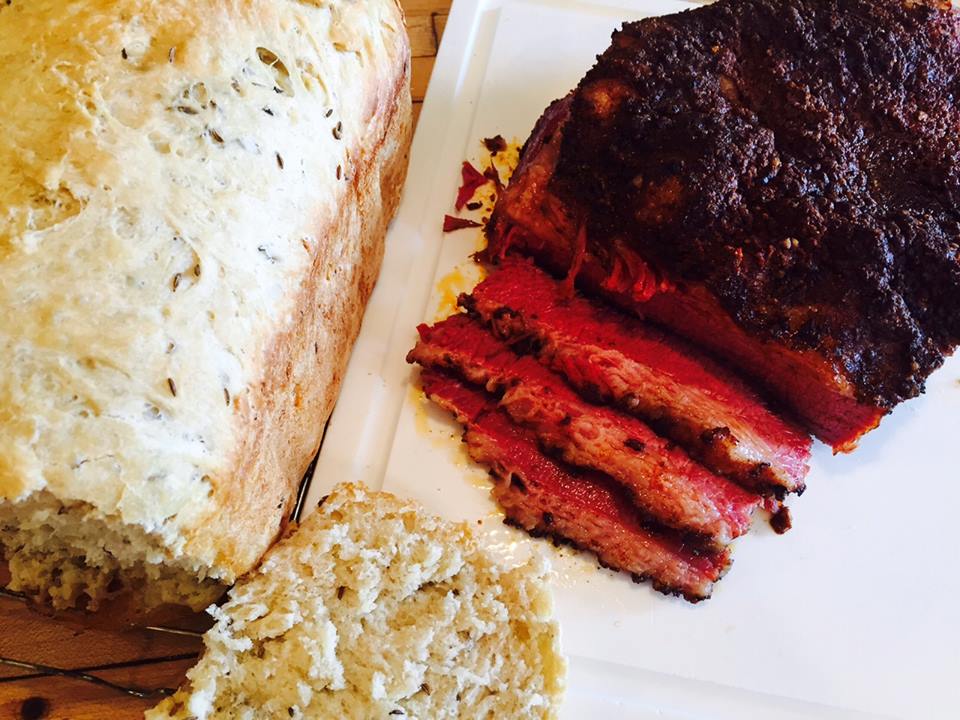
The air in the kitchen doesn’t have a chance to clear. If it isn’t yeasty caraway rye bread, it’s the pastrami ritual. The brisket, trimmed to a lean quarter-inch of fat, has been removed from the brine where it’s been curing, stirred and flipped lovingly four times a day, and now, after rubbing with smoked paprika, fresh ground pepper, and ground coriander, it’s ready to bake, sealed on a rack over a water bath. Do you know how long it takes to grind two tablespoons of Tellicherry pepper with only the peppermill from the kitchen table? It’s worth it.

With the vat of brine removed from the refrigerator, there’s room for the boxes of organic strawberries and a couple more bottles of wine. Layer the strawberries between paper towels in a sealed box and they’ll hold for ten days—instead of one. But we don’t need ten days. Strawberry rhubarb pies are on the menu.

Going kayaking today? Here’s lunch for the dry box. Muenster cheese en croute. Shredded and baked with minced parsley, lots of garlic, and sealed in pastry covered with toasty sesame seeds. Remember to pack the local craft brew, an IPA.

A hike down Shinglemill Creek? Pastrami sandwiches and trekking poles.

On the return, crispy fried oysters with homemade coleslaw, the cherished recipe from the cafeteria lady where I taught in 1973.

“Do you always eat this way?” asks the school days friend.

“When family visits, yes, absolutely yes.

food and tradition


Food and Tradition.

It’s part of every memoir. Follow me on Facebook.

food and tradition

Your Truth Can Inspire Others

Your truth can inspire!

Linda Joy Myers, Author and Founder of the National Assn of Memoir Writers,

shared a post today about vulnerability and truth in memoir. I don’t want to quote her suggestions in their entirety but you can read the entire post here.

There was one point that stood out for me.

When you’re dealing with the truth that you’re exposing, she suggests (her point #4) that you should

make a list of the ways you feel your story will help others—think of ten messages you will deliver in your book.”

I think this suggestion is one of the strongest reasons to press onward with your truth.
It’s more than a rationalization.
When the truth in your memoir presents strong examples of surviving the events that you detail, others who are experiencing the same will find strength and good in your conclusions.

Furthermore, if your memoir style is strong, you’re avoiding the “woe is me” syndrome.  Your memoir will stand out for other reasons and your words will be taken seriously.

Keep at it!

your truth


your truth

Do a writer a favor. Like my Facebook page. 🙂


Writer Conference Recharge

When the going gets tough, it’s tempting to close and laptop and back away. Writing is a struggle for all of us, and yet, if we back away, we’re just pushing The End further down the line.

This morning I awakened at 4:45 in a terrifying nightmare sweat. It was the first time my memoir crossed the line, jumped from my manuscript to my dreams. I was glad to see the light of dawn fade the darkness.

I’m that close to The End.


It’s been a long slog that I wish I had shared somewhere, somehow. Living these past twenty months in a new location, I haven’t yet joined a regular writer community and it shows in my insecurities.

Reading aloud, especially, is a great way to pinpoint the strengths and weaknesses of your work. Reading aloud to yourself is OK, but not as effective as reading to an audience.

I (very recently) asked if I could read a couple chapters of my work to two very new friends for feedback—one male, one female, two diverse individuals—two different chapters, two different occasions. It reminded me that there’s no substitute for the value of community for honest feedback and support.

It also reminded me that I should look for the someone who needs my support. We all need help finding our way through the darkness.


I’m participating in two writer conferences in the coming months. These are an opportunity to learn and share that I look forward to every year.

I know many writers wonder how much they’ll get out of a conference for the time and money spent. If you’re wondering that, know that it’ll be worth it. I’ve never yet left a writer event that didn’t lift my spirits and send me home inspired and recharged.


writer conferenceSome West Coast events coming up:

The Pacific Northwest Writers Conference is coming up July 28-31, 2016 in Seattle. Note that if you can’t attend the conference, you can still take Masters Classes.  www.pnwa.org/

The Magic of Memoir conference is October 15 and 16, 2016 in Oakland CA.  A specialized event for memoir writers. I’m attending it for the first time and it looks promising.  http://magicofmemoir.com/

The Northwest Writers Weekend takes place Nov. 4-6, 2016 at an old-fashioned camp in the woods about a half-hour’s drive from the Southworth Ferry WA (take from Fauntleroy/Seattle). This weekend is unique in that it includes workshops on songwriting. Bring your instruments! Great sense of community here. http://www.nwwritersweekend.org/

writer conferenceFollow me on Facebook.