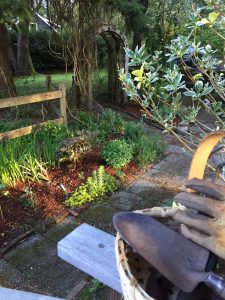
Night Falls

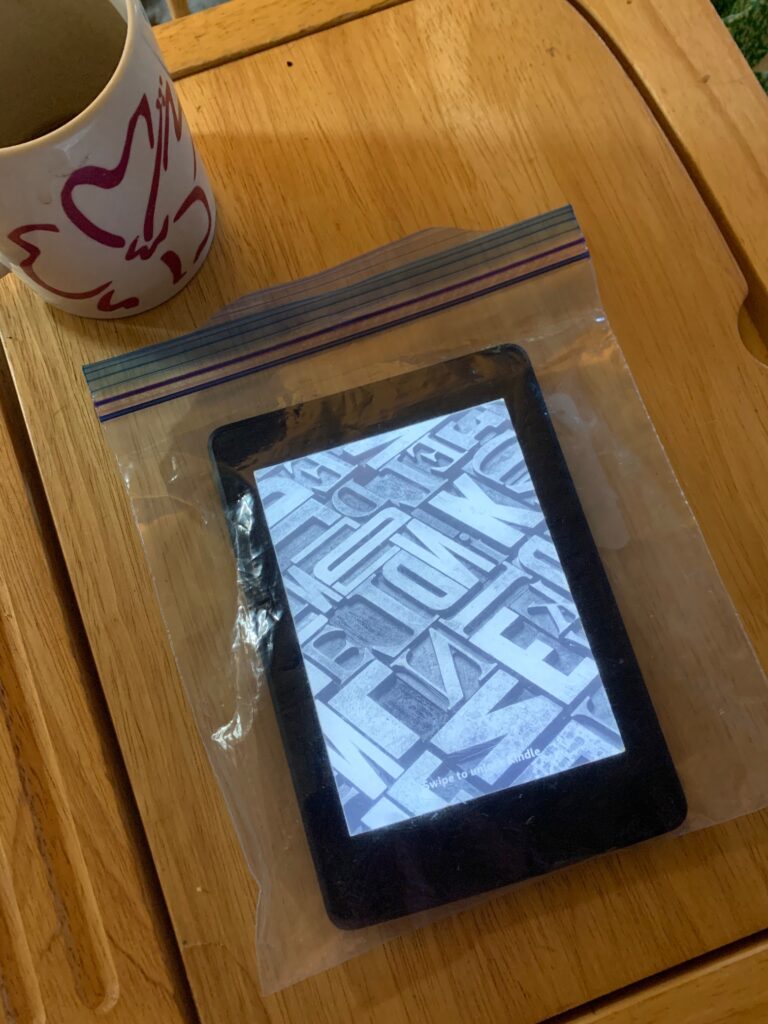
I confess. I love to read in the hot tub after dark. I put my Kindle in a quart-size zip lock bag, lie back, and rest my “Kindle bag” on one of those inflatable bathtub pillows. Not jets, no light. All I want is the sky and the sounds of the night.

I read as the night falls around me.

Precisely at sundown, daylight dims, the gulls are gone and the Canada geese come honking like New York City traffic. First they arrive in pairs.

As dark descends, there are fours and sixes, until finally a great flock circles wide where the creek feeds the harbor. They fly low, continuing to honk.

“Here we are! Make way!” they announce, until finally the entire squad cruises to bed down for the night along the shore line.

Then the barred owl arrives, landing high up in a Douglas fir about seventy-five feet away. I only know he’s there because of his melodious call in the pitch black.

“Who-cooks-for-you? Who-cooks-for-you?”

From somewhere around the Judd Creek bridge, I hear a muted response.

“Who-cooks-for-you?  Who-cooks-for-you?”

Next comes the moon, rising high against the velvet sky. I admire it through the silhouette of the blossoming cherry tree before me.

The tub is just hot enough to warm my weary bones and lull me to the edge of dozing off.

My dog Lily lies nearby on a cushion covered with her much-loved wool saddle blanket. She’s a Golden Retriever/Great Pyrenees mix, so the Pyrenees in her is here to love and protect. She’s never far from my side.

30 minutes later feels like an hour.

“C’mon Lily. Time to go in.”

She is as reluctant as I am.

Kindle in a quart bag.

This Is Where It Began

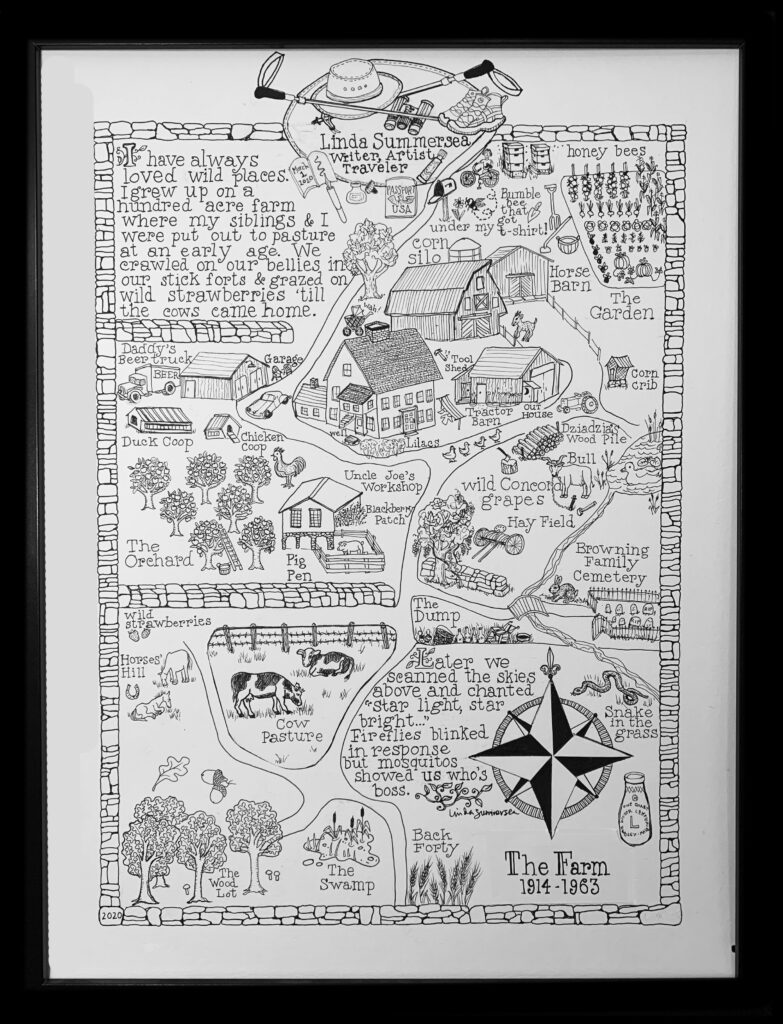
This is The Farm. One-hundred acres of wild woods and domesticated fields. A couple dozen milk cows, two draft horses, two pigs, twelve+ rabbits, twelve-odd laying hens, twenty-four ducks, one billy goat, one barn cat named Jasper, and one mongrel dog named Skippy. And four barefoot kids.

“I have always loved wild places. I grew up on a hundred-acre farm where my siblings and I were put out to pasture at an early age. We crawled on our bellies in our stick forts, and grazed on wild strawberries till the cows came home.”

It’s all here—from the Bee Hives and the Vegetable Garden to the Big Barn, Silo, and Horse Barn, the Orchard, Pig Pen, Garage, Farm House, Tractor Barn, Tool Shed (my favorite), Corn Crib, Outhouse, Duck Coop, Chicken Coop, Pond, Woodpile, Uncle Joe’s Workshop, Hay Fields, Cow Pastures, Horse’s Hill, original owners’ Family Cemetery, The Dump, The Swamp, Woodlot, and The Back Forty.

“Later we scanned the skies above and chanted “Star light, star bright…” Fireflies blinked in response— but mosquitos showed us who’s boss.”

CGI in “The Call of the Wild”

I am somewhat embarrassed to admit that I was unaware that the animals in The Call of the Wild are CGI until I was a few minutes into the film. Computer-Generated Images.

Had I known, I doubt that I would have gone to see The Call of the Wild yesterday. I like my animals living and breathing. This turned to be a good thing because, had I known, I would have missed out on a very good (not great) film.

I had read nothing in advance of going to the theater. I watched the trailer. Looked pretty good. I checked the Rotten Tomatoes ratings. 72% from the critics. 90% from the audience. The critics’ rating has since dropped to 65%.

My two reasons to see it:

I never got around to reading Jack London’s book and I have always loved wild places.

The prospect of a couple hours near horizontal in a heavily-upholstered Dad-chair before a mammoth curved screen seemed like the way to go.

A few minutes into the film, I began thinking “This is weird”, followed by “This dog doesn’t seem normal”, followed by “Wait. This is very odd.” As more animals joined the scenes, I realized they were definitely not normal.

It wasn’t just a matter of imaging. It was the animals’ ability to respond in a human manner. Buck the dog is beyond smart-dog-intelligent, and it was unsettling. The animals interact with each other in the same way that animated animals do. Think Bambi.

It was obvious that no animals were harmed in the making of this film. CGI enabled its animal cruelty and dog fights. Animals with evil intent. Animals with loving interactions. CGI makes personification possible on every level.

Which leads me to the “Kid-Friendly” label. I certainly wouldn’t take a child to see The Call of the Wild without making it very clear to the child that these are not real animals, even though they are physically perfect.

As the film progressed, I wanted very much to Google “making of Call of the Wild 2020”. I waited until I was in the car, waiting for the ferry home.

CGI has been used for lots of films. The difference is that we know the dinosaurs in Jurassic Park were not real.

Your Phobia, My Joy

This morning I was reading a piece in The New York Times about three friends embarking on a 7-day kayaking trip in the wilds of Alaska*. On Day 1, within minutes of being dropped off, a whale spouts offshore, close enough for gleeful joy or absolute fear—depending upon your response to large mammals in close proximity to you in the wild.

Two of the three took the sighting as a good omen. The other, who had once been surrounded by dolphins while scuba diving, went into panic mode.

I put the article aside and came here to think about it.

Isn’t it interesting how one person’s phobia can be another’s absolute joy? And, beyond that, how you can experience an event that causes a phobia, but then, through mind over matter, reshape your response to that event.

You can see where this is going. It reminded me of my siblings and me growing up on the farm.During the hot, dry summers of Massachusetts, the heat was periodically broken by magnificent thunderstorms. We could see them approaching in the distance.

The thunder—the louder the better. Let it rock the sky. I loved to hear it roll across the landscape. The lightning—let it draw maps of madness, etching veins of light bright as the stars in response to the thunder. My sister, on the other hand, was terrified, and still is, of thunder and lightning. I don’t know what caused the differences in our responses. My father always told us a cockamamie tale of Rip Van Winkle and his pals bowling tenpins in the sky. I stood before the south window, watching the storm wipe across the valley. My sister fled to her room with a pillow squished around her head.

For years, after a fall from an extension ladder, I was terrified of heights. The ladder stood in the stairwell of my parents’ home under construction when I was thirteen.

“After the carpenters went home for the day, my sister and I sometimes carried boardgames up the hill from the farm. We liked playing Monopoly and Scrabble in the shell of our future bedroom. We sat on the floor, our backs to the open 2×4 walls, playing in the bright light of the west sun as it crept lower in the sky until it was time to go home for supper.
Without a flight of stairs, the only access to our second floor bedroom was up and down the rungs of an aluminum extension ladder from the basement. The ladder rose from the basement floor, past the first floor, and stretched up past the second floor to lean against the open stairwell. Our parents didn’t express any safety concerns. Nor did the carpenters. No one did. Until the day I fell out of the sky.
“Falling out of the sky.”
That’s what it felt like. I felt like Jack falling off the beanstalk. Like a squirrel missing a branch while leaping from one oak to another. Like Alice falling down the rabbit hole. Or a saint slipping off a heavenly cloud. (Yes, I was still under Papal influence.)
It happened after school one day when I remembered I’d forgotten the Monopoly game up at the new house. It was close to supper time. I didn’t want to be late to the table so I sprinted up the hill and rushed into the cellar’s framed door opening. I hurried across the room and scaled twenty steps up the rungs of the ladder into the late afternoon light. When I reached the top of the ladder, I climbed out onto the plywood second floor and quickly gathered up the game board and its pieces, hastily stuffing the contents back in the box. I ran back across the room. What came next was a bit of carelessness.
As I stepped from the floor to the ladder with the Monopoly box tucked under my left arm, my foot slipped. I missed the rung completely. I hadn’t yet grabbed onto the rung above with my right hand so I had no safeguard, no back-up.
Stepping on air is something you don’t ever want to experience. In a nano-second I realized my critical error, but it was too late. I found myself moving in a slow motion free fall. I was tilting backwards, and reached out in a panic, desperately grasping for the rungs of the ladder. But my right hand was closing on air.
My left hand opened. The Monopoly game fell with me. If Isaac Newton hadn’t already done the experiment, I might have been onto something big.
My right hand kept grabbing. I was upside down. Then I was right side up again. Slowww motion. Circular. All the while, I was still in a panic, trying to grab onto the ladder to stop my fall as my hands neared the ladder again, but I was too far away. It was only a few inches, but it was too far away.
In the blink of an eye, the concrete floor was rising up to meet me. My shoulders hit first. Then the sound of a dull thud was followed by a slosh between my ears as my head smacked the concrete.

The Monopoly box was unhurt.”

from The Girl with the Black and Blue Doll, Linda Summersea

From that moment on, I was afraid of heights. Leaning over the balcony in a theater. Riding in a glass elevator. Stepping across the room to the floor-to-ceiling glass at the top of the World Trade Center in New York.

When 9/11 happened, it didn’t make me afraid of flying, even though I was in New York that day, preparing to fly home, putting my suitcases in the trunk of the car, when a call came—telling me to turn on the television.

It took me a while to shake off my fear of heights. I can’t remember any defining moment. I just know that I have conquered it on ziplines in the jungle and swaying rope suspension bridges over rushing waters. I stand on a granite ledge at the top of a climb and feel the exhilaration.

Don’t get me wrong. Sometimes a bit of fear is a good thing. When I watched American climber Alex Honnold climb El Capitan in Free Solo, I held my breath and feared for his life. There are lessons to be learned from close calls.

Nevertheless, yesterday while working the chainsaw in the blackberry patch, I briefly considered the advantages of rappelling down the hill with the chainsaw to attack a greater area. Ha. Let me not get carried away with this fearlessness stuff.
________________________________

*It was Just a Kayak Trip

Winter is Coming

The fog is thick this morning, surrounding us in a soft blanket of grey, creeping close and closer still, cloaking the shrubs, disguising the gardens. The fog horn has blown all night long at intervals as regular as breath. In and out, in and out, in and out. I sync my breathing, pull up the quilt again, and soon return to my dreams.

I always look forward to the horn in the night, as it predicts the following day will begin with cozy quiet.

A hike in the fog is a mystery walk. Who knows what’s around the next bend? It alerts the senses to each snap of a twig, each rustle of wings leaving the brush, each croaky caw of the raven high in the top of a fir.

Winter is coming.

winter is comingFog on water. Clean. Fresh as laundry on the line.

Fog will soon become rain.  Batten down the hatches.

Except, no need to batten down hatches or shutter the windows. No wind is on the horizon.

I’m reading Ahab’s Wife—which must be the source of my windy thoughts. A nautical read—especially of an earlier century—always makes me think of cobblestone streets and scrimshaw from Nantucket town to Lahaina. Like Ahab’s wife, I would have made a fine New England whaler’s wife, I think, watching from the rooftop walk if I couldn’t be at sea. If I couldn’t climb the rigging in search of a whale’s spouting, I’d be stitching a cross-stitch sampler and minding the gardens before minding the hearth fires that follow. I would have plenty of time to write.

Winter is coming.

Winter is a writer’s blank canvas, as white as the snow, as empty as a new journal page.

Music shifts from blues to classical. And lots of musing.

Winter is coming.

I hear a flock of geese going by. Right this minute. There’s an osprey still occupying the nest down the road, but not for long.

Winter is coming.

I doubt that I could live where there is no change of seasons.

How else would I receive reminders to begin again?

How else to embrace the changes that are inevitable?


winter is coming

Follow me on Facebook.

A Return to Morocco after 42 Years

In 1975 I was twenty-three years old and had never traveled beyond the borders of North America. Yet one day, I got it into my head that I wanted to tour Morocco. Long story short, a few months later my new husband and I were singing “Marrakesh Express” at the top of our lungs in a shiny blue Renault. We were traversing the mountains and deserts of Morocco on a journey that would take us through Casablanca, Rabat, Meknes, and Fes along the undulating ribbon of freshly paved highway that connected them all to the oasis of Marrakesh.

Fast forward. 2017. Intrepid Travel’s Walking With Berber Nomads trip appeared in my Facebook feed. Whoosh! Suddenly I could hear the muezzin’s call to prayer, smell the spices in the medina, and feel the breeze lifting my hair off the back of my neck on the Barbary Coast. I signed up the very next day.

Why Morocco? Why now?

Well, you never forget your first time, right? I had thought of Morocco periodically over the years, and now I wanted to see if Morocco in the digital age had managed to remain the kind, eager-to-please country I remembered so vividly.
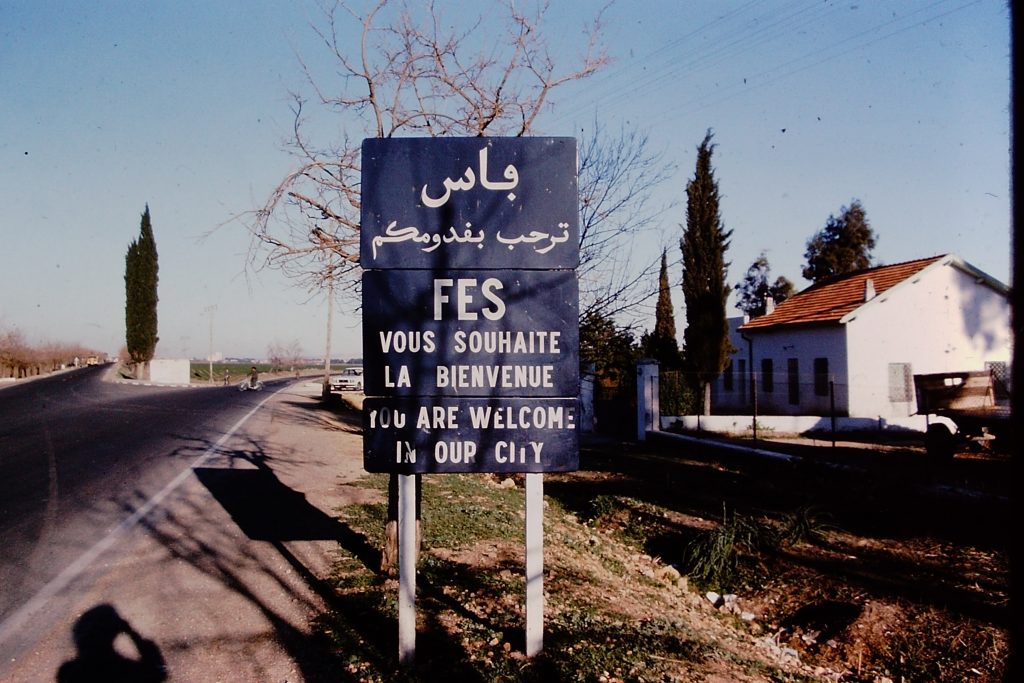
“You are Welcome in Our City”

This sign of hospitality on the outskirts of Fes remains my most enduring memory of 1975 Morocco.

See the young man on the motor scooter in the distance? He offered—undoubtedly in the employ of the hotel—to lead us to a reasonably priced guesthouse, petite dejuener included. We followed, and it was lovely. Tiled floors and a balcony overlooking the city, upstairs from a French bakery. Merci beaucoup. At the time, Arabic and French were the prevalent languages.

In those days before Trip Advisor, we traveled unencumbered by reviews. It may have been naive, but times were different.

We never met another traveler on that trip, and once we were outside the cities, we never saw another car. No wonder Jimi Hendrix was hiding out there! We did chat with some Peace Corps volunteers in Rabat whom we recognized as Americans by the Clarks Wallabies on their feet.

Early each day, with an Orangina in one hand and an open box of fresh croissants between us on the seat, I spread the road map on my lap as a napkin and off we went.

In contrast to the few lodgings in 1975, today there are now over a thousand hotels of all sizes—mostly in the cities—in a country the size of California. Frankly, other than these small differences, the countryside we experienced during our Walking With Berber Nomads trip remains very much the same beautiful, undeveloped landscape that I recall.

Morocco

Between Ouarzazate and the mountains

The twelve of us arrived from the US, Canada, UK, Germany and Australia to join Abdellah, our nomad guide, in Marrakesh. Most of the group were millennials, along with three 40ish, one 50ish, and me, the baby boomer senior citizen at 67.

Abdellah briefed us on our trip details before dinner. We were the very first participants—the guinea pigs as it were—so flexibility was going to be our motto. The next morning we set out on the same switchback roads I recalled. During the 7-hour drive from Marrakesh, we chatted, laughed, enjoyed the scenery, and bonded rather quickly with our shared love of traveling, hiking, and worldwide cultural experiences.

Soon we crossed the mineral-rich mountains of the Low Atlas and rolled off-road to the desolate location where we would join our Berber nomad family. It was springtime in Morocco. The nomads were ready to move their winter camp from the lowland desert to higher elevations for summer, and we would be hiking alongside, 9 to 15 km (6 to 10 miles) a day, an average of 4 to 5 hours a day on foot.

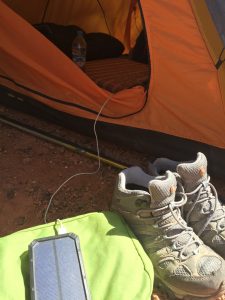
For three weeks prior, I had laid out my duffle contents on a coffee table back at home, adding and subtracting the vital and frivolous contents. Most valuable items: broken-in hiking boots with wool socks, wet wipes, hand sanitizer, trekking poles, solar charger, journal. We each were allowed a duffle bag (40 lb/ 18 kg max) and had purchased drinking water along the way. There would be no water available for bathing or showers.
Morocco

Meeting our Berber family

As we approached the Berber camp, our van drove ahead to drop off our gear, and we walked the final couple of miles to stretch our legs.

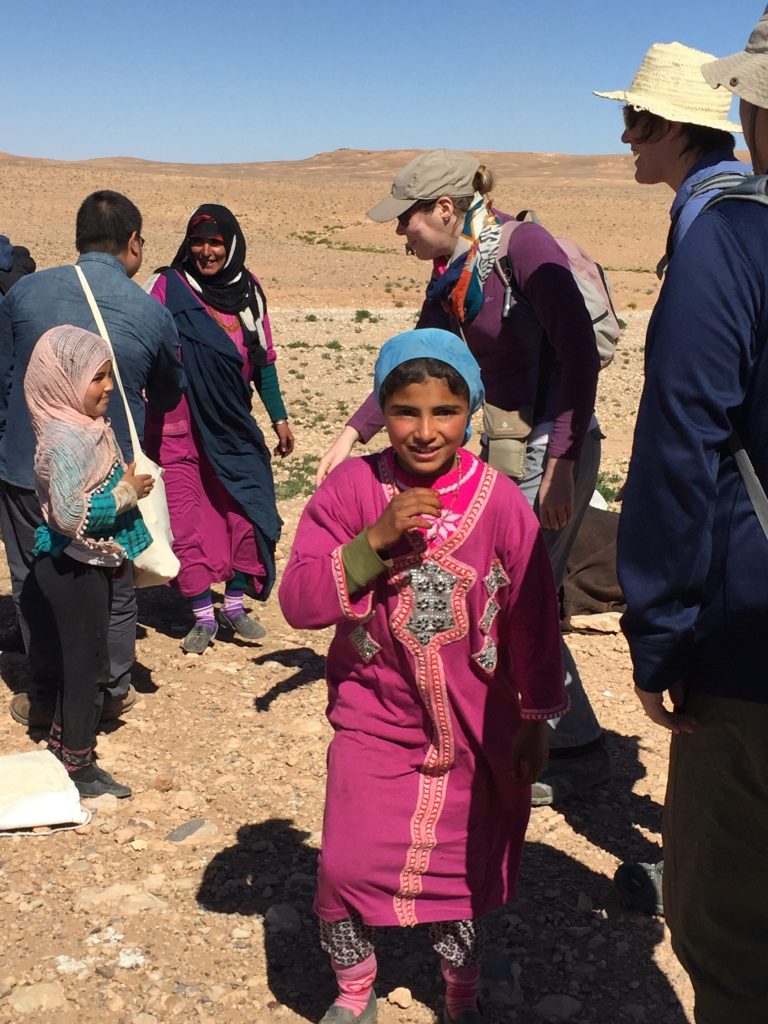
Our Berber nomad family was waiting for us across the plain at a location with smoke darkened caves that had been hand-carved into the banks by nomads hundreds of years ago.

A cook, as well as a contracted team of three men to transport our tents and gear on mules, rounded out our group.


MOrocco

Tucking in the Baby Goats

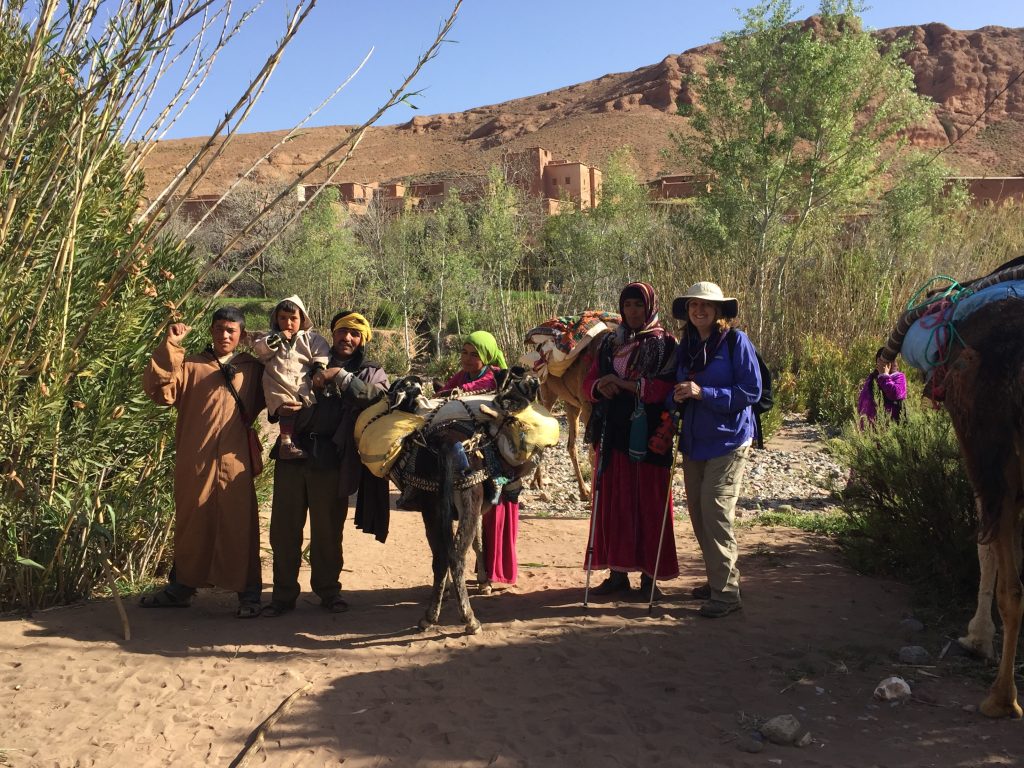
The animals consisted of 3 adult camels (1 of them very pregnant, and no—darn it—she didn’t give birth that week), 3 mules, 4 donkeys, 53 goats, 8 baby goats, 120 sheep, and 2 chickens. The baby goats tolerated being tucked into blanket pockets on the back of a donkey every morning with the two chickens decorating the top of the blanket pile like the bride and groom on a wedding cake.

Day temperatures averaged low 80s F./ 26 C., and dropped to 40s F./4.5 C. at night. Not too hot, not too cold. “Just right,” said the baby bear.

After dinner in the cave, we retired to our tents and fell asleep listening to the murmur of animals around us. I slept deeply in my silky long underwear with a change of clothes stuffed in the pillow shell of my sleeping bag.

Morocco

Sunrise Slowly Coming over the HIlls

At dawn, we were awakened by a symphony of cellphones with a back-up chorus of goats and sheep. I hustled into my clothes, laced up my boots and sprang from my tent to greet the day. Watching the low rays of the sun swim over each hill until we were all bathed in its rosy warmth never got old.

Morocco

Tents Pitched on the hill over the Caves

Breakfast: Mint tea, English breakfast tea, sweet Moroccan oranges, cheese, flatbread and jam.

While we ate breakfast, the crew took down the cook tent, packed up, and set out ahead of us. As Karen Blixen’s houseman Farah had longed to do in Out of Africa, the mule team went ahead of us and prepared for our arrival.

Each day had a similar routine, except for the days when they didn’t. Yes, pleasant surprises were frequent, but the common denominator was the same relaxed pattern.

Privy

  1. Rise and shine. Use privy, a hole dug in the ground with a canvas privacy stall around it.
  2. Pack up, take down tent, refill our water bottles.
  3. Eat breakfast.
  4. Hike for a couple of hours, enjoy a 15-minute break with a snack of tangerines, nuts and some bite-size cookies/biscuits like American animal crackers. Maybe some chocolate.

    Morocco

    Break for Tea in a Dry Riverbed

  5. Continue hiking to the night’s campsite.
  6. Enjoy the lunch that awaited us in a cave lined with rugs and our sleeping mats.
  7. Rest for the afternoon in our

    Solar Charging my iPhone

    tents or communally in a cave, write in our journals, or explore.

  8. Meet for dinner in a cave around an oil lantern. Share stories and comradery.
  9. Before or after dinner join the nomads in their singing, dancing and drumming.
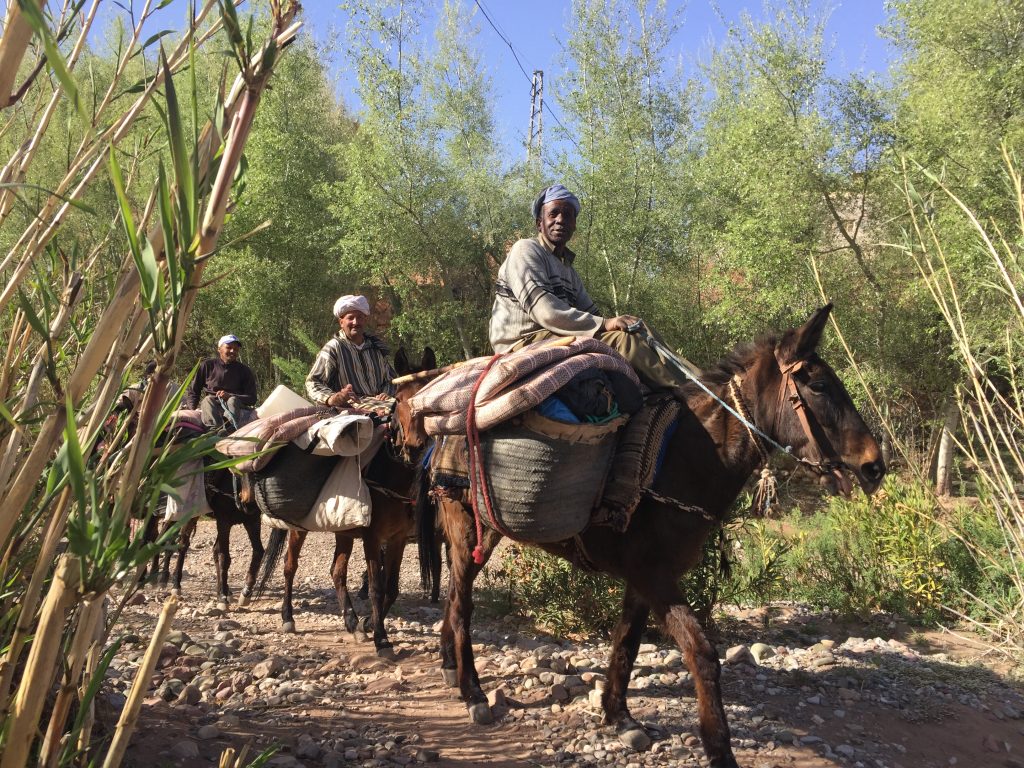
 

Mule Team Transporting our Gear
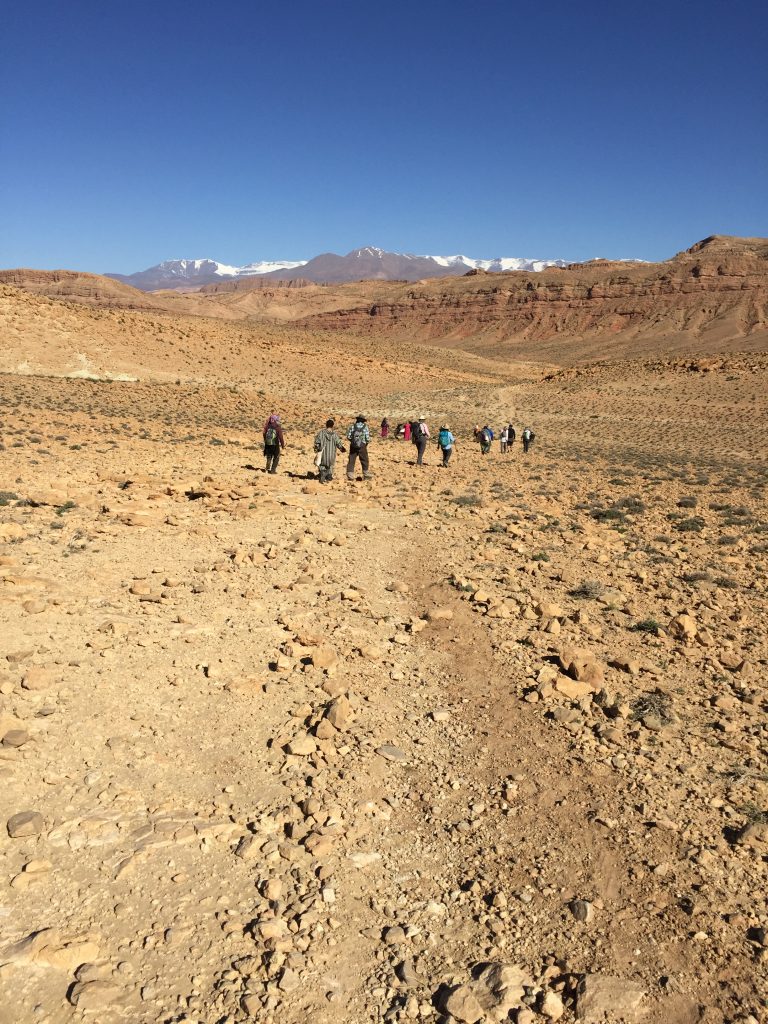
 

Day Two. The High Atlas before us. Seven hours. Crossing two valleys, countless ridges and a dry riverbed.
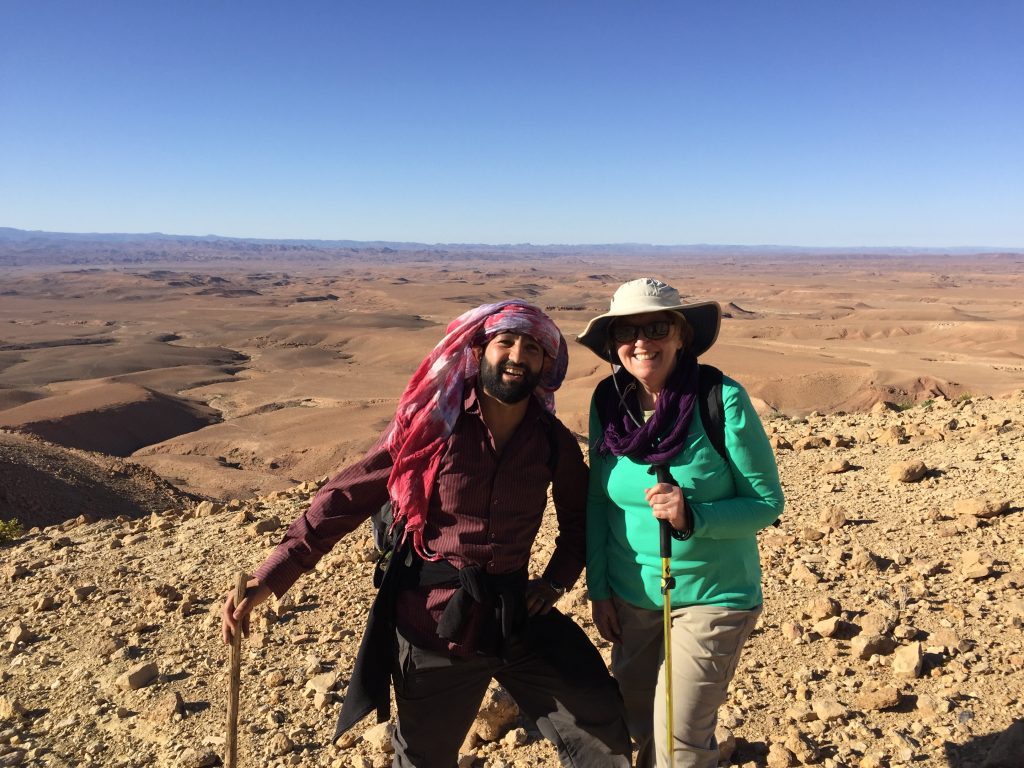
Abdellah and Linda Summersea pause at the first 1000′ climb in elevation. Low Atlas behind us, High Atlas ahead of us.

Our guide Abdellah with a member of the nomad team.

What did We Talk About on the Trail?

Everything except politics. Exclamation Point.

When you’re traveling with strangers, you don’t have the same reservations about being judged, so you tend be more frank. In the group, we rarely, I think, spoke about ourselves. This was about cultural immersion and we wanted to learn as much as we could about the nomadic lifestyle. For myself, I found that the conversations I had were about comparing travel destinations, discussing religious philosophy, and asking Abdellah questions about everything under the Moroccan sun: halal vs. non-halal, education, solar energy in Morocco, and more. Abdellah frequently addressed us on topics related to our passage: farming, crops, exports, irrigation, the structure of village politics, cemeteries and burial customs—anything we saw that caught our interest. Other times, we walked along alone with our thoughts, the rhythm of our footsteps the only sound.

After many miles, a village.

The nomads follow the old caravan routes, so our trek eventually brought us to some of the original 1000-year-old kasbahs (walled towns) in the mountains. The family herded the animals around their perimeter, while we passed through two villages. We saw the architecture and gardens up close, and stopped for tea at a B&B.

Approaching the Village
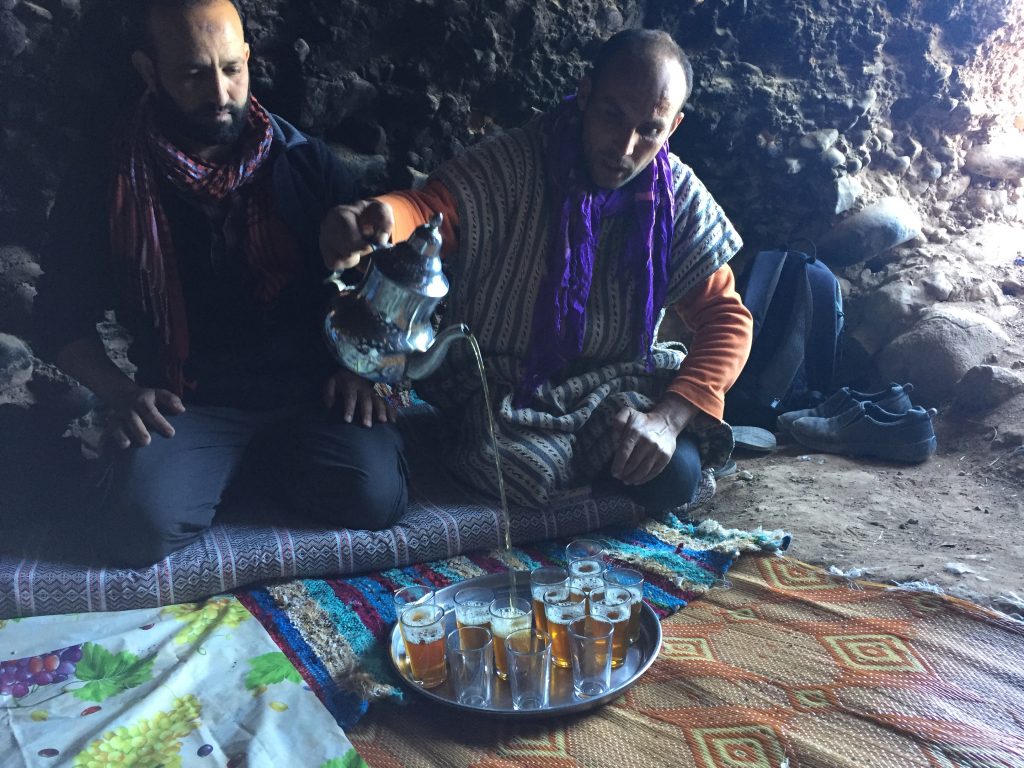
As in Moroccan households, in camp, fresh mint tea was a ritual at every meal. The silver teapot is held high while pouring into the traditional glasses with lots of Moroccan lump sugar.

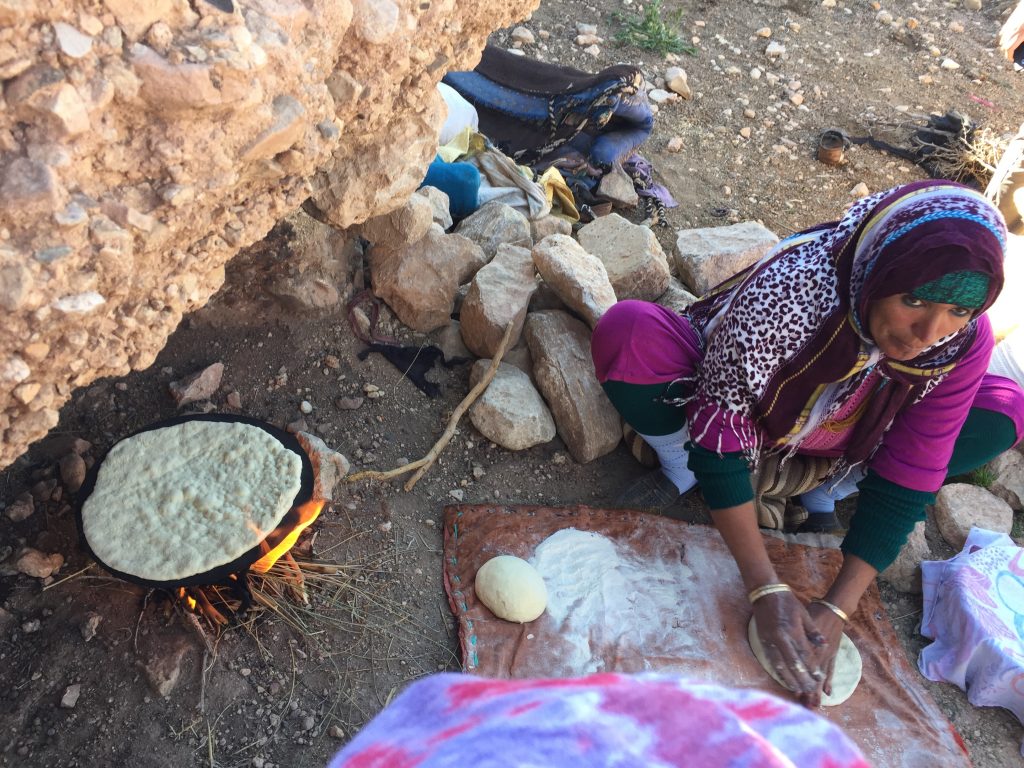
Fatima shared her daily tasks, teaching us a variety of skills from flatbread baking over the fire to goat milking at dawn. She even applied kohl to the eyes of our women and organized a mock wedding with the “bride” selected from our group and the cook serving as “groom”. The wedding took place on our final night in camp, a celebration that coincided with reaching the nomads’ summer location. There was a bridal procession with singing and dancing, and even “parents” of the bride and groom to demonstrate the details of a typical Berber nomad wedding.
Morocco

Fatima with Flatbread

Morocco

Linda Summersea with our Berber Nomad Family

That night was our final night in camp. The following morning we expressed our heartfelt thanks to the family for being such kind hosts and so generous in sharing their culture with us.

We passed along items from our gear that we thought they might be able to use. I contributed my trusty roll of duct tape.

After many hugs and shukran’s (thank you’s), we reluctantly lifted our backpacks for our last hike as a group.

Just before rounding a bend in the trail, I turned back for one last look at the scene of camp activity in the distance. Generations of nomads have repeated this tradition annually in the deserts and mountains of Morocco, but for how much longer, I wondered.

Ahead of us, our van was waiting, ready to return us to the bustling streets of Marrakesh—and our first showers in a week.

After we split up at the hotel, I spent a couple extra days unwinding in the city, eating ice cream, getting a hammam (traditional scrub-down, bath and massage), and exploring the Djemma el Fna Square to see how the cobra charmers were doing.

But that’s a story for another day.

#RockTheCasbah


MoroccoFollow my adventures on Facebook.

Earth Day 2018

Earth Day 2018

Coffee. Walnuts, banana, cheddar cheese. Journal. Coffee. Email. Coffee. Coffee. Feed pets.

Gardening trousers, wooly socks, Black Dog t-shirt, 20+year-old Coolibar hat, ancient Merrills. leather gloves. Basket, trowel, hand fork, weeder, wheel barrow, kneeler.

Kneel, dig, pull, gather, worm, smile, sun. Move, dig, pull, gather, smile. Greenhouse, bonemeal, potash, pour. Garden, bonemeal, potash, sprinkle, rake. Mulch. Water.

Kneel, dig, pull, gather. Repeat. Repeat. Repeat. Repeat. Repeat. Repeat. Repeat. Repeat. Dump wheelbarrow.

Kneel, dig, pull, gather. Repeat. Repeat. Repeat. Repeat. Bonemeal, Potash. Rake. Mulch. Water. Repeat. Repeat. Repeat. Repeat. Dump wheelbarrow.

Irrigation pipe. Connector broken. Male+Male connector.

Earth Day 2018 Recycle Event. Long line. Drop off dead TV. Smile.

Farmers Market. Donut. “Early Girl” tomato plants. Smile.

Garden center. More mulch. Male+Male connector. Check.

Irrigation pipe. Male+Male connector. Wrong. Hmm. Frown.

Garden center. Exchange Male+Male connector.

Irrigation pipe. Male+Male connector. Right. Check. Turn on water. Success. Turn off water.

Kneel, dig, pull, gather. Repeat. Repeat. Repeat. Repeat. Repeat. Repeat. Repeat. Repeat. Dump wheelbarrow.

Greenhouse. Fish fertilizer. Raised Bed. Dig holes. Bonemeal, fertilizer, potash. Tomato Plants. Mulch. Water. Garden Journal.

Porch. Shoes Off. Kitchen. Refrigerator. Leftovers. Water. Water. Water. Aleve.

Fir cones, storm branches, wheel barrow. Dump. Clouds, Rain.

Kneel, dig, pull, gather. Repeat. Repeat. Repeat. Mulch. Repeat. More rain. Repeat. Repeat. Repeat. Repeat. Dump wheelbarrow. Sun.

Fence repair. Check. Replace section.

Drainage troubleshoot. Pencil, paper. Check. Aleve.

Rock wall analysis. Move slates. Dry wall, think, design. Smile.

Peel trousers, shirts, socks, shoes. Hot tub. Sigh. Float. Sink. Sun. Trees, blossoms, birds.

Shower, shampoo.

Sofa, cheese, wine. The Grave’s a Fine and Private Place, Alan Bradley. 5 pages. Doze. 2 pages. Doze.

Leftovers, email, NY Times crossword.

Alan Bradley. Doze.

Journal. Bed. Read. Doze. Lights out.

6,884 Steps.

Earth Day 2018.


Linda Summersea Follow me on Facebook.

seasonal blueThanks!

Dawn on the 4th of July

The 4th of July dawns on Vashon Island with the sunrise race of the hydros (hydroplane boats, see wiki). 52 years running— a race to circumnavigate the island at sunrise.

People love it. Or Hate it. It’s a noisy tradition that I haven’t been here long enough to love, and certainly how could I “hate” someone else’s tradition? Let them be.

Yesterday, as I listened to the screamy high-pitched voices of a neighbor’s grandchildren echoing across the water, I thought: “Ahh, yes. This is fair enough retaliation for the sound of music that I periodically bounce off the wall behind me as I melt into my steamer lounge chair.”

The space created by a house with a bank of fir trees to the left and tall hedges to the right produces a pretty awesome surround sound simulation for someone sitting in its midst. I know for a fact that neighbors to the left and right are oblivious to it because I’ve gone behind the hedge to check. They hear nothing.

Those across the water, au contraire, are in the path of the volume. I’m more careful if I see anyone on a deck in the distance, but I do love the sound of music over water.


Maybe twenty years ago, friends had just picked us up from our dock on the lake in Arkansas. The dock juts from a peninsula into a narrow cove with steep-sided hills. The Corps of Engineers plan shows an elevation gain of fifty-five feet on the switchback path over a distance of maybe twenty feet on the map.

King—yes, that really was the name on his birth certificate— put the inboard in reverse, and the boat slowly—very slowly—came about. He had these high dollar speakers in the boat, and unexpectedly, he and I exchanged a recognition of the music and the hills and the magnification. I felt a massive rush of goosebumps. Full body music magic.

It was a wordless exchange. We were perfectly still. I watched as King reached to put the engine in neutral and I know that we both twitched our ears—figuratively—like a deer does when you surprise it on a path in the woods. Roger and Grace were in the bow chattering about some silly something. King and I, the introverts in the stern, were content to say nothing as we listened.

Heart of Gold (Neil Young) was playing—its lyrics of growing old were lifting to the hills around us with vivid clarity.

The boat—and the moment—froze in time, barely moving on the just-before-sunset stillness of the glassy water. Clouds were caught in the reflection on the surface.

For me, it was a flashback to the first time I felt a massive disconnect with life. 1971. No need to go there now. Those feelings. Old Man hit on it too. I suppose I thought it odd that Neil Young, at such a young age, was so simultaneously tuned in to the brevity and sweetness of life.


Recently I read an anecdote about Neil Young playing this exact music over water that made me laugh out loud. LOLOL out loud out loud. Partly because our only boat at the time was a little rowboat.

I want to get it right, so here’s the story—word for word from Graham Nash, as he told it to Terry Gross on NPR in 2013.

I was at Neil’s ranch one day just south of San Francisco, and he has a beautiful lake with red-wing blackbirds. And he asked me if I wanted to hear his new album, “Harvest.” And I said sure, let’s go into the studio and listen.

Oh, no. That’s not what Neil had in mind. He said get into the rowboat.

I said get into the rowboat? He said, yeah, we’re going to go out into the middle of the lake. Now, I think he’s got a little cassette player with him or a little, you know, early digital format player. So I’m thinking I’m going to wear headphones and listen in the relative peace in the middle of Neil’s lake.

Oh, no. He has his entire house as the left speaker and his entire barn as the right speaker. And I heard “Harvest” coming out of these two incredibly large loud speakers louder than hell. It was unbelievable. Elliot Mazer, who produced Neil, produced “Harvest,” came down to the shore of the lake and he shouted out to Neil: How was that, Neil?

And I swear to god, Neil Young shouted back: More barn!

Who would have guessed that King, not too many years later, would crash his private plane while hurrying home one evening after work?

We just don’t know when the music is going to stop, so we just have to keep playing.

Go there:

https://www.youtube.com/watch?v=Eh44QPT1mPE

dawns 4th of julyFollow me on Facebook.

And maybe, subscribe to my feed via email. 

Writing in the Garden

After two weeks of getting the gardens back in shape, I finally climbed down from the ladder and removed my deerskin gloves. I stood back to admire the roses I had just pruned, gathered up my tools and peeled off the extra layer of denim that does a superb job of protecting one from thorns while having a full body immersion in rosa floribunda “Lime Sublime”.

That morning I had crawled around in the shade of a respected Douglas Fir, tidied the copper bird bath and plucked a couple hundred weeds that were hiding behind a wall of Digitalis purpurea. Common foxglove is labeled an invasive species here in Washington but I let it enjoy grandfathered perennial status in my garden. Who can resist gorgeous, long-lasting spires that are happy to fill in the blanks before a backdrop of charcoal stone walls?

Every empty pot from the greenhouse was now refreshed and blooming plentifully. The two packets of nasturtiums that I had picked up half-heartedly from the rack at Thriftway have become the surprise stars of the garden. They never grew very well in my other gardens, but they’re loving it here—as I am.

Nasturtiums have been my favorite trawritingiling annual, ever since stepping from the street into the bright inner courtyard of the Isabella Stewart Gardner Museum nearly fifty years ago. Their variegated foliage dotted with brilliant orange and lemon-colored blooms hung in a curtain twenty or thirty feet from the fourth floor window boxes of Mrs. Gardner’s living quarters.
I had a boyfriend who was Henry Higgins to my Eliza Doolittle. I was a naive farm girl and he, a tweed-jacketed student at a private men’s college. He introduced me to the Gardner Museum on The Fens in Boston, took me to dinner at La Petite Auberge and presented me with bouquets of fragrant flowers that filled the elevator with their heady scent as we rode up to the 8th floor of my dormitory amidst the envious sidelong glances of other bell-bottomed young women.


At home, we never had flowers on the table. With the exception of Mummy’s favorite lilacs in June, Daddy wouldn’t allow it. He said that florist flowers reminded him of funeral homes. Leave it to him to find evil and sadness in soft-petaled Stargazer lilies and pendulous snapdragons.

But my love of flowers grew as tall as the roses on my arbors. Here in coastal Washington, many of the plants are foreign to me. There are lots of new Latin names to learn and growth patterns to observe.

Best of all, while I’m dead-heading lilies or untangling clematis, my mind can wander freely. While raking up the fir cones after a storm, I can leaf through ideas for future writing. While cutting lavender to weave lavender wands for my dresser drawers, I can harvest ideas for an essay.

And sometimes, I’m able to encourage new growth by thinning out a chapter that I’m not a hundred per cent pleased with.

A little pruning, a little staking. Companion planting of subjects and objects. Like walking the rows in a landscape nursery, I enjoy searching for the perfect verb to complement a noun.

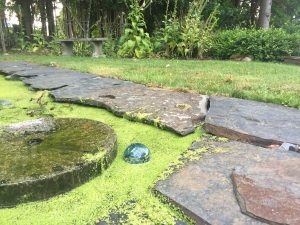
While kneeling at the edge of the lily pond and reaching to remove some fallen leaves, I see my reflection in a gmillstonelass orb floating on the surface.

I’m no longer that young Eliza Dolittle, but I still have a lot to learn.


writing Follow me on Facebook.

Snowstorm

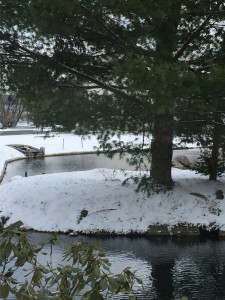
A spring snowstorm arrived overnight in the Berkshires, triggering more childhood memories.

Haven’t lived where snow is a regular event for more than twenty-five years.

There was plenty of warning. We all knew the snow was coming. I went to the Stop & Shop yesterday afternoon. Stocked up on groceries for a couple days’ worth of meals.

When the wind awakened me in the middle of the night, I got up and peeked through the blinds, still a little surprised to see the forecast snow accumulating. Turned the heat up a couple degrees and went back to bed, burrowing under the covers as I did when I was a child.

When I reawakened at seven, the snow was still blowing.

Suddenly it was as if I were listening to the behemoth wood-paneled Zenith radio that stood next to the kerosene stove in our kitchen in 1955.

I remembered the radio announcer and the “no school” bulletins. Heard the wind echoing in the chimney. Felt the cold linoleum floor beneath my feet on the way to the bathroom.

Smelled the coffee percolating on the counter. Sniffed the burnt toast that my mother grilled directly on the cast iron stove top. Given any feasable alternative, my mother always avoided dirtying a pan.

Smelled the wet wool from Mummy’s gloves drying in the open jaw of the warming oven. She helped Daddy broom off his car before he left for work.
This morning, after my own coffee, I returned to the memoir chapter that I was working on at bedtime.

“Winter.”

Synchronicity.

snowstorm


snowstormFollow me on Facebook.