YouTube Channel Content

My newest 2-minute videos are on my YouTube channel:
https://www.youtube.com/@LindaSummersea 

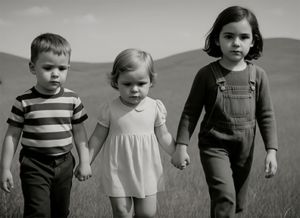
They include a Book Trailer, Interview with publicist Danette Kubana, and a 2-minute mini-movie (image shown at left) about Summersea’s experience with Body Dysmorphic Disorder.

View buying options for The Girl with the Black and Blue Doll here. 

🎞️  🎙️ ATTENTION: Are you a podcast or radio host or book club host?    

We’d love to appear on your media to talk about teen depression, BDD, and/or its relationship to the pressures created by social media.

OR, The Girl with the Black and Blue Doll or other topic.  The Girl is about a girl who becomes depressed at an early age, but it’s by no means a downer of a read. You’ll cheer for the girl’s successes as she comes of age.              And…It’s all told in the voice of the girl!


Contact us using the Contact Us form linked above, or email: linda@lindasummersea.com

May You Live in Interesting Times

This morning, as I was heading out for a brisk walk before the rains came, I found myself thinking of all the turmoil I’ve survived while treading water in the rough seas of my life during the past two years.

There’s a curse, long attributed as a Chinese curse and now debunked as simply a curse of unknown origin.

“May you live in interesting times.”
“Interesting times” appear to have been the least of the curses I’ve survived over the past two years.

Yes, I say “survived” because that’s the simplest way to look at it. The people who know me by my married name were surprised when I disappeared, probably because I never revealed the details to them.

And my writer friends?  When I had to run away from the most shocking betrayal of my life, I wrote online that I wasn’t ready to write about it yet—let alone talk about it. The cheerful group of friends and acquaintances who follow me on Facebook still don’t know what happened. Heck, even I don’t know what happened. All I know is that I found myself driving ten hours a day to get to the place that I remembered for its happy times. I cried for the first forty-five minutes. My cat, Minnie, cried for the first two hours. But we stuck it out.

So, now what? As I stare at the screen before me and type a few words, cut and paste a few words, I remember someone from long ago and I stop to google an old friend’s name. I’m sure that many of us, at this age, call out to the old days and find that Google has the answers to our questions. Once I catch up with myself, I hope to reconnect with some of these old friends. Well, maybe one or two. People change.

Here in the place where I’ve landed, during the summer, I cross paths with homeless people. One night, as I stood on the sidewalk with one of them, each of us licking an ice cream cone, I asked how long he’d been on the streets.

“Ten months,” he said. He shared that he has cancer. He also has five brothers who refuse to see him.

He said, “Everybody has a story. You, me—we all have a story.”
I responded, “Yes. Now that you’ve shared your story, some day I’ll tell you mine.”

My sister has been my saving grace. I joke that she pulls me back from the ledge. Not really true because I need to stay around to see how this story ends.

Next week is our 50th wedding anniversary. I dream about him. I admit that I miss him even though our marriage was a lot less than perfect.

Due to the circumstances, I don’t even know if I’ll ever see him again.

Everyone has a story. You, me—we all have a story.

Buckets of Bats

(Edit: Trigger Warning. I apologize for not labeling this post as including Animal Death.)

Growing up in an 1850’s farmhouse in Massachusetts ignited my imagination like no place since. In the cellar, where I was sent to pull carrots from the sandbox in winter, I fantasized about the farmhouse being part of the Underground Railroad. See, there was this dark stone tunnel from the cellar to the outside. It had a huge wooden door that rolled back on a steel track and made me think of the stone rolling back off the tomb of Jesus.

The tunnel was how Babci entered the cellar to feed the hungry wood-burning furnace. She filled her apron two or three times to satisfy it’s yawning.

Leaving the cellar, I took the stairs to the first floor—swatting away the spider webs and watching in case something might reach through the open treads and grab me by an ankle. After that, I passed through the parlor, where no one—to my knowledge—has ever entertained guests. All I know is I’ve been told that when the last of the Browning family died, Mr. Browning was laid out there, and a horse and buggy carried him in his coffin down past the apple orchard and across the field of timothy grass to the Browning family cemetery.

Leaving the parlor, I stopped to handle the seashell that my father brought back from New Caledonia after World War II. Then I climbed to the second floor where Mummy might be waiting for me with a task or two.

When Mummy needed an onion or two from the attic, I had to take the first three steps in the pitch black, then grab the pull string hanging down from the single bare light bulb that lit the stairs. The steps were worn smooth as river rocks, and I always wondered about the girls who went before me. Did they wear petticoats and eyelet blouses—or dungarees and a t-shirt—like me? I liked to raise the lid on Babci’s steamer trunk. It had carried her church clothes, a wicker basket, and her featherbed—all the way from Poland to the port of Antwerp and across the Atlantic to Ellis Island. She told me how cold it was, riding in the open boats that ferried the travelers to the immigration desks.

The attic had a scary part too. My brother Dicky told me that Daddy enlisted him to help kill the bats that hung from the rafters during the day, minding their own business until dusk when they fled the attic in droves, gobbling up mosquitos all the way. Dick said Daddy gave him a bucket and a steel pipe, and they smacked those bats dead, filling buckets with the bodies of the furry little creatures.

How’s This for a Belated New Year’s Resolution?

I’ve just posted my first note with Substack. I hope you’ll follow me.

I’ve been enjoying so many other Substack writers that I’m going to post there for the most part, and occasionally, here on my (old, previous) WordPress blog. Take a look.

Love and Cheers, Linda Summersea

https://lindasummersea.substack.com/?r=1l92ik&utm_campaign=pub&utm_medium=web

Discoveries Upon Re-reading My Manuscript

I’ve spent the past few days re-reading my memoir manuscript from start to finish.

This time I wanted to focus on experiencing the manuscript as a reader would, while watching for any needed edits in sentence structure, punctuation, tone, and voice. In the past, in addition to my developmental editor’s work, I’ve done seven (eight?) complete revisions. I tell myself that after all, there must be a point where I say “The End. Done. Finished.”

This time, the manuscript was a pleasure to read, especially Linda’s voice as she transitions from adolescent to young woman. I found that I liked this young woman and was proud of her commitment to her goals as she rejected the negativity put upon her by her parents.

In the manuscript formatting, I noticed there were now quite a few paragraph indents that shouldn’t be there. I don’t know how I caused them to occur, but no matter, I was happy to go through and fix them. It’s part of a writer’s job, right?

When I got to the Epilogue, I found that I need to change an omission.

I have never addressed how I feel about my parents today, years after their deaths.
When I was in Massachusetts this Thanksgiving 2023, I went to their graves for the first time.

You read that correctly. For the first time.

This year I came to forgive them and I was ready to visit.

One can’t ever know how or why parents act as they do. We/they do what they feel is best at the time.

The best of my own marriage arises from our children. I hope that my memory of providing love and consistency rings true. Because of my own turbulent upbringing, I kissed and cuddled our sons from the start and tried to raise them in contrast to my childhood. They’re now adults—both warm, loving, and productive human beings.

Ultimately, I hope our sons will remember me as loving—because Love is all there is.

Do You Remember Woodstock?

It’s that time of year when some of us look back on August 13-18, 1969 and wish we’d had the presence of mind to head to Max Yasgur’s dairy farm in Bethel, NY that weekend.

It would have been so easy to stick my thumb out on the Mass Pike. Maybe with “Woodstock or Bust” on a piece of cardboard. But, no, it was almost time to go back to college in Amherst. I couldn’t bail on my waitress job—I needed the money for school.

I only know one person who was there, and all I seem to remember about his recollection is mud and more mud. I guess you had to be there.

Since I wasn’t there, I’m not going to rattle on about it except to say that this weekend The New Yorker has reprinted Ellen Willis’ August 29, 1969 coverage of “The Not-So-Groovy Side of Woodstock.”  (RIP Ellen Willis.)

It’s a very good read, and, to be fair, I’d rather you read it at the source.

To whet your appetite:

Willis told of Abbie Hoffman interrupting The Who’s set to berate the crowd re: listening to music when a Michigan activist had just been sentenced to a long prison term.

She said “Peter Townshend hit Hoffman with his guitar.”

(Yay, Pete!)

And for the list of performers, thank you, Wikipedia!

https://en.wikipedia.org/wiki/List_of_performances_and_events_at_Woodstock_Festival

Can you dig it?

Mama Told Me Not To Go

Back in the day, my mother told me a slew of lies, but none worried me so much as the lie I divulge in Chapter 65 of my memoir, The Girl with the Black and Blue Doll.

Chapter Sixty-Five

Fertilized Eggs

When I reflect on Kristen and the Saturday night dances, I remember that not dancing was OK with me. I don’t know what I would have done if someone had asked me to dance. I watched American Bandstand, but that was a far cry from dancing for real. I didn’t have the self-confidence that junior high dance classes would have provided.

Back in eighth grade, some of my classmates had attended ballroom dancing classes at the United Church of Christ. They began with the fox trot and waltz, so they knew the basics.

When I asked my mother if I could go, Mum said, “Absolutely not!”

“That’s how girls get pregnant, ” she added.

It was the first time my mother mentioned anything remotely related to sex, and I was baffled. After that, I pressed my nose to the window whenever our school bus took the corner on Main and Church. I wondered what could possibly go on behind the clean brick walls of the United Church of Christ that would result in pregnancy. My friends Irene and Susan attended the classes. The morning after, they constantly rattled on about dancing with this or that cute guy. They were having fun. They were learning to communicate with boys. And they weren’t getting pregnant.

I was so confused!

#

During the summer before sixth grade, Mum felt she had fulfilled her sex education duty by handing me a booklet called Growing Up and Liking It. The Modess Corporation, a manufacturer of sanitary napkins, published the slim little pamphlet.

“These are the ‘Facts of Life’,” she said, handing it over for my inspection.

I brought the booklet upstairs and plopped on my bed to see what these “Facts of Life” were all about.

There were illustrations of the female reproductive organs—the uterus, the ovaries on each side connected by fallopian tubes. There was even a vagina through which a lively sperm was wiggling its way along in search of eggs.

The writer described how, each month, the ovaries released eggs. The illustration looked like a pinball machine layout. If an egg were fertilized, you’d get pregnant, and­—Mamma Mia!—a baby would begin to grow inside you. The booklet neglected to explain how the egg got fertilized. I read it and re-read it. There was no explanation of how the sperm got in there, and there was no one with whom I could discuss this awkward topic. I thought it was damned poor editing on the part of the Modess Corporation.

It followed that every month, from age twelve until I was eighteen-and-a-half, I worried myself sick about getting pregnant. I marked my period on the free Hallmark pocket calendars we got at the pharmacy checkout counter. I drew a star for each bloody day and double stars for days of particularly heavy flow. During my period, I was relieved and buoyant. I was also in terrible discomfort since I was one of those unlucky ones who had to endure severe menstrual cramps aching all the way down my inner thighs, practically to my knees. I had curl-up-in-fetal-position pain, with eyes-shut and teeth-clenched pain.

“Mum, I have cramps, and aspirin isn’t helping,” I said.

“That’s the ‘Facts of Life’,” was all she said.

One month, I told my mother I was late.

“What have you been doing that you’re worried about your period being late?”  she said. Her words were staccato. Her eyes were alarmed.

“Nothing,” I said. This was certainly true. But later, when I was getting ready for a blind double date to the drive-in with my neighbor with her boyfriend and her boyfriend’s friend, my mother confronted me again.

“Your father wants to make sure you know about the Facts of Life,” she said.

I assumed he meant my period and those enduring cramps. I didn’t know why he cared, but whatever.

“Yeah. I know.”

By the way, when I went to the drive-in, sitting in the back seat with the blind date, I was too shy to say a word during the entire night. Likewise, my blind date didn’t say a word. After the movie, they dropped me off in my driveway, and I fled into the house. Is that what dating was supposed to be like?

#

Around the time of the ballroom dancing classes—perhaps even instigated by my inquiry into the ballroom dancing classes—my mother confiscated my juvenile cotton underpants and replaced them with tight, white, nylon-spandex panty girdles. They were ghastly. I knew from the occasional gust of wind on the playground that other girls wore garter belts. The nylons Mum brought home were thigh-high with seams up the back and buttoned onto my panty girdles. Pantyhose hadn’t been invented yet.

Years later, my first real boyfriend slid his hand beneath my skirt. It was the summer after high school graduation. He was horrified.

“Are you wearing a girdle?”

He squinted through his Coke-bottle eyeglasses.

“Umm. Yes.”

This episode, by far, beat any other humiliation in my past. I felt the familiar heat of a blush rise to the tips of my ears. As soon as he asked, it dawned on me that maybe this was my mother’s idea of birth control. Those panty girdles weren’t for jiggle control! I didn’t have anything to jiggle! And who would consider having sex with her daughter if she wore an ugly panty girdle? Mum needn’t have worried about me having sex because I had no idea what sex was. Despite growing up on a farm in the midst of a couple of dozen cows who were frequently pregnant after being tended to by our resident bull, I had never seen fertilization in action—except for that one time when our German Shepherd, Lady, was bushwhacked in the garage by the neighbor’s mutt.

#

In high school, I had a few crushes, but no one ever asked me out until Bill, a good-looking young man who sat next to me in homeroom in tenth grade. He used to be “Billy” in elementary school. Still, high school has a way of giving young people the opportunity to modify their details. Bill invited me to a semi-formal dance during junior year’s start of football season. It was “Homecoming.” I wore an above-the-knee, seafoam green, shantung dress with white tights. Fabric rosettes decorated my brown patent-leather flats, and Bill brought me a wrist corsage of sweet-smelling gardenias. We both smiled awkwardly under the scrutiny of the hundred-watt ceiling light in my parents’ front hall.

This occasion was only the second time I had ever eaten in a sit-down restaurant, the first being that lunch with Mémère when I was nine. Bill and I had dinner at a steak house called Dante’s Inferno. I hoped I wouldn’t embarrass him with my lack of manners. If I had known it would be the only time I would ever be invited to a dinner and dance in high school, I would have paid more attention. That fall, we also went to museum openings, an occasional foreign film, and my first movie in a cinema—the new style of movie theater attached to the equally new malls.

We saw Dustin Hoffman and Anne Bancroft in The Graduate. It was my first non-Disney, non-Elvis movie. Of course, I didn’t know what Benjamin and Mrs. Robinson were up to when the camera framed Benjamin in the triangle of Mrs. Robinson’s shapely leg. (Fun fact. I know now that it wasn’t even Anne Bancroft’s leg in The Graduate poster. It was Linda Gray’s.)

Bill chuckled knowingly during the implied sex scenes while I was ill at ease. He occasionally gave me a chaste kiss good night. Once, we even experimented with what amounted to basic necking, pressing our lips onto each other’s lips without much enthusiasm. At the time, his lack of interest contributed to my deep-seated belief that I was unlovable. Decades later, I would learn that he was gay and that there had been no reflection on me.

#

A couple of months after the semi-formal dance, it was Christmas week. I put on that same seafoam green shantung dress and drove myself to Denholm’s Department Store in the city twenty miles away on a school night. As if proof of my emotional immaturity—and my hesitation to leave childhood far behind—I was on my way to fulfilling my childhood fantasy of having my picture taken with Santa Claus. I must have told Mum and Dad because I had to ask permission to borrow the car. If they thought it strange that a sixteen-year-old would be going to see a department store Santa, they didn’t say anything about it.

I stood in line with the little kids in my seafoam green shantung dress. It was the prettiest dress I have ever owned—bar none. Children and their mothers did not notice me, or maybe they did. I was nervous. I had my coat unbuttoned, ready to shed quickly as I got closer to Santa.

When it was my turn, I handed my coat to an elf. I stepped up to Santa and sat timidly on the edge of his lap, barely touching his red velvet thigh. I told him I wanted nothing except the photo and directed one of my rare smiles toward the elf with the camera. Santa didn’t say too much. Maybe he ho-ho-hoed. After the camera flashed, I stepped down from the Santa throne, and a few minutes later, my Polaroid snapshot was ready. Santa’s elf handed it to me in a Merry Christmas photo card.

I liked it. I did. I saw myself carefully seated on Santa’s thigh in my seafoam green, shantung dress with the white tights. My long, brown hair looked perfectly clean and shiny. I couldn’t find fault with anything about my appearance. I stared at the photo as I rode down the escalator and floated out the door to where it was snowing lightly—a scattering of fluffy flakes under the streetlights to top off this fairy-tale evening.

I drove home on autopilot, parked the car in the driveway, and before anyone had time to question me, I hung my coat in the closet and went upstairs to bed. I’ve never shared that experience with anyone before now. Maybe I’ve always been embarrassed at being so lonely and emotionally withdrawn, but having my photograph taken with Santa Claus at age sixteen made me happy.

#

My mother could have saved me eight years of anxiety about unexpected pregnancy if she had told me right up front or given me a book about actual sex, not a booklet pussyfooting around about some fertilized eggs. Suppose I had known the essential “Facts of Life”. In that case, I might have better disputed her claim about the United Church of Christ dance classes. I might have found a reason to smile at all those Saturday night dances.

And why, I wonder, did the topic of sex never come up when my girlfriends and I got together?

The Reveal, May 8, 2022

The long story short is that in 2013, I began writing my coming-of-age memoir, THE GIRL WITH THE BLACK AND BLUE DOLL, covering events from age 3 through 21.

For the past eight years, I’ve hidden my secret life—my memoir writing life—from my three younger siblings.

I had no way of knowing what their response would be, but five days ago, one year after Mummy’s death at 92, three of us were gathered at my youngest brother’s home in western Massachusetts, and I decided it was time to let them in on my secret.

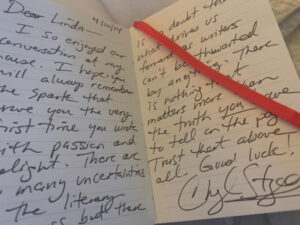
To prepare for my reveal, I reminded myself of the inspiration and reassurance Cheryl Strayed’s words provided in my writer autograph journal in 2014.

“Dear Linda, I so enjoyed our conversation at my house. I hope you will always remember the spark that drove you the very first time you wrote with passion & delight. There are so many uncertainties in the literary business, but there is no doubt that what drives us forward as writers can’t be thwarted by anything. There is nothing that matters more than the truth you have to share on the page. Trust that above all. Good Luck! Cheryl Strayed“

By 2014, I had finished two drafts and began querying agents. BIG mistake.

Two drafts is at least four drafts too soon for querying. I received dozens of rejections. Most of them didn’t even send official rejections, they just let my query automatically age out of consideration at Querytracker’s 121 days. I did, however, receive one request for a full.

It was from a New York agent who said he loved it. “Talk soon!” he wrote. And then he ghosted me.

I learned my lesson.

After the fifth draft, I hired a developmental editor, who gave me brilliant, professional feedback. I wrote draft six and seven and sent off a handful of well-researched and personalized queries.

The next request for a full came from an agent I have tremendous respect for. She’s in Toronto and by then it was 2021.  She also rejected it. Note to self: Don’t ever think of any agent as “my dream agent”.

I haven’t queried in six months. During this time, I’ve taken four query classes from different writing teachers while further fine-tuning my manuscript. About ten days ago, I had a eureka moment that would dramatically improve the reading and comprehension of my story.

I made those changes, and in preparation for The Reveal, I had THE GIRL WITH THE BLACK AND BLUE DOLL printed and spiral bound for beta-reading. One copy for each of us siblings.

When I got to Gerry’s house, I carried in a tote bag bearing my secret life. I quickly tucked it in a corner of the dining room and joined two of my siblings and one sister-in-law with lots of hugs and kisses.

Frankly, I was a wreck. I wasn’t 100% convinced I’d be able to go through with it.

As soon as we were all settled at the dining room table, I said, “I have something to share with you, and I think this is a good time.”

Everyone looked a little shell-shocked, so I said, “Don’t worry. It’s nothing bad.”

Later in the afternoon, Sharon said her first thought had been “She can’t be pregnant!”

Right. I’m 72.

Gerry said his first thought was that I might be transitioning. Nope.

Over the next five hours, I shared when, how, and why I had finally become a writer. I mentioned that I’ve been encouraged in the last two years as awards, publications, and speaking engagements began to come in.

I was taking Lidia Yuknavitch’s The Body of the Book manuscript class in Portland OR when #MeToo gained traction following the exposure of widespread sexual-abuse allegations against Harvey Weinstein. I wrote my #MeToo chapter The Colombian that morning and read it to the class that night. It was published by Jennifer Pastiloff in The Manifest-Station.(Unfortunately, they misspelled “Colombian.” The typo: “Columbian.” I’ve made my share of typos, so I’ve ignored it.)

Some of my favorite experiences were being named 2021 Finalist for Best Unpublished Memoir by the Pacific Northwest Writers Association in Seattle, and being invited to address the Omaha Chapter, National League of American Pen Women at their March 2022 meeting.

I still don’t have an agent. I explained the query process to them and the much-desired “request for a full”.

As we were talking, frequently, Sharon would ask “Do you remember the time…?”

And I would respond, “YES, I have a chapter on that…  And wait— I’ll read it to you.”

It was So Much Fun and we all were so elated with our surprise afternoon’s entertainment.

Gerry said he was enlightened since my memoir includes a period of ten years before he was born.

Sharon said it was fascinating how each of us viewed same events from different perspectives.

Gerry added that he felt it’s great that I’ve reflected on my early life to consider if there’s been any influence on unfolding what he called The Life Experience.

My sister-in-law Robin said “I’m struggling with this. There are mixed emotions because I met your parents at a much later stage. It’s sad and weird for me because your story is a different experience.” Tears were shed.

Sharon added,  “As I read this, I’m just glad that you were able to write it down so eloquently.”

What I know now: My siblings are 100% supportive. That is, thus far, two out of three of them.

I realize my fears were totally unwarranted.

Sharon and I talked about things we’ve never spoken of.

It was the Best day Ever.

Immediately after all was said and done, and still with all of us at the dining room table, I checked my email.

Omigosh! There was an email from the author Paddy Eger, representing the EPIC Writers Group in Bellingham WA. I’m a member and she was asking me to call her at my earliest convenience. On a Sunday. On Mother’s Day!

 My fingers hit those numbers fast and furiously. She answered.

She wanted me to know that my Prose piece, Mr. Buchwald, which is Chapter 61 of THE GIRL WITH THE BLACK AND BLUE DOLL, had won the 2022 EPIC First Prize for Prose.

What timing!

This. In the dining room immediately after The Reveal. We were all mind-blown. What an affirmation.


Update: June 13, 2022

Gerry, Linda, Sharon
We laughed and laughed!

My other brother Richard (aka Dicky in the memoir) is now reading and approving of my story. He’s also been freaking us out with memories of his own!

A Woman Who Desires More Writes a #Memoir

Hear me share a couple of childhood anecdotes from The Girl with the Black and Blue along with discussions of immigration and what values drive a woman to persevere on the road to pursuing her dreams.

Recently I had the pleasure of being interviewed by Fiona Citkin for her program, #TheBridgeforWomenWorldwide. (18-minute video)


“I have always loved wild places.

I grew up on a three-generation, hundred-acre family farm

where my siblings and I were put out to pasture at an early age.

We crawled on our bellies in our stick forts

and grazed on wild strawberries till the cows came home.”

Linda Summersea


Linda Summersea, a late bloomer in creative writing, authored a memoir THE GIRL WITH THE BLACK AND BLUE DOLL, and confessed:

“My writing is not my hobby. It’s my passion. I want to write and travel and live my life to the fullest for as long as I am able.”

Please VIEW on YouTube and LIKE. ❤️ THANKS!

#comingofage #amwriting #writercommunity #literarynonfiction #amquerying

Frank McCourt was my Inspiration

About once a year, I do a Google search for Noah Adams’ NPR interview with Frank McCourt so I can hear McCourt’s lovely Irish voice and once again, be inspired.

Why was is Frank McCourt my inspiration?

  1. Because it was after hearing NPR’s 2009 interview with Frank McCourt, that I knew I wanted to write my own memoir.
  2. Because when Frank McCourt published his first book, Angela’s Ashes, at the age of 66, I thought maybe I could still be considered an “emerging” writer at my age.
  3. Because I loved the way he managed to write the dreadful conditions of his childhood in a comic manner.  Wikipedia calls it a “tragicomic memoir of the misery and squalor of his childhood.”
  4. Because I had first-hand knowledge of a painful childhood.

No, I didn’t grow up in squalor. We lived on a 3-generation farm where we had plenty of food to eat, and a hundred acres to run around. Of course, the reason we had a hundred acres to run around was that my mother commonly locked us out of the house so she could watch “her stories” on television and smoke cigarettes. I was in charge of the younger kids and, for their entertainment, I led them over hill and dale, dodging cow patties, grazing on wild strawberries, and building stick forts until the cows came home.

When I heard the NPR interview, I was 59.  It took me more than a few years until I got started. I was naive enough to think that my memoir would be ready after two or three rounds of editing. Ha! It’s taken seven drafts to get it right.

But enough about me. My mother would always accuse me of “getting a big head” if I said anything positive about myself. 

I think I’ve managed to write some decent tragicomedy in my 371 pages of The Girl with the Black and Blue Doll. (McCourt’s has 369 pages. A coincidence.)

But I can’t match McCourt’s “we were so poor” story.

He told of how they were often without food.

One night he asked his uncle about food to eat and his uncle said there was none, so after the uncle went to bed, young Frank saw his uncle’s discarded fish and chip newspaper on the floor.  He retrieved it and began to lick the oil out of the newspaper pages.  Licking the obituaries and the sports pages and the headlines of World War II (and more!) until there was no more oil to lick.

I still think that fish and chip newspaper is the most tragicomic story I’ve ever read.  In my own memoir, the fish and chips were a bit more serious. Here’s the short version.

Like McCourt, we also were Catholics. One day when my mother had just put the Crisco on the stove to heat for the fish on Friday that she was going to cook, she got distracted. She heard the bread man toot his arrival in the driveway, and since Mummy was always very chatty, she and Norman always spoke at great length. The next thing she knew, Norman saw black smoke pouring out the screen door. A fire! The firetrucks, my baby brother being brought out to his carriage, my siblings and I running down the road from the school bus to discover the disaster. I saw my 10-year-old brother being flung horizontally from the front step by a fireman.

“Get outa here!” snarled the fireman.

“It’s my house!” screamed my brother.

That night as we sat around the kitchen table, my mother cried. Then, my father began to cry. I don’t know what we had for supper, but it wasn’t fish and chips.

And the next day? We went to school as usual. Dirty hair, smoky clothes. Sad.

I was in the girls’ room when I heard Sister Florentine’s voice, “Where’s Linda?”

That concerned me but I eventually came out of the stall and she ran to throw her arms around me. I remember her wooden cross pressing into my chest, her scratchy wool habit, and the feeling of being held like a baby.

It was my very first hug. I was in eighth grade.


Here’s a link to the NPR interview. Noah Adams reveals a great deal of the man in this 9-minute listen. Enjoy!

https://www.npr.org/1996/10/01/1045022/frank-mccourt-on-angelas-ashes