Make Beautiful Music

Last night I dreamed that I was getting married. My female relatives, young and old, were gathered all around me. It was a consummate summer scene in a fragrant apple orchard with vivid green grass and brilliant blue sky.

Instead of a frothy veil, I wore a simple crown of daisies in my hair. This crown was just like the one I had braided in my kitchen from a bouquet of Stop & Shop daisies shortly before I was married nearly forty-three years ago. This time there was no groom to be seen.

I innately knew that this marriage was mine alone.

I watched my sister approach carrying a banjo, in spite of the fact that she has never played a musical instrument.

She handed the banjo to me, in spite of the fact that I also have never played a musical instrument.

I sat down with this instrument in the midst of the wedding guests and looked down at the fretboard that crossed my lap. It was a light-colored wood that made me think of birch forests. Or maybe aspen.make beautiful music

I tentatively strummed across its taut nylon strings with my thumb, and was surprised to hear amazing music, so I continued to play. I played as if I knew what I were doing and the music kept coming, clear and beautiful.

The relatives moved in closer, surprised at my sudden talent.

And then it was gone.


I think that my dream means that sometimes we underestimate our abilities and our capacity for creating our own joy.

The banjo is a less respected instrument than guitars and violins and cellos, but it’s capable of beautiful music. Just because we’re different doesn’t mean that we can’t be beautiful.

This year, embrace your uniqueness and your dreams of the future. Don’t depend on anyone else to get you there or you may find yourself disappointed.

You and your path, like the banjo, might be uncommon, but they’re no Linda Summersealess deserving of success. You can get there on your own. I know you can.

Happy New Year.


make beautiful music

Follow me on Facebook.

Write from Passion. Write from Pain.

When I began writing my memoir, it was a bonfire burning brightly, my fingertips hot on a keyboard that had never revealed my thoughts or memories. To anyone. I looked down upon my small-child-self from a bird’s eye view, flying low, watching the small child whose introversion was created by responsibilities and fear.

The small child ran and ran, never getting away, and the story ignited.

It burned tall as the trees, like the annual winter brush-burning that took place in our woodlot. We pulled scorched potatoes and sweet corn in twists of aluminum foil from the ashes and ate them greedily while setting fire to yet another pile of scrub.

The writing has been like that. I have grasped the fiery memories, explored the value of what stays and what goes. Yet even after several front to back revisions, and a chronologically accurate piece, I still didn’t feel comfortable that it was done. Whole. Meaningful.

It was accurate in a literal sense, but the pulse beneath the outward story was lacking.

I kept looking for guidance and have finally found it in the opportunity to study my work and the work of seven other writers meeting weekly since August.


I began what I’m now thinking of as a “Misfit’s Holiday”, taking the train down to Portland on Tuesdays and returning on Wednesdays after a manuscript class with Lidia Yuknavitch and a sound night’s sleep in the bunk room at The Society Hotel (Seattle Times: “Hotel Hip”).

We’ve met eight times with four to go, and man, I have grown!

The class series is called The Body of the Book and involves going deeper, going Corporeal, Lidia’s unique approach to teaching writing. It’s for eight writers who dare to go beyond the traditional critique models to “engage in collaborative art making.” (from Corporeal Writing)

As it says in the course description, after acceptance, participants agree to commit to “helping one another see the patterns at work in their material, helping them hunt for hidden metaphors, pointing out distinct rhythms and repetition and images, and supporting the writers in daring to develop them further, in the ways that other workshops insist on plot, narrative, and action.”

In a sense we are sharing the role of teaching and I dare say that, with Lidia as our teacher facilitator, it has clicked for all of us. After about four weeks, we were all in the groove, seeing those patterns in our own work as we saw them in each other’s, and you could see the growth in our pages. For me, it was the eighth week that was the bombshell.

I had set up a spreadsheet where I transcribed the notes from my peers for each chapter, so that I could go back and take another look at my work.

Bingo. Some hidden memories blasted to the surface. Other chapters fell out of the manuscript, no longer necessary to the overall story. My language evolved, advanced, grew. Paragraphs moved, watery chapters thickened.

Eight weeks in, I have nearly 30,000 words revised. Along with reading and critiquing 90 pages of my fellow students’ work per week, it’s a big task to tuck this into a life being lived.

I’ve been staying up till midnight—no— till one, till two in the morning—not wanting to close the lid on my laptop, and often remembering a better way to say something as I fall asleep, then sitting up to quickly note it before it disappears on the back of my eyelids.

Most importantly, I’ve gone full frontal “corporeal, in the body” in this revision and I’ve regained my writer confidence.

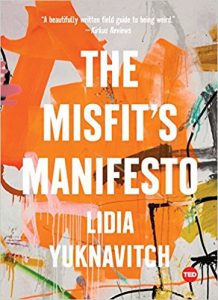
writingI suppose it’s not a coincidence that Lidia’s  The Misfit’s Manifesto launched this past week at Powell’s City of Books. My fellow misfits and I sat together front and center, knowing that we shared a special secret.

I can’t wait for Tuesday.


writing


Like me, Follow me.

Misfits

Misfits are all around us, sitting next to us on trains, wrapped in sleeping bags on wet sidewalks in doorways of businesses darkened for the night, taking deep cleansing breaths on adjacent yoga mats, directing us in traffic, speaking to us from the fronts of classrooms, handing us change at cash registers, sipping a mug of coffee beside us, selecting a disk of perfectly matching matte makeup masking much. Glancing sideways at stop lights, ignoring the rain dripping inside collars, shivering, sweating, disguised, dark, diagnosed, undiagnosed.

Misfits probably maybe definitely usually hide themselves from the general public from their mothers from their fathers because they have to want to need to today tomorrow forever maybe.

Misfits walk with eyes shades drawn with minds scarred more than wrists than knees. They’ve fallen gotten up fallen again. And again. Again.


Misfits, if they’re fortunate, find a kindred spirit in their midst.

Lidia Yuknavitch is such a kindred spirit.

The Misfits Manifesto arrives October 24, 2017. Embrace it.


Lidia Yuknavitch will be speaking at Powell’s Books in Portland OR on 10/24/17.

She’s a wonder.

Lidia also has a TedTalk of the same name. View it here.


Like me on Facebook. Follow me. Thanks!

Unexpected Triggers

Yesterday, Janet brought me a freshly-picked bouquet of August blooms accented with curly-topped white phlox. They were just like the phlox that were as tall as I in the days when I ran barefoot in dewy cool green grass. I was 3 or 4 years old in that memory and my grandmother’s phlox border must have been about thirty feet long. It stretched the length of our tractor garage from the tool shed to the outhouse.

Vivid blue-violet salvia, the spiky perennial kind, sturdy-stalked and long-lived, stood out boldly, almost dominating the three velvety stalks of gladiolus that completed the arrangement. I placed them in the middle of the coffee table and examined the gladiolus more closely.

They were a color that I’m still challenged to describe—somewhere near coral but pinker and not quite red. These sweet gladiolus were the trigger.

How could I have forgotten about my mother’s love of gladiolus?

Gladiolus were always prominent in the displays on the altar at St. Joseph’s when I was growing up. After Mass, my mother would coo over the gladiolus.

“Did you see the red and yellow gladiolus? Ohhh, they’re so beautiful…”

You may know that gladiolus are grown mostly for cutting.

My mother, however, never cut a single stem of hers.

The reason was that my father would not allow fresh flowers in our house (except for lilacs which he had grown up with). He despised the fragrance of fresh flowers and said that they made the house smell like a funeral parlor.

Maybe it was the metamorphosis of soft vulnerable petals to dry and withered remains that offended him. Acceptance of his mortality had never come easily.

My mother would not be discouraged. She planted her beloved gladiolus in a long, straight row, five inches apart like it said on the bulb package, next to the Tenderpod green beans. She would walk in the vegetable garden after supper in August, and given the alternative, she was content to admire her gladiolus next to the green beans.

In the house, she placed a bouquet of plastic flowers in a cheap cut-glass vase on top of the TV. They couldn’t come close to standing in for flowers sprung from the soil, rained on by spring showers, and coaxed open by summer sunshine. These plastic flowers would never die, even though they faded to pale ghostly shadows in the window’s bright light.

Eventually, silk flowers were invented, and my mother tossed the dusty plastic flowers, replacing them with silk roses, red as the ones lovers send on Valentine’s Day, flowers that my mother never received.

The years passed and soon my father was at the end of his days, under hospice care at home, a hospital bed installed in their living room. When my mother found him dead, she refused to unplug his oxygen until the first responders came to take on the task.

The next day, she awakened and went into the living room. She swears that one of the roses red as a lover’s valentine had popped up from the bouquet during the night. She says she found it sticking out five inches above the rest and is convinced to this day that my father was sending her a message from the other side.

And while I do believe in ghosts and I do believe in miracles, and in lovers bringing red roses, I’m not sure that I can believe in this particular ghostly miracle.


gladiolusFollow me on Facebook. I can always use a few more friends.

Meditation on One’s Calling

Clearly, for me, May has been a month of false starts and unfinished business, crossroads, and decision-making. Let’s try this blog post again. 🙂


Every Friday morning, I park my vehicle under a large Kwanzan cherry tree in a parking lot a couple blocks away from the Senior Center. With its fragrant double blossoms, it’s the kind of exemplary cherry tree that we associate with cherry blossom festivals in the Spring.

Two weeks ago its petals were drifting down to the pavement in flurries so thick it was accumulating like snow. Moist and slippery. And beautiful.

I was on my way to my weekly Guided Meditation Class.

I was thinking about earth—dirt, soil, compost, all of the above. I had spent a month that was more outdoors than in. I had been walking the earth, digging in the earth and thinking about digging in the earth, in the sun and in the shade, in the brutal heat and the cool rain.

#

I had begun April walking with Berber nomads from the desert plains to the Atlas mountains of Morocco, where the earth and the air were dry as toast. For a week, our international group of twelve were an active part of the nomadic experience 24/7.
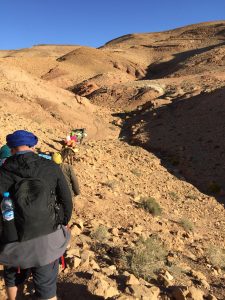
Atlas Mountains, Morocco, April 2017.


No running water save for one lively spring that poured  from a crack in the upthrust rocks on day 2. No conveniences of any sort, and millions—billions—of brilliant pinpricks of stars above by the time I slid into my sleeping bag in a new location each night. Intimately connected to the earth, with only the occasional bleating of sheep and goats breaking the silence.

When I returned, I spent a week transitioning back to modern life and crawling around in my damp gardens, thinning, transplanting, and weeding in preparation for another couple of weeks away in the outdoors.

I set out again, hiking the woods and hills in the Berkshires Mountains of western Massachusetts, enjoying “carpe diem” moments to continue the hiking momentum that had dominated my days in North Africa. Again, I hiked for hours without even noticing the time.

I found myself drawn to the trails where my literary heroes had walked, some of these trails now part of the Appalachian Trail. Went to the farm of Herman Melville and walked in his woods, climbing over fallen trees, and standing beside gardens that were still half-asleep after a long, stormy winter.

On one particularly unseasonably warm day, I climbed Monument Mountain where Melville and his friends had enjoyed these same views after a sweaty hike through mature deciduous woods scattered with the rocky remains of boulders tossed there during the Ice Age ten-thousand years ago.

Drove down to Amherst to Emily Dickinson’s home. Looked out the window from her second-floor bedroom, more gardens, more inspiration.

#

All of those experiences were uppermost in my mind on my way to meditation class that Friday morning.

Our theme that day: What do I have that I can share with the world?

We began with deep breaths in and deep breaths out. 4 seconds in, 4 seconds out. Belly breaths. By the time we reached the completion of our meditation, I was 8 seconds in, 11 seconds out. A new level of relaxation for me.

When I opened my eyes, I had my answer to the theme.

#

“Sharing my truth” is my answer. It’s been my goal for the past few years. I had dug deep into shrouded memories to write my childhood memoir after a long career as a teacher. I thought those years of teaching had (almost) been fruitless. I knew I had affected lives here and there, as most teachers do, and I had felt the reciprocal effects of my students’ lives as they taught me their life lessons. But teaching was not the career I had longed for as a child. I wanted to write, and it was a great relief when I realized later in life that it wasn’t too late.

#

Two days ago, our meditation theme was a variation on our earlier “sharing”.  What was “our purpose” or “our calling”in life?

Suddenly I remembered the words of a school principal during one of my annual job assessments. She told me that true teachers are born, not made, and that I was a natural-born teacher.

During Friday’s meditation, those words suddenly came back to me and I understood that all those years of teaching were not for naught.

I now see that there’s a connection between my previous life’s work and my current life’s work. With my writing, I hope to, want to, will continue to teach, but on a different scale and in a different format. No longer one to one, or one to thirty, writing has the ability to be one to infinity. As a writer, our work and inspiration can carry on long after we are gone.

What is your calling? your purpose?


meditating, meditation

Follow me on Facebook.

The Best Stand-Up Comics

Rolling Stone magazine has just revised its list of The Best Stand-Up Comics (top 50) and Richard Pryor has risen to #1. Quote:

“As is the case with all great artists, Richard Pryor went through an evolution in his life and work: He survived a disturbing childhood whose scary and colorful personalities shaped the basis of his early act.”

Wait.

I knew that.

Disturbing childhoods have always provided great material for comedy. While writing my memoir, The Girl with the Black and Blue Doll, A Not-Very-Depressing Memoir of Childhood Depression, I had to pull up dozens of those tragicomic scenes. Wanna know my Top 3?

3.  One Christmas, Mummy buys Daddy the ultimate hot new gift, an 8mm Brownie movie camera. After we kids have opened our gifts, she brings it to him in bed (since he never participated in Christmas)  and we stand behind her eagerly anticipating his response. What follows is an ominous crack on the wall across from his bed as Daddy propels the camera with a pass Tom Brady would have envied. I was 7.

2.  At age 8, I’m finally going to have my first birthday party, on the lawn in front of our farmhouse, and everything is perfect—right down to the monarch butterflies fluttering through my grandmother’s perennial beds. That is, until my grandfather enters the scene, stumbling amidst the guests, raving mad and accusing my mother of dropping me and my siblings off at a movie theater so she can drink in bars. The guests run to their vehicles and flee.

1.  Daddy’s ’49 Plymouth coupe—with 9-year-old me in the back seat—loses its breaks on the steepest hill in Worcester, Massachusetts, the one heading down Route 9 to Shrewsbury with the heaviest traffic in the city on Saturday mornings. And guess what? It’s all my fault. I was a jinx.

I wish I could say this is fiction, but—hey—I survived. LOL.

Yes. LOL. Laughing Out Loud!

Once you survive the tragedy, you have to celebrate the comedy.

In writing my memoir, I was careful to make it uplifting. We’re told to give the readers a protagonist to root for. At the end, I checked off the chapters in a spreadsheet, marking each one as either “happy” or “sad”. I was pleased to see that my memoir’s content was equally divided between the up and down moments.

The “sad” scenes were more like WTF scenes, and that’s good. We all have to have something to motivate us in life, right?

I would have preferred a few more happy chapters, but, all in all, it makes good comedy. If this writer gig doesn’t work out, I can always try stand-up.

the best stand-up comics


Subscribe to my blog here. No spam. I promise.

Follow me on Facebook for more WTF adventures while I continue my search for agent and publisher.

Read the entire Rolling Stone list of the 50 Best Stand-Up Comics here.

Find Your Past in Your Present

It has not been an easy month.

I noticed this morning that I have seventeen unfinished drafts of blog posts. Four of them were written in the last thirty days. There they sit, waiting for another day.

On the bright side, I also noticed that when I least expect it, I find a relevant moment in my present life that takes me back to my past.

This week that moment came in the form of recurring scenes in the film Paterson.

Paterson is about a bus driver named Paterson, who happens to drive his bus in Paterson NJ. He’s also a poet, and we watch him repeat his daily pattern over and over with subtle differences.

IMDb describes the film as “A quiet observation of the triumphs and defeats of daily life, along with the poetry evident in its smallest details”.

I can’t imagine a better description. Paterson leads, I think, a zen existence. Even though Paterson’s daily life takes place in the present day, you find yourself easing out of the digital age to a quieter rhythm of existence. Your pulse slows.

This is not to say that the film is slow, although, yes, a moviegoer used to high flash action will certainly be fidgeting. In fact, many people will find it slow, but its strength is in that quiet rhythm, and that quiet rhythm might be the reason for its many nominations and awards*.

So—what was it about Paterson that took me back?

The Lunch Box.

patersonPaterson carried a lunch box to work every day that was exactly like the black lunch box with the thermos in the cover that my father carried to the factory, day after day, month after month, year after year.

It was the same lunch box that millions of other factory workers in the 50s carried to work. Even Ralph Kramden, the bus driver played by Jackie Gleason in the iconic television series The Honeymooners, carried the same lunch box.

As I watched Paterson sitting on a park bench with his open, and neatly packed, lunch box beside him, it made me realize that I never—throughout my entire childhood at home—ever saw the contents of the lunch box that sat on the counter next to mine each morning before we set out for school and work.

I knew that every day of my grammar school years, my own lunch box held a peanut butter and grape jelly sandwich on squishy white not-Wonder bread, a thermos of warm Kool-aid, and—if I was lucky—two or three small oatmeal cookies. Sometimes I found a fleshy single slice bologna sandwich, but after two or three bites that stuck to the roof of my mouth, I dropped it in the wastebasket along with its waxed paper wrapping.

During the writing of my memoir, I spent the past three years mentally reviewing as much of my childhood as I could muster up, so I had to laugh this week at the lunch box question.

What did Daddy eat for lunch?

I haven’t the fainted idea.

Whatever it was, he must have found it acceptable because I don’t remember him complaining about it—and he complained about a lot.

Every day he returned the lunch box to its place next to the sink’s drainboard and every morning he picked it up before setting out.

It’s odd that in replaying my childhood like a staticky 8mm film on the screen inside my head, I never once saw The Lunch Box.

What else have I missed?


One more thing:

Paterson ends with an event that reinforced another part of my present. No spoilers here, but the meaning—I believe—is that a writer has to write. There is no other choice.


*Boston Society of Film Critics Awards, 2nd place, Best Screenplay. Boston Online Film Critics Association Awards, 4th place, Ten Best Films of the Year. Dublin Film Critics Awards, 6th Place, Best Film.  Adam Driver (Paterson) was nominated several times for Best Actor and won at least two: Toronto Film Critics Awards, Best Actor. Los Angeles Film Critics Association Awards, Best Actor.

Follow me on Facebook.


Writing the Nightmares

This morning I awakened at four, as is not uncommon for me. I rolled over and thought happy thoughts, took a few deep belly breathes and fell back asleep, only to reawaken two hours later with a vivid nightmare shaking me by the shoulders.

Writing the Nightmares

When I attended The Magic of Memoir conference in Oakland CA two weeks ago, I was witness to a lot of amazing stories told by brave, wounded, survivor writers. It made me realize that writers with those kinds of memories are more likely to write about them—in memoir or as the basis for fiction—than the fortunate souls who leaned back and pumped their swings higher and higher into blue skies and fluffy white clouds.

Last night I was reading one such story and it combined with my personal memories to produce this morning’s nightmare in full living color. (I don’t often dream in color.)

The content is not so important. I wanted to forget it quickly—but I haven’t. I could tell you about the multiple layers of the dream—but I won’t.

Instead I’d rather tell you about where my mind wandered after that.

I clicked open the piece that I’m fine-tuning for The Lit(erature) Lounge storytelling event next Sunday at the Open Space for Arts and Community on Vashon Island, WA. It’s partly about my grandmother Mémère. My chain of thought this morning went something like this. Not the writing piece, just the musing. I’ve left out the punctuation. Ha. Too many apostrophes.

“Mémère. French.

Memoir. It sounds French, but it isn’t spelled French. We spell armoire with the e, so why not memoir with the e? If it were, we’d be spelling it memoire. Our memories. Another inconsistency of the English language.

Memoire of Mémère.

Mémoire. Like armoire. An armoire is a chest. And isn’t a memoir like a chest? A chest of memories?

Except that armoires were originally used to store weapons. Memoire then is not so far-fetched, since doesn’t a memoir-née-memoire also store weapons?”

Writing the Nightmares

As I read the memoir last night, I thought of the woman who wrote it, who lives here on this island. Another survivor walking around with a smile on her face in the midst of all these other survivors walking around with smiles on their faces.

Because we all survive something.

It might not be the stuff of memoirs, but it’s another layer that has made us who we are. If we’re lucky—and we can make our own luck—we get to put it behind us and let the good days, the now days, the tomorrow days, outshine the nightmares.

Once we have finished writing the nightmares, we’ll be on the other side, ready to pump our swings higher and higher into the blue skies and fluffy clouds.

writing the nightmares


writing the nightmaresFollow me on Facebook.

Subscribe to this Blog by click here or the Subscribe button at the top of the page. Go ahead. I’m never gonna Spam you. 🙂

The Value of Writer Critique Groups

The value of writer critique groups was brought home to me this week.

I finally located a Memoir-specific critique group and joined their Write & Share meet-up on Wednesday at the Greenwood branch of the Seattle Public Library.

Frankly, I arrived a little shell-shocked.

Riding the ferry is always relaxing. Seagulls and sea spray off the bow, and I, optimistic as always for the very slight chance of seeing otters or orcas. Maybe just sipping my coffee and reading a few pages of a book that I’ve brought along.

But battling the morning commuter traffic for over an hour was a shock to my country girl chill.

I was beginning to doubt my decision. I told myself that I’d participate in this meeting but probably wouldn’t return because the wild drive might be just too much.


A little backstory. The Memoir group has 63 members and has been meeting for two years. They have two meetings per week, and in order to keep the critiques productive, a maximum of five members—first come, first served—are allowed to sign up for any one meeting.

The meet-up schedule is writing from ten to noon, followed by an hour of reading and critiquing. It works because most members have other jobs and responsibilities so many aren’t available for meetings on a regular basis.


The Value of Writer Critique Groups

the value of writer critique groupsMy previous critique group experience was two years ago. We met in Eureka Springs, Arkansas, and I was a member of that group for almost two years. Since then, I’ve had writer friends and reader friends critique chapters here and there, but nothing in a live, small group setting where a discussion can take place.

I’ve benefited from their friendly but professional feedback, but I recently found myself stuck in the “muddy middle”, as the middle of a manuscript is often called when you get bogged down with uncertainty about your direction.


So here I was, entering a new-to-me library at Storytime with a dozen strollers in the hall and gurgling babies everywhere. Sweet.

I saw two likely members of the Memoir group seated at a table tapping away. They were together, but they weren’t, somehow, “together”, and each was absorbed in working.

I took a chance and asked if they were the writers’ group. They were.

Introducing myself, in that brief moment, I knew that this was going to work out fine. I found a spot for myself and tried to write.

Couldn’t concentrate. No matter.

I had come prepared with printed copies of a piece for Write & Share so I wasn’t under stress to produce something new on the spot.

At noon, we moved into a reserved study room, everyone introduced themselves, and a productive session of reading and critiquing began.

Most of all, I appreciated the reading and critique of the other writers’ work. So much of what was said about their chapters could apply to mine. Structural reminders, scene notes, characterization, pacing, and so on. As a result, I was able to learn from far more than just a critique of my two double-spaced pages.

Sometimes, it’s just nice to be with others who are walking the same path. I think that one doesn’t choose writing. Writing chooses you. Every writer I’ve ever met agrees with one thing: we can’t stop writing.


The pages I had chosen to share were a memoir chapter that I’m planning to read at an Open Mike in Oakland CA next weekend during The Magic of Memoir conference. It was great to receive feedback confirming what I had selected.

They suggested a couple of tweeks that I hadn’t noticed and gladly accepted. We try very hard to look for flaws in our work with an open mind but oftentimes we miss obvious places where a better word might be swapped in or something that we take for granted might need clarifying.

One of the writers had questions about changes he was considering for the beginning of his manuscript. I could identify with that—I’ve changed the opening chapter of my memoir three times this year!

The group said, “No! Don’t change it.” And that was that. Within reason, we trust another writer’s opinion, especially when they explain why something does or doesn’t work.

I can see that I’m going to brave the traffic. Certainly not weekly. Not even bi-weekly. I think I can safely commit to every third week. It’ll keep me on track.

Besides, I want to know which of my opening chapters is the one that works.


the value of writer critique groupsFollow me on Facebook.

Sit With Us App

The Sit With Us app was announced yesterday, creating a subtle but ground-breaking way for lonely teens to connect in lunch rooms without calling attention to themselves.

16-year-old Natalie Hampton designed the Sit With Us smartphone application in response to the feelings that she experienced when she spent her entire 7th grade year eating lunch alone. The app invites students to become ambassadors and indicate their lunches are open for other students to join.

A brilliant idea.

If you’ve ever experienced lunch room loneliness, the news of the app may have hit you right in the middle of your aching stomach. The same stomach that felt really sick every single day as you slid your cafeteria tray down the stainless steel counter, dreading the end of the line, knowing that after you gave your fifty cents or dollar to the lunch lady, you’d have to pick up that tray and join the crowd whose roaring voices were filling your head with fear.

I was one of those kids.

I attended a parochial school in a neighboring town for grades K-8, and then, because my own town had a public junior high that went up to grade 9, I was forced to make my transition to public school there. After that, I transferred to a public high school back in the neighboring town again for grade 10-12.

I ate lunch alone every single day for those three years.

I can tell you the colors of the matching Bobbie Brooks sweater and skirt sets that the girls at the popular tables wore as I inched my way to a place by the window.  I remember their hair styles, their loud laughter, their Weejuns, their monogrammed sterling silver necklaces, their purses that held their rat-tailed teasing combs and packs of cigarettes. I can even tell you the conversations I overheard.

I did actually have a handful of friends—not at the same time, of course. But those friends had boyfriends or a lunch schedule that wasn’t the same as mine.

Every day my schedule placed me in the cafeteria at its busiest. By the time I lifted my tray from the counter and turned to face my fate, there were just a few single seats here and there.

The oak tables and chairs were lined up so close together that I had to lift my tray to shoulder height as I squeezed through the tight aisles. The sturdy old chairs had fifty years worth of bruises on their legs with lots of rough spots. They had seen a lot of abuse.

My goal each day was to carefully pick my way through the crowd to an empty space without getting a run in my nylons. About once a week, I failed. My stocking snagged on a splintered chair leg and I felt the hole in my stocking grow as its climbed up my leg leaving an ugly track of broken nylon and pale skin.

If I was lucky, my mother might have a spare pair of nylons at home but usually I had to wear the same stockings with the runs in them until she remembered to pick up a replacement.

We lived in a rural area of farms—no stores. I rode the school bus home and depended on my mother for the sundries of high school life. Nylons, binder paper and ball point pens.

It wasn’t so bad. I survived.

But the Sit With Us app would have helped.

sit with us app


sit with us appFollow me on Facebook.


Maybe you know someone who could use the Sit With Us app. It’s available as a download in App stores.

Sit With Us App