Inspired by The New Yorker. Writer needs forever home. Adoption listing.

Linda Summersea May 2016Meet Linda. She came to us with a BFA and MFA, but sadly, these degrees were not in Creative Writing. Her shame for advanced degrees in a field outside of writing has left her cowering in self-doubt but she no longer piddles when addressed in a loud voice and rarely bites back—providing she is given lots of affection. As she is of advanced age, we have been having a difficult time placing her in a tolerant environment where she can thrive. Although easily distracted Linda can be kept on task with black coffee and BoomChickaPop. She benefits from a long walk every day, preferably in the shade of a forest with someone who is open to discussing writing prompts. In the past, Linda has run off to foreign countries without warning and been difficult to locate. She has recently been micro-chipped. Problem solved. Linda’s current wardrobe is almost entirely black, but since she responds well to tie-dyed garments, we’re hoping to add other colored garments in the near future. Linda would do best in a one-writer home with access to a hot tub.


I wish I could say that the topic of writer-as-pet-needing-forever-home was my own brilliant idea. Alas, Sarah Hutto beat me to it. Read her hysterical piece Writers Looking for Forever Homes here in The New Yorker. And thanks to Seattle writer Camela Thompson for the heads up. It made my day. Still laughing.

Are you a writer? Surely you are now opening a Word doc to pen your own adoption listing.


New YorkerFollow me on Facebook or I’ll bite you.

Meditation on One’s Calling

Clearly, for me, May has been a month of false starts and unfinished business, crossroads, and decision-making. Let’s try this blog post again. 🙂


Every Friday morning, I park my vehicle under a large Kwanzan cherry tree in a parking lot a couple blocks away from the Senior Center. With its fragrant double blossoms, it’s the kind of exemplary cherry tree that we associate with cherry blossom festivals in the Spring.

Two weeks ago its petals were drifting down to the pavement in flurries so thick it was accumulating like snow. Moist and slippery. And beautiful.

I was on my way to my weekly Guided Meditation Class.

I was thinking about earth—dirt, soil, compost, all of the above. I had spent a month that was more outdoors than in. I had been walking the earth, digging in the earth and thinking about digging in the earth, in the sun and in the shade, in the brutal heat and the cool rain.

#

I had begun April walking with Berber nomads from the desert plains to the Atlas mountains of Morocco, where the earth and the air were dry as toast. For a week, our international group of twelve were an active part of the nomadic experience 24/7.
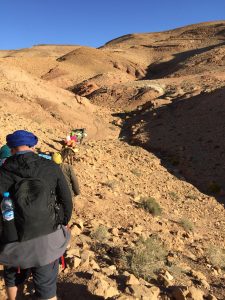
Atlas Mountains, Morocco, April 2017.


No running water save for one lively spring that poured  from a crack in the upthrust rocks on day 2. No conveniences of any sort, and millions—billions—of brilliant pinpricks of stars above by the time I slid into my sleeping bag in a new location each night. Intimately connected to the earth, with only the occasional bleating of sheep and goats breaking the silence.

When I returned, I spent a week transitioning back to modern life and crawling around in my damp gardens, thinning, transplanting, and weeding in preparation for another couple of weeks away in the outdoors.

I set out again, hiking the woods and hills in the Berkshires Mountains of western Massachusetts, enjoying “carpe diem” moments to continue the hiking momentum that had dominated my days in North Africa. Again, I hiked for hours without even noticing the time.

I found myself drawn to the trails where my literary heroes had walked, some of these trails now part of the Appalachian Trail. Went to the farm of Herman Melville and walked in his woods, climbing over fallen trees, and standing beside gardens that were still half-asleep after a long, stormy winter.

On one particularly unseasonably warm day, I climbed Monument Mountain where Melville and his friends had enjoyed these same views after a sweaty hike through mature deciduous woods scattered with the rocky remains of boulders tossed there during the Ice Age ten-thousand years ago.

Drove down to Amherst to Emily Dickinson’s home. Looked out the window from her second-floor bedroom, more gardens, more inspiration.

#

All of those experiences were uppermost in my mind on my way to meditation class that Friday morning.

Our theme that day: What do I have that I can share with the world?

We began with deep breaths in and deep breaths out. 4 seconds in, 4 seconds out. Belly breaths. By the time we reached the completion of our meditation, I was 8 seconds in, 11 seconds out. A new level of relaxation for me.

When I opened my eyes, I had my answer to the theme.

#

“Sharing my truth” is my answer. It’s been my goal for the past few years. I had dug deep into shrouded memories to write my childhood memoir after a long career as a teacher. I thought those years of teaching had (almost) been fruitless. I knew I had affected lives here and there, as most teachers do, and I had felt the reciprocal effects of my students’ lives as they taught me their life lessons. But teaching was not the career I had longed for as a child. I wanted to write, and it was a great relief when I realized later in life that it wasn’t too late.

#

Two days ago, our meditation theme was a variation on our earlier “sharing”.  What was “our purpose” or “our calling”in life?

Suddenly I remembered the words of a school principal during one of my annual job assessments. She told me that true teachers are born, not made, and that I was a natural-born teacher.

During Friday’s meditation, those words suddenly came back to me and I understood that all those years of teaching were not for naught.

I now see that there’s a connection between my previous life’s work and my current life’s work. With my writing, I hope to, want to, will continue to teach, but on a different scale and in a different format. No longer one to one, or one to thirty, writing has the ability to be one to infinity. As a writer, our work and inspiration can carry on long after we are gone.

What is your calling? your purpose?


meditating, meditation

Follow me on Facebook.

American Writers Museum

american writers museumToday is opening day at The American Writers Museum in Chicago IL.

Actually I didn’t even know that it was being assembled until page A13 in this morning’s Wall Street Journal.

According to the review by Edward Rothstein (Critic At Large), the AWM has been created at a “sensible” cost of under $10 million: its 11,000 sq. ft. are housed on the second floor of an office building at 180 N. Michigan Avenue, Chicago, IL 60601.

Since I haven’t visited, I can’t very well make this a review within a review, but I do think the concept of a writers museum sounds pretty admirable. Of course, as a writer myself, I found myself questioning the punctuation of its name. Should it be American Writers’ (possessive apostrophe) Museum?

No, I guess not. It’s not owned by writers, they don’t possess it, so it can hardly be possessive. It’s not even for writers, as one doesn’t go there to learn writing. It’s best described as a museum for readers (Rothstein says that “an earlier era’s powerful American writers’ museums were called libraries.”)

Mr. Rothstein, for the record, says “I wanted to like the result much more than I actually do.” The fact that his review is entitled “A Cliffs Notes Approach to Literature” hints at his opinion so I dug in. The accompanying WSJ image shows The American Voices exhibit of 100 (dead) writers. Rothstein finds a lot to critique/criticize.

Again, I’ll not quote his lukewarm response to the finished result. It seems to me that his review hints at his personal dilemma. He weighs the better and lesser points of the museum. I could picture him walking around saying “…hmm.” On the plus side, Rothstein does say that the AWM was “put together with care and designed with panache by Andrew Anway”. And FYI, The American Writer Museum is “the brainchild of Malcolm O’Hagan, a retired engineer who, after seeing the Dublin Writers Museum, was determined to build one like it here.”

I could say something about Americans not revering their writers quite as much as the Irish. However, that might be debatable.

After reading the Rothstein review, I sought out the AWM website. They have a lot to share at the museum, and a lot of it is interactive.  There are a many events lined up, including writer readings and signings. Ha! I guess we all know what the newest writer coup will be.

My favorite page is their Affiliates list: The Museums/Writer Homes officially affiliated with them. A long list is it. A bucket list, to be sure.

My second favorite is the home page because my favorite deceased author, Herman Melville, is featured dead center—I mean, “front and center”.

Checking out some other reviews online:

Amy Diegelman for BookRiot calls it “Chicago’s New Literary Paradise”.

The Chicago Tribune’s reporter Steve Johnson calls it “far-reaching, dramatic”.

The Washington Independent Review of Books tells the story of the museum’s inception in this 2012 article.

It’ll be a while before I get to Chicago. In the meantime, if you visit The American Writers Museum, we’d love to have you share your impression here.


american writer museumI’d love it if you’ll follow me on Facebook.

C’mon, you know you want to. 😉

International Women’s Day

Today is International Women’s Day.

International Women’s Day was originally International Women’s Work Day. So I mused about whether I should write about feminism in the workplace, or the role of women in the world, or simply, as smart and outspoken writer #MaryKarr posted this morning: “hope folks wind up grateful for unpaid butt wiping & food prep & the oft-underpaid female.”

“Feminism and basic equality for women”

international women's dayThat’s what I can relate to most, as a woman who came of age during the Betty Friedan, Gloria Steinem, Shirley Chisholm, Roe vs. Wade days.

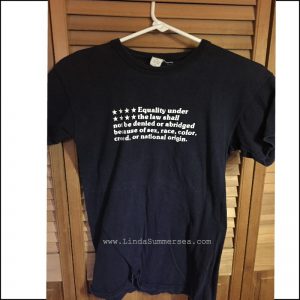
My 1972 E.R.A. t-shirt still hangs in my closet. “Equality of rights under the law shall not be denied or abridged by the United States or by any State on account of sex.”

Not to quibble with our accomplishment in gaining the Equal Rights Amendment, but as Ruth Bader Ginsberg has said:

The Equal Rights Amendment needs to be added to the Constitution, so that “no one” can take it away. Let’s not let anyone get any ideas.


Yes, Sojourner Truth, the flappers like my grandmother who got the 19th amendment passed, and Rosie the Riveter, all came first.

But the 60s is when it all blew up.

As little girls in the 50s, some of us were feeling the stirrings of simple injustices.

“I was clearly a young feminist, even though the word ‘feminist’ was not in my vocabulary. As an elementary student, I always questioned—only in my thoughts, mind you—why the boys were the only ones who got to carry the dark green metal wastebaskets full of trash out to the incinerator on the edge of our schoolyard at 2:45, shortly before the first bell rang the close of our school day.

Our school had a fearsome brick incinerator. A tall smoke stack reached skyward from its concrete top, spreading the remains of our rejected schoolwork high over the town, just like the smoke that rose over the Vatican marking the election of Pope John XXIII after Pius XII died.

I envisioned the representative boys from all of the classrooms, gathering there in the afternoon like a secret society, punching and fooling around as they waited their turn to feed the monster. After emptying their wastebaskets, the boys retraced their steps. They knew precisely how much time they could waste while dawdling in the halls on the return trip, and yet still arrive in time to grab their school bags and lunch boxes and line up with the rest of us.

Even as a Kindergartner, I noticed that only boys got to carry the wooden milk cases from the front hall, where the milkman delivered them, to our classroom where more boys unpacked the milk bottles and stood them on the radiators to warm.

The issue of patrol boys annoyed me even more. I may have been young, but I knew damn well that I was as qualified to usher students across a street as any badged and belted bully boy at St. Mary’s.

Of course, the injustice went both ways. Occasionally someone would misbehave, and guess what? It was always a boy who got his bottom or hand whacked with the stern oak pointer of retribution. Each class had a couple of boys who were marked as troublemakers and were flogged constantly until they escaped to high school.

In eight grade Civics class, we learned there were such things are “congressional pages” who carried messages for the members of Congress in Washington and did other errands. This appealed to me. I looked up the requirements. I only needed a letter of recommendation from my teacher to a state Senator or Representative to accompany my application. Then I found out that girls were not allowed. I was furious. As I tallied the limitations of my sex, I saw that boys clearly had an unfair advantage.

At home, it was no different. The domestic chores went to us girls. I was assigned vacuum duty as soon as I was strong enough to wield a Hoover. Robby never had to lift so much as a duster.

After our baby brother was born and we moved from the farm to our new house on the hill, the chore scales at our house tipped even more in favor of Robby, who was now ten years old. He no longer had to feed the pigs. His chores were reduced to taking out the trash and feeding the dog, and then he went off with his .22 until suppertime.

My sister and I had to vacuum, take our baby brother for stroller rides, change his diapers, put away his toys, prepare his baby bottles, entertain him, put him to bed. In addition that that, I had to cook dinner four nights a week, and do the dishes.

Mummy worked those four nights a week. She passed me the baby as I entered the front door after school and skipped merrily down the steps to drive away in her Jeep. No instructions and no looking back.”

~The Girl with the Black and Blue Doll, Linda Summersea

Later, as a young teacher, I finally was able to afford the orthodontic braces that Daddy said I didn’t need. Imagine my shock when the orthodontist’s office informed me that the procedure would not begin until I brought my new husband’s signature to take responsibility for the payments! In 1974!

If you know me, you already know that I did not bring them my husband’s signature, and I gave them a good talking-to regarding the need to change the financial arrangement requirements on their forms.

Today, thankfully, girls can become congressional pages. They can even grow up to run for President of the United States—although we’re far behind many other countries in acknowledging women as world leaders.

Girls are no longer assumed to be the goody-two-shoes, and boys no longer have to take the blame for every wrong deed.

With equality comes responsibility. Happy International Women’s Day!

#internationalwomensday

international women's day

Follow me on Facebook.

Subscribe to my blog. Thanks!

Writing, Breathing, Thinking

Writing, breathing, thinking—emphasis on “thinking”, and not necessarily in that order—are the essential elements of a writer’s waking hours.

Lately I’ve been filling out Writer Residency applications, and this especially leads me to a lot of thinking about writing and why I write. I look at the notes—my notes, my opinions—that I’ve written in the spreadsheet columns of my previous year’s application records.
“Terrible artist statement.” “Decent project description.”
I don’t shy away from the failures. They’re mostly failures. I keep trying to improve.

I couldn’t stop writing now if I tried.

And like the old shampoo bottle adage of the 60s, “lather, rinse, repeat,” with each round of applications, I examine myself closer and closer, not looking for flaws—because that’s easy—but instead, looking for my strengths. We can write in our garret or vacuum or basement or bedroom, but no one will ever know what we have to share unless we can convey our strengths to the gatekeepers of the publishing world.

So we keep going, and we try to express it better, stronger.

When I awaken, whether it’s at 4:30 or 6:30 or somewhere in between, I reach for my laptop and my coffee, and get to work.

I couldn’t stop writing now if I tried.

When I gave myself permission to write my childhood memoir, when I unlocked the door to my deepest memories, everything poured out like the Flood of ’55 in New England. I saw the good memories and silly memories bobbing in the dark water, carried along under grey skies, the fears and fantasies, everything moving past, fast and faster. I could barely keep up. I typed as fast as I could, sometimes dropping single words into a parallel document because I was afraid of losing the memories as the momentum grew.

I couldn’t stop writing now if I tried.

I mostly write about what’s inside of me. Who would have thought that we could keep thinking for this many years and have all of those thoughts piling up inside our brains, indiscriminately filling cell after cell with content?

I couldn’t stop writing now if I tried.


writing, breathingFollow me on Facebook.

The Best Stand-Up Comics

Rolling Stone magazine has just revised its list of The Best Stand-Up Comics (top 50) and Richard Pryor has risen to #1. Quote:

“As is the case with all great artists, Richard Pryor went through an evolution in his life and work: He survived a disturbing childhood whose scary and colorful personalities shaped the basis of his early act.”

Wait.

I knew that.

Disturbing childhoods have always provided great material for comedy. While writing my memoir, The Girl with the Black and Blue Doll, A Not-Very-Depressing Memoir of Childhood Depression, I had to pull up dozens of those tragicomic scenes. Wanna know my Top 3?

3.  One Christmas, Mummy buys Daddy the ultimate hot new gift, an 8mm Brownie movie camera. After we kids have opened our gifts, she brings it to him in bed (since he never participated in Christmas)  and we stand behind her eagerly anticipating his response. What follows is an ominous crack on the wall across from his bed as Daddy propels the camera with a pass Tom Brady would have envied. I was 7.

2.  At age 8, I’m finally going to have my first birthday party, on the lawn in front of our farmhouse, and everything is perfect—right down to the monarch butterflies fluttering through my grandmother’s perennial beds. That is, until my grandfather enters the scene, stumbling amidst the guests, raving mad and accusing my mother of dropping me and my siblings off at a movie theater so she can drink in bars. The guests run to their vehicles and flee.

1.  Daddy’s ’49 Plymouth coupe—with 9-year-old me in the back seat—loses its breaks on the steepest hill in Worcester, Massachusetts, the one heading down Route 9 to Shrewsbury with the heaviest traffic in the city on Saturday mornings. And guess what? It’s all my fault. I was a jinx.

I wish I could say this is fiction, but—hey—I survived. LOL.

Yes. LOL. Laughing Out Loud!

Once you survive the tragedy, you have to celebrate the comedy.

In writing my memoir, I was careful to make it uplifting. We’re told to give the readers a protagonist to root for. At the end, I checked off the chapters in a spreadsheet, marking each one as either “happy” or “sad”. I was pleased to see that my memoir’s content was equally divided between the up and down moments.

The “sad” scenes were more like WTF scenes, and that’s good. We all have to have something to motivate us in life, right?

I would have preferred a few more happy chapters, but, all in all, it makes good comedy. If this writer gig doesn’t work out, I can always try stand-up.

the best stand-up comics


Subscribe to my blog here. No spam. I promise.

Follow me on Facebook for more WTF adventures while I continue my search for agent and publisher.

Read the entire Rolling Stone list of the 50 Best Stand-Up Comics here.

Find Your Past in Your Present

It has not been an easy month.

I noticed this morning that I have seventeen unfinished drafts of blog posts. Four of them were written in the last thirty days. There they sit, waiting for another day.

On the bright side, I also noticed that when I least expect it, I find a relevant moment in my present life that takes me back to my past.

This week that moment came in the form of recurring scenes in the film Paterson.

Paterson is about a bus driver named Paterson, who happens to drive his bus in Paterson NJ. He’s also a poet, and we watch him repeat his daily pattern over and over with subtle differences.

IMDb describes the film as “A quiet observation of the triumphs and defeats of daily life, along with the poetry evident in its smallest details”.

I can’t imagine a better description. Paterson leads, I think, a zen existence. Even though Paterson’s daily life takes place in the present day, you find yourself easing out of the digital age to a quieter rhythm of existence. Your pulse slows.

This is not to say that the film is slow, although, yes, a moviegoer used to high flash action will certainly be fidgeting. In fact, many people will find it slow, but its strength is in that quiet rhythm, and that quiet rhythm might be the reason for its many nominations and awards*.

So—what was it about Paterson that took me back?

The Lunch Box.

patersonPaterson carried a lunch box to work every day that was exactly like the black lunch box with the thermos in the cover that my father carried to the factory, day after day, month after month, year after year.

It was the same lunch box that millions of other factory workers in the 50s carried to work. Even Ralph Kramden, the bus driver played by Jackie Gleason in the iconic television series The Honeymooners, carried the same lunch box.

As I watched Paterson sitting on a park bench with his open, and neatly packed, lunch box beside him, it made me realize that I never—throughout my entire childhood at home—ever saw the contents of the lunch box that sat on the counter next to mine each morning before we set out for school and work.

I knew that every day of my grammar school years, my own lunch box held a peanut butter and grape jelly sandwich on squishy white not-Wonder bread, a thermos of warm Kool-aid, and—if I was lucky—two or three small oatmeal cookies. Sometimes I found a fleshy single slice bologna sandwich, but after two or three bites that stuck to the roof of my mouth, I dropped it in the wastebasket along with its waxed paper wrapping.

During the writing of my memoir, I spent the past three years mentally reviewing as much of my childhood as I could muster up, so I had to laugh this week at the lunch box question.

What did Daddy eat for lunch?

I haven’t the fainted idea.

Whatever it was, he must have found it acceptable because I don’t remember him complaining about it—and he complained about a lot.

Every day he returned the lunch box to its place next to the sink’s drainboard and every morning he picked it up before setting out.

It’s odd that in replaying my childhood like a staticky 8mm film on the screen inside my head, I never once saw The Lunch Box.

What else have I missed?


One more thing:

Paterson ends with an event that reinforced another part of my present. No spoilers here, but the meaning—I believe—is that a writer has to write. There is no other choice.


*Boston Society of Film Critics Awards, 2nd place, Best Screenplay. Boston Online Film Critics Association Awards, 4th place, Ten Best Films of the Year. Dublin Film Critics Awards, 6th Place, Best Film.  Adam Driver (Paterson) was nominated several times for Best Actor and won at least two: Toronto Film Critics Awards, Best Actor. Los Angeles Film Critics Association Awards, Best Actor.

Follow me on Facebook.